
Analyzing the ACII Community: Is Affective Computing Truly Inclusive?
How diverse is the ACII community? Analysing gender, geographical and business diversity of Affective Computing research
This study quantifies the diversity of the Affective Computing community (ACII conference) from 2005 to 2019 using standardized metrics. By analyzing authors, keynotes, and organizers, it establishes a benchmark for gender, geographic, and business diversity, contributing its dataset to the European divinAI initiative.
Executive Summary
TL;DR: This paper provides a rigorous "diversity audit" of the premier Affective Computing conference, ACII. While the community leads many AI sub-fields in gender representation, it suffers from severe geographic centralization and a lack of industrial participation.
Background: Positioned as a critical meta-analysis, this work transitions from purely algorithmic bias studies to examining the human fabric of the research community itself. It utilizes data from the European divinAI initiative to set a quantitative baseline for future inclusion policies.
The "Diversity Crisis" in Human-Centered AI
Affective Computing involves machines identifying and responding to human emotions—a task fraught with cultural and demographic nuance. The authors argue that if the research community is homogeneous, the resulting systems will inevitably inherit the biases of their creators. Despite the rapid growth of the field (doubling every ~4 years), the diversity of its "actors" (authors, keynotes, organizers) had remained unquantified until now.
Methodology: Borrowing from Ecology
To measure diversity, the authors move beyond simple percentages and adopt metrics used in biology to measure species diversity:
- Shannon Index (): Measures "richness" (how many different countries/types) and "evenness."
- Pielou Index (): Measures "evenness" specifically (how balanced is the split between male/female).
By applying these to gender, geography, and business affiliation, they created a Conference Diversity Index (CDI) that allows for a direct "apples-to-apples" comparison between ACII and other AI giants like NeurIPS or ICML.
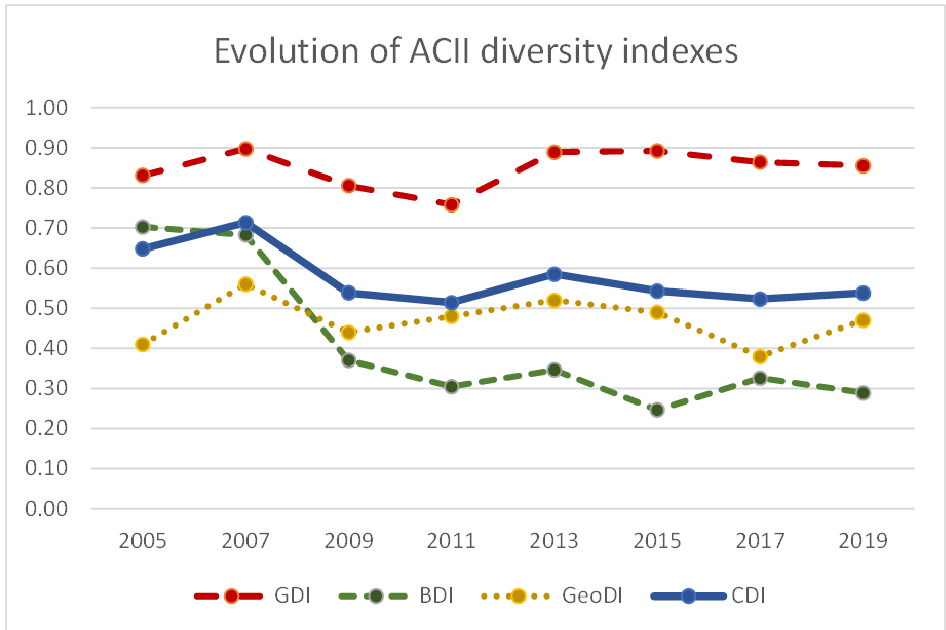 Above: The stagnation of diversity indices over 15 years suggests that without intervention, community demographics do not naturally diversify.
Key Findings & Benchmarking
1. The Gender "Glass Ceiling"
ACII's Gender Diversity Index (GDI) is relatively high (0.81–0.90), often exceeding general AI conferences. However, the "50% parity" mark is almost never reached. Interestingly, women are well-represented in authorship (~30%) but were historically under-represented in organizing roles until a major spike in 2019.
2. Geographic Exclusion
The conference follows a strict USA-Europe-Asia rotation. Consequently, Oceania, South America, and Africa are virtually invisible in the data. Over 58% of keynote speakers originate from North America, reinforcing a Western-centric view of "affect."
3. The Academic Silo
The Business Diversity Index (BDI) is the community’s weakest link. ACII is dominated by academia, with a 1:8 ratio of industry-to-academic authors. This suggests that while Affective Computing is theoretically rich, it has yet to reach the "product maturity" seen in fields like Computer Vision.
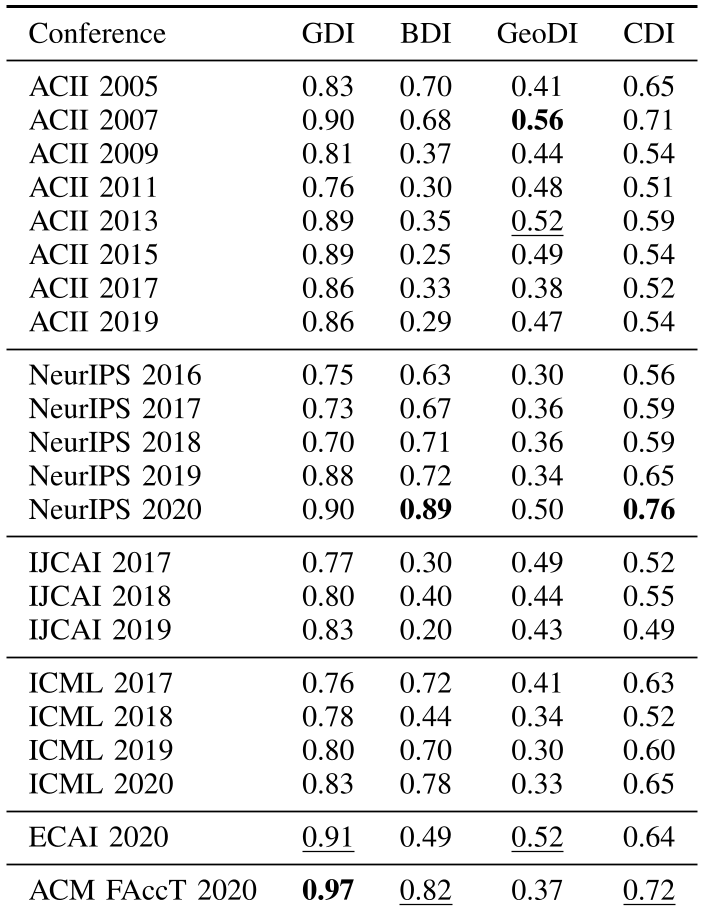 Comparison Table: ACII stands strong in gender balance but lags behind conferences like ACM FAccT in overall diversity.
Critical Insight: The Need for Monitoring
A standout observation is the stagnation of the CDI. Despite the mainstreaming of AI ethics, the demographic makeup of the ACII community has not radically changed in 15 years. The authors conclude that "passive" inclusion does not work; the community requires active policies (travel grants for the Global South, industry-specific tracks, and diversity chairs).
Future Outlook
The study provides a roadmap for the ACII community to:
- Bridge the Industry Gap: Encourage startups (like Affectiva or AudEERING) to take more active roles in organization.
- Go Global: Leverage post-pandemic "hybrid" formats to include researchers from under-represented continents.
- Expand Dimensions: Move beyond the binary gender model and include race, disability, and sexual orientation in future reports.
In conclusion, or as the authors put it, diversity is not just a "nice-to-have"—it is a technical requirement for building affective systems that actually work for everyone.