
Make a Difference: How Diversity-Driven Rewards and Social Effects Save Mobile Crowdsensing
Make a difference: Diversity-driven social mobile crowdsensing
The paper proposes a novel reward mechanism for Mobile Crowdsensing (MCS) that simultaneously leverages user diversity (to improve sensing quality) and social effects (to boost participation). By formulating the interaction as a two-stage bilevel optimization problem involving a diversity graph and a social graph, the authors derive a closed-form solution where the optimal reward is uniquely determined by the Katz centrality of a superimposed network.
TL;DR
Mobile Crowdsensing (MCS) relies on the "wisdom of the crowd," but not all crowds are equal. This paper introduces a unified framework that rewards users not just for their efforts, but for their diversity (how unique their data is) and their social impact (how much they motivate others). The breakthrough is a closed-form solution that identifies the optimal reward as a function of Katz Centrality within a combined social-diversity network.
The Core Conflict: Diversity vs. Influence
Service providers face a dilemma. Should they pay a premium to a user in a remote area to get diverse data (The Diversity Effect)? Or should they pay an influential "social butterfly" who will convince ten friends to join for free (The Social Effect)?
Prior works treated these as separate problems. This paper argues they are two sides of the same coin. By modeling users as nodes in two overlapping graphs—a Social Graph (G) and a Diversity Graph (Δ)—the authors provide a roadmap for maximizing profit while keeping users happy.
Methodology: The Bilevel Balancing Act
The problem is structured as a two-stage game:
- Stage I (The Provider): Sets rewards to maximize profit (defined as Value of Information minus Total Payout).
- Stage II (The Users): Decide their effort levels based on rewards, costs, and the "Social Satisfaction" they get from seeing friends participate.
This leads to a Bilevel Optimization problem. While usually "NP-hard" or non-convex, the authors find that under reasonable stability conditions (Assumption 1), the system collapses into a solvable linear system.
The Superimposed Graph
The most striking insight is the creation of a Superimposed Graph: This matrix accounts for who influences whom (), the reciprocity of that influence (), and the "distance" between users in terms of data uniqueness ().
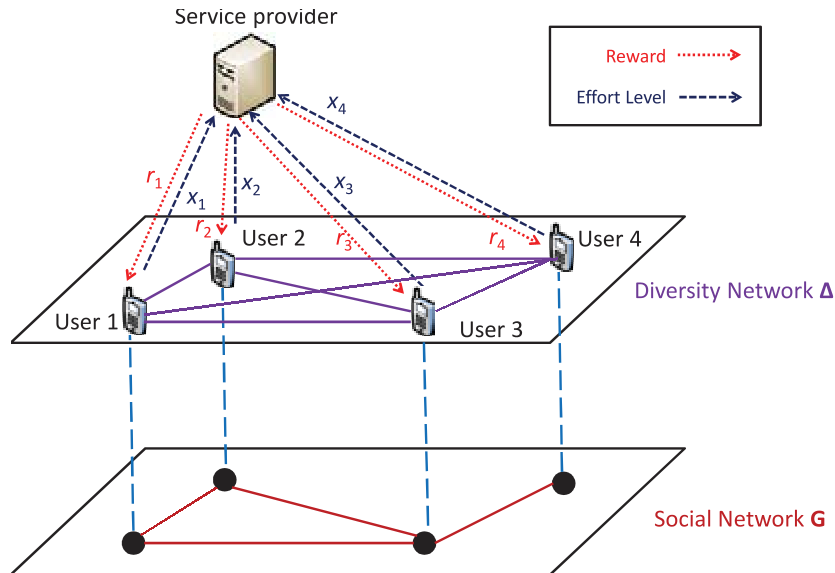 Figure 1: The interaction between the Service Provider and Users via Social and Diversity Networks.
The Anatomy of an Optimal Reward
The authors prove that the optimal reward is not a flat rate. It is a surgical calculation involving:
- Capability Subsidies: Payment for the user's base sensing skill.
- Diversity Premiums: Extra pay if user is physically or demographically isolated from others.
- Social Multipliers: A bonus if user acts as a "seed" that drives others' participation.
- Social Discounts: A reduction in pay if user is so socially influenced by their friends that they would have participated even for less money.
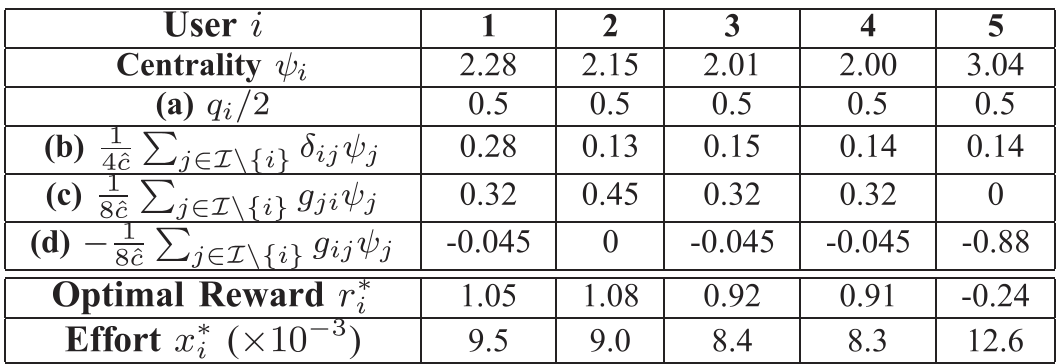 Table 1: Real-world breakdown showing how "Celebrity" users and "Isolated" users receive different reward components.
Experiments: Why "Near Enough" Isn't Good Enough
Using Facebook ego-network traces, the researchers compared "Full Information" (knowing the graphs) vs. "Zero Information."
Key Findings:
- Win-Win Scenario: Having full network data doesn't just help the provider exploit users; it actually increases Social Surplus. Efficient rewards lead to higher total participation and satisfaction.
- The Asymmetry Trap: In networks with "stars" (highly asymmetric influence), knowing the Social Graph is significantly more important than knowing the Diversity Graph.
- The Danger of Mean Estimates: Relying on the average diversity of a population (rather than specific distances) can lead to catastrophic profit drops as the network becomes more connected.
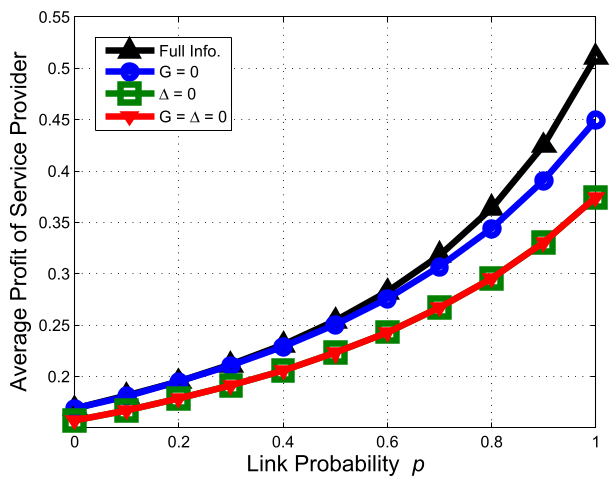 Figure 2: Performance gap between knowing the full network versus assuming no social ties ().
Critical Insight & Future Outlook
This work elegantly translates social capital and data entropy into a single mathematical language: Graph Centrality. By treating "difference" (diversity) as a link in a network, it allows providers to use classic social network analysis tools to solve modern data science problems.
Limitations: The current model assumes the provider knows everyone's costs. In reality, users hide their true participation costs. The next frontier for this research is "Truthful Mechanisms"—designing these rewards so that users have no choice but to be honest about their influence and their effort.