
DMLDroid: Engineering Resilience in Android Malware Detection via Multimodal Fusion
DMLDroid: Deep Multimodal Fusion Framework for Android Malware Detection with Resilience to Code Obfuscation and Adversarial Perturbations
This paper introduces DMLDroid, a deep multimodal fusion framework for Android malware detection. It integrates three heterogeneous feature representations—permissions/intents (tabular), DEX file structures (RGB images), and API call graphs (sequences)—using a Dynamic Weighted Fusion (DWF) mechanism to achieve state-of-the-art results (97.98% Accuracy, 98.67% F1) on the CICMalDroid 2020 dataset.
TL;DR
DMLDroid is a robust Android malware detection framework that solves the "brittleness" problem of AI detectors. By fusing Tabular data (Permissions), Image data (DEX files), and Sequential data (API calls) through a Dynamic Weighted Fusion mechanism, it maintains near-perfect accuracy (98%+) even when attackers use advanced code obfuscation or adversarial GANs to mimic benign behavior.
Background: The Cat-and-Mouse Game of Malware Detection
In the Android ecosystem, static analysis has long been the first line of defense. However, current SOTA detectors suffer from a critical flaw: Generalization is not Robustness. A model might achieve 99% accuracy on a clean dataset like CICMalDroid, but its performance often collapses when faced with:
- Code Obfuscation: Scrambling method names or encrypting strings.
- Adversarial Examples: Injecting "benign-looking" permissions via GANs to trick the classifier.
DMLDroid tackles this by arguing that while an attacker can easily manipulate one modality (e.g., adding a permission), it is significantly harder to maintain malicious functionality while simultaneously spoofing the bytecode's visual signature and the API's execution flow.
Methodology: The Power of Three
DMLDroid utilizes three distinct "views" of an APK, each handled by a dedicated neural backbone:
1. Tabular Modality (TF)
- Features: Permissions and Intents from
AndroidManifest.xml. - Model: MLP with PCA dimensionality reduction.
- Vulnerability: High impact on detection but extremely easy to spoof via adversarial perturbations.
2. Image Modality (IF)
- Insight: Instead of raw byte-to-pixel mapping (which is fragile), DMLDroid maps DEX sections (Header R, Identifiers G, Data B) to RGB channels.
- Model: CNN. This creates a "structural signature" that remains stable even if individual opcodes are changed.
3. Sequential Modality (GSF)
- Innovation: Optimizes API Call Graphs (ACG) using Community Detection and Centrality Measures to keep only the most "influential" API sequences.
- Model: DistilBERT. By using a transformer-based language model, it captures the context and long-range dependencies of API calls.
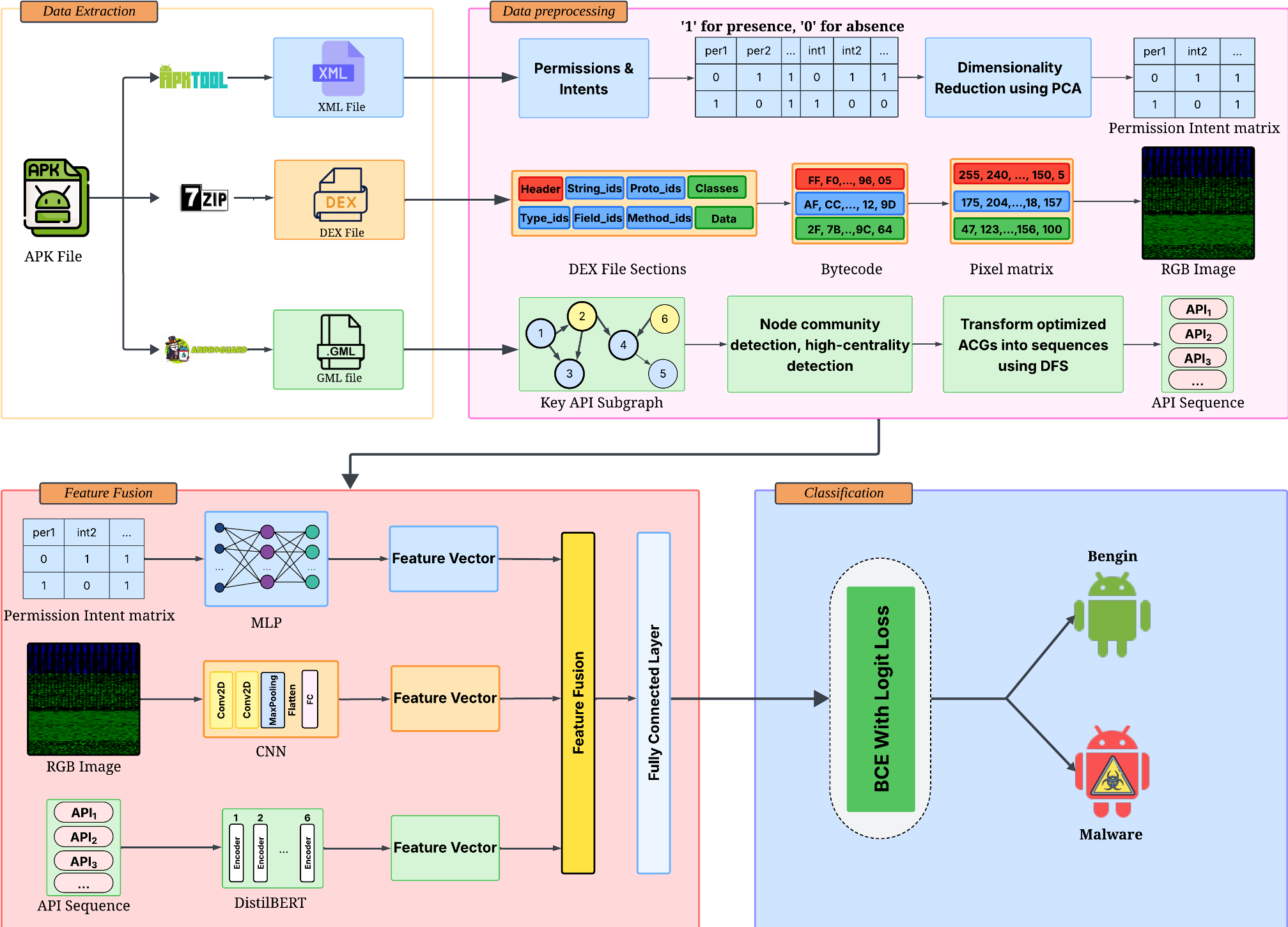
The "Secret Sauce": Dynamic Weighted Fusion (DWF)
The paper's most significant contribution is its systematic evaluation of five fusion strategies.
- Concatenation & Attention: These often suffer from "unimodal bias." If the model learns to rely heavily on Permissions (TF) and an attacker poisons those features, the final prediction fails.
- DWF (Dynamic Weighted Fusion): It calculates an importance score for each modality. During an adversarial attack on manifest features, the DWF mechanism detects the inconsistency and shifts the model's confidence toward the Image and Sequential modalities.
Experimental Results: Proving Resilience
DMLDroid was tested against Obfuscapk (for renaming/encryption) and MalGAN variants.
| Metric | Original Test | Adversarial (Targeted TF) | Mixed Obfuscation |
|---|---|---|---|
| DMLDroid (M5) | 98.67% F1 | 99.26% F1 | 98.95% F1 |
| Baseline (Chimera) | 95.01% F1 | 93.67% F1 | 74.76% F1 |
| Unimodal (MLP-TF) | 97.88% F1 | 8.71% F1** | 97.52% F1 |
The result is startling: while the single-modality MLP (U1) drops to a useless 8.71% F1 under adversarial attack, the DWF fusion (M5) actually improves or stays stable because it effectively ignores the "noisy" tabular input and relies on the harder-to-obfuscate API sequences and DEX images.

Critical Insight & Conclusion
DMLDroid demonstrates that Multimodality is not just about higher accuracy—it is about Security.
However, there is a "BERT tax." Using DistilBERT for API sequences increases inference time by ~130x compared to simple MLP/CNN models. For real-time on-device detection, this remains a challenge. The authors suggest that future work should focus on Efficiency-Robustness Trade-offs, perhaps using lighter-weight sequence models like 1D-CNNs or structured state-space models (SSMs) to maintain the robustness found in DMLDroid without the computational cost of transformers.
Takeaway: In the world of AI security, don't put all your eggs in one feature basket. Use DWF to ensure your model knows when to "stop listening" to compromised data.