
DNA Replication as a Model for Computational Linguistics: A Biomimetic Approach to Syntax
DNA Replication as a Model for Computational Linguistics
This paper proposes a biologically inspired model for human language processing based on DNA replication and nucleotide binding mechanisms. Utilizing Constraint Handling Rules (CHR) and CHR Grammars (CHRG), the authors implement a unified framework that performs analysis and synthesis simultaneously to solve complex linguistic phenomena like long-distance dependencies.
TL;DR
This research bridges the gap between molecular biology and AI by proposing a language processing model inspired by DNA replication. By using Constraint Handling Rules (CHR), the authors demonstrate that human language phenomena—specifically long-distance dependencies—can be modeled as the simultaneous "analysis" of a sequence and the "synthesis" of its complement, mirroring how biological machinery repairs or copies genetic information.
Problem & Motivation: The Gap Between Biology and Linguistics
In traditional Computational Linguistics, parsing and generation are often treated as distinct, sequential tasks. You either analyze a sentence to find its meaning or synthesize a sentence from a meaning representation. However, biological systems don't work this way. When a cell repairs damaged DNA, it analyzes the existing template and synthesizes the missing link in a single, fluid motion.
The authors argue that existing NLP methods struggle with:
- Long-Distance Dependencies: Relating words that are far apart (like a relative pronoun and its antecedent).
- Complex Motifs: Handling structures like tandem repeats and pseudoknots, which often lead to high computational complexity (-hard in some biological contexts).
- Static Pipelines: Most parsers lack the flexibility to "replicate" information across different parts of a sentence structure dynamically.
Methodology: Analysis Plus Synthesis
The core innovation lies in applying the Watson-Crick base pairing logic to sentence structure. In DNA, Adenine (A) pairs with Thymine (T). In linguistics, the authors treat pronouns as "unpaired bases" that look for their specific "complements" (referents) to achieve a stable "folded" state of meaning.
The CHR Framework
The authors use Constraint Handling Rule Grammars (CHRG). Unlike top-down parsers, CHRGs operate on a "constraint store," treating parts of the sentence as constraints that can be rewritten or augmented.
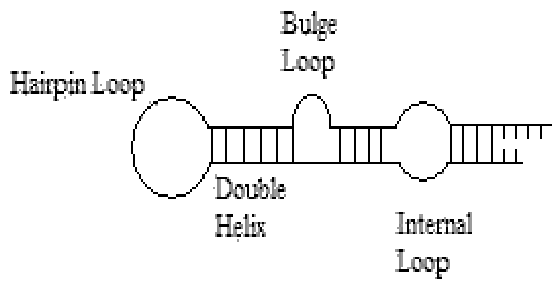 Figure 1: Common RNA motifs like hairpins and loops which share structural similarities with linguistic dependencies.
The Replication Mechanism
When the system encounters a pronoun (e.g., "she"), it triggers a rule that searches the constraint store for a matching proper noun (e.g., "Gioconda"). If the gender and number features unify, the system "synthesizes" a copy of the noun's meaning into the pronoun's position.
The CHR Logic:
prolog pronoun(Start, End, Pro, G, N), name(S1, E1, Name, G, N) ==> name(Start, End, Name, G, N).
This rule literally "superimposes" the name onto the pronoun's coordinates, achieving simultaneous analysis (identifying the pronoun) and synthesis (filling it with specific meaning).
Experiments & Results: Mapping Biological Forms to Language
The authors tested this model on several complex structural patterns:
- Tandem Repeats: The system identifies literal repetitions (e.g., "Tut, tut") and biological repeats with efficiency.
- Long Distance Dependencies: In the sentence "This is the house that Jack built," the model recognizes that "house" is overt early in the sentence but missing after the verb "built."
- Pseudoknots: By introducing heuristics into the CHR rules, the authors solved the "Inverse RNA Folding" problem (designing a sequence for a structure) in linear time, suggesting that linguistic "cross-serial" dependencies can be handled similarly.
Note: The paper utilizes logic-based constraints to synthesize 'missing_noun_phrase' markers, effectively reconstructing the semantic map of a sentence through replication.
Critical Analysis & Conclusion
Takeaway
The value of this work lies in its unification of data types. By treating a sentence as a biological string, the authors provide a pathway to build parsers that are more resilient to the "noise" and "gaps" often found in natural speech, similar to how DNA repair mechanisms handle damaged sequences.
Limitations
- Pruning Complexity: While the logic is elegant, in a massive constraint store (like a long document), the number of potential unifications for a pronoun could lead to a combinatorial explosion without better heuristic filtering.
- Simplistic Semantics: The current model focuses on syntactic replication; deeper semantic nuances (like thematic roles) are only touched upon briefly.
Future Work
The intersection of Stochastic CHR and linguistic probability remains a fertile ground. Applying this "replication" model to multi-modal tasks—where a visual cue might "bind" to a linguistic token—could offer a biologically plausible alternative to current cross-attention mechanisms in Deep Learning.