
DNE: Revolutionizing Diffusion Network Extraction with 300x Speedup
DNE: A Method for Extracting Cascaded Diffusion Networks from Social Networks
The paper introduces DNE (Diffusion Network Extraction), a scalable algorithm for inferring latent diffusion links in social networks using only infection time-series data. By modeling the diffusion process as a Markov random walk and introducing a "Reaching Time" metric, DNE achieves state-of-the-art performance in network reconstruction efficiency.
TL;DR
Inferring the "who-infected-whom" structure in social networks is a classic "latent variable" problem. DNE (Diffusion Network Extraction) solves this by modeling information flow as a Markov random walk. By shifting focus from exact time intervals to the order of infections, it achieves a staggering 300x speedup over previous SOTA methods and requires far fewer data samples (cascades) to reach peak accuracy.
Background & Motivation: The Latent Linkage Problem
In social media or epidemiology, we often see a "cascade"—a sequence of users posting a hashtag or people falling ill. However, the actual transmission links are invisible. We know when Grandma got the flu, but we don't know if she caught it from the mailman or the grocery store.
Previous methods like NetInf popularized the use of submodular optimization to solve this, but they face two major hurdles:
- Complexity: They become prohibitively slow as the number of nodes and edges grows.
- Data Hunger: They require thousands of cascades to "cover" the network structure, which isn't always available in real-world scenarios.
Methodology: The Intuition of "Reaching Time"
The core innovation of DNE is the adaptation of Hitting Time—a concept from Markov chains—into a new metric called Reaching Time (RT).
1. Markov Random Walk Modeling
The authors treat each information cascade as a random walk on a graph. If node is infected before node , there is a potential directed link with a specific transition probability.
 Fig 1: General initial graph illustrating potential diffusion paths based on infection times.
2. From Hitting Time to Edge Rank
Calculating exact hitting times is computationally expensive ( or ). DNE bypasses this by introducing Edge Rank (). Instead of calculating the exact probability based on time differences (), it uses the number of nodes infected between two nodes as a proxy for the probability of a direct link. This Inductive Bias makes the model robust against different transmission models (Exponential or Power Law) because it only cares about the sequence of events.
Experiments & Results: Efficiency without Compromise
The authors tested DNE across various synthetic (Kronecker, Forest Fire) and real-world networks (Football leagues, Co-authorship).
Massive Scalability
The most striking result is the runtime. In a random Kronecker graph, DNE is 300 times faster than NetInf. In a real-world political blog network (19k links), DNE finished in 4 minutes, while NetInf took 8 hours.
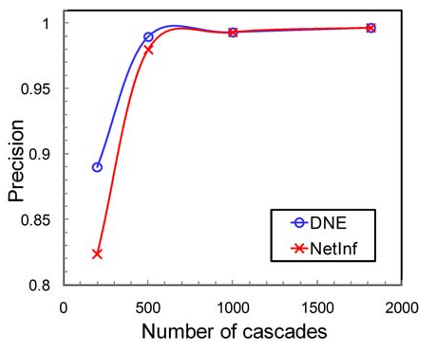 Fig 2: Running time of DNE vs. NETINF across different network models showing the exponential gap in efficiency.
Low Cascade Dependency
DNE maintains high Precision and Recall even when the number of observed cascades is small (10-20% of what NetInf requires). This is critical for emerging trends or new viruses where data is scarce.
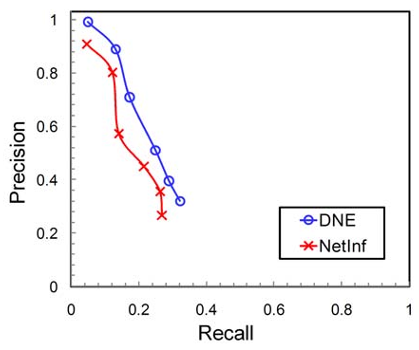 Fig 3: Performance metrics (Precision/Recall) illustrating DNE's superiority in sparse data environments.
Critical Analysis & Conclusion
DNE succeeds because it recognizes that in noisy social environments, the order of infection is a more stable signal than the precise timing, which can be influenced by external factors (internet latency, sleep cycles, etc.).
Takeaway: If you are building a system to track "Viral Marketing" or "Fake News" propagation, DNE provides an industrial-strength backbone that scales linearly with the number of edges.
Limitations: While DNE is fast, it assumes a homogeneous diffusion process. If different types of information propagate at fundamentally different speeds within the same network, the "Edge Rank" approximation might require additional weighting factors.
Future Work: Integrating this approach with GNNs (Graph Neural Networks) to predict not just the links, but the future infection time of unreached nodes would be the next logical step for this research.