
DNN-DP: Balancing Privacy and Performance in Crowdsourced Deep Learning
DNN-DP: Differential Privacy Enabled Deep Neural Network Learning Framework for Sensitive Crowdsourcing Data
The paper introduces DNN-DP, an ε-differentially private deep neural network framework designed to protect sensitive crowdsourcing data. By injecting adaptive Laplace noise into the affine transformation of input features based on their relative importance and value ranges, it achieves state-of-the-art accuracy in privacy-preserving classification tasks.
TL;DR
DNN-DP is a novel framework that integrates Differential Privacy (DP) into Deep Neural Networks by injecting adaptive noise directly into the input's affine transformation. By prioritizing "important" features and adjusting for varying data ranges, it achieves near-SOTA accuracy (86.4%) on sensitive datasets while preventing attackers from reverse-engineering raw training data from published models.
Problem & Motivation: The Privacy-Utility Tug-of-War
In the era of crowdsourcing, data is the new oil, but it is often leaked. When companies train models on user locations or medical records, two major threats emerge:
- Direct Data Theft: Attackers stealing raw datasets.
- Model Inversion/Linkage Attacks: Attackers querying a public model to infer whether a specific individual's data was used for training (Membership Inference).
Prior solutions like Homomorphic Encryption are mathematically secure but computationally "expensive"—taking hundreds of seconds for a single prediction. Earlier DP-SGD methods, which add noise to gradients, suffer from "Privacy Budget Explosion": the more you train, the more privacy you lose, or the noisier the model becomes.
Methodology: High Intuition, Low Noise
The core insight of DNN-DP is that not all features are created equal. If you are predicting income, "Education" might be more critical than "Native Country." Adding the same amount of noise to both ruins the model's intelligence.
1. Feature Importance Evaluation
The framework uses a Random Forest (Gini Index) to rank features. It calculates the Variable Importance Measure (VIM). Highly relevant features are allocated a smaller portion of the noise to preserve their signal.
2. Adaptive Noise Coefficient
Data is heterogeneous. Feature A might range from [0, 1] while Feature B ranges from [1000, 5000]. DNN-DP designs an adaptive coefficient that scales the Laplace noise relative to these ranges, ensuring the noise is "just enough" to mask individual records without drowning out the global pattern.
 Fig 1: The systematic framework of DNN-DP, highlighting the adaptive noise component.
3. Proof of ε-DP
The authors mathematically prove that by injecting noise into the first hidden layer , all subsequent layers inherit the privacy protection because they never touch the raw data again. This decouples the privacy cost from the number of training epochs—a massive advantage over gradient-based methods.
Experiments & Results
The authors tested DNN-DP against the US Census (Adult) dataset.
- Accuracy: DNN-DP hit 86.4%, coming remarkably close to the 88% of a standard "No Privacy" model.
- Benchmarking: It consistently outperformed the Functional Mechanism (FM) and Differential Private Random Forest (DiffPRF) across various privacy budgets ().
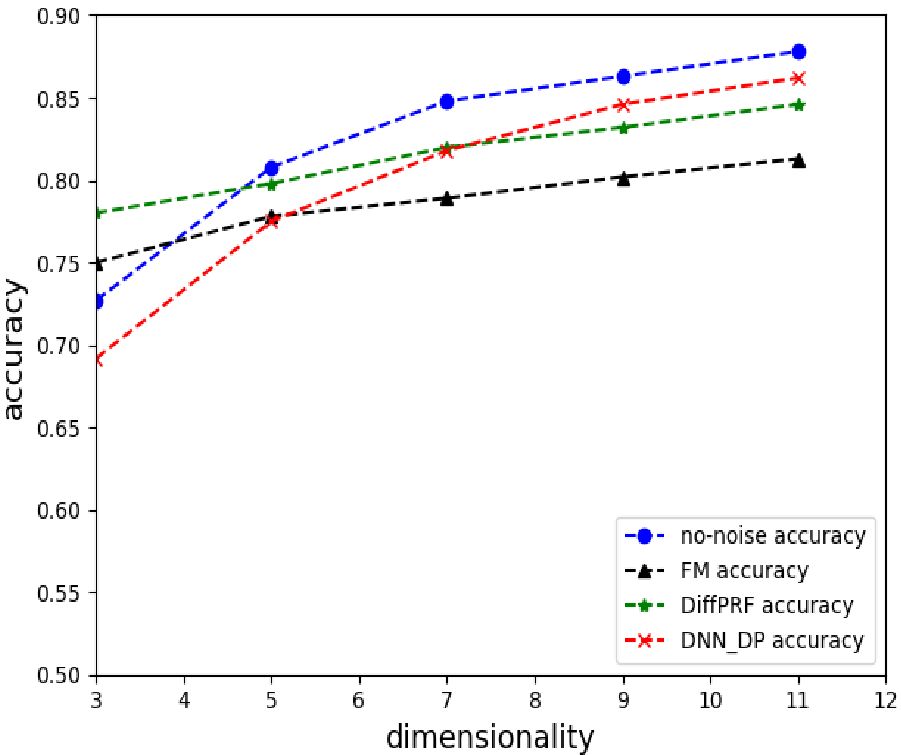 Fig 2: Comparison of classification accuracy. Note how DNN-DP (red line) maintains high accuracy even as the privacy budget fluctuates.
Another key finding was the Stability: Unlike standard models that might overfit, the DP-enabled training showed a much smaller gap between training and testing accuracy, suggesting that the added noise acts as a form of regularization.
Critical Analysis & Future Outlook
Takeaway: DNN-DP proves that we don't need to choose between privacy and performance. By being "smart" about where we put the noise (input layer + important features), we can build industrial-grade models that respect user privacy.
Limitations:
- The current model is optimized for discrete classification. Its performance on regression (continuous values) remains to be explored.
- The feature importance is calculated via Random Forest before the DNN training; an end-to-end differentiable importance weight might be even more efficient.
Future Work: The authors aim to extend this to LSTMs for time-series data, which would be a game-changer for private processing of IoT and sensor data in smart cities.