
Do Your Hobbies Reveal Your Politics? Mapping Global Bias in Reddit Communities
Do the Communities We Choose Shape our Political Beliefs? A Study of the Politicization of Topics in Online Social Groups
This paper investigates the correlation between non-political interest groups and political bias on Reddit using Latent Dirichlet Allocation (LDA) and Jaccard similarity analysis. By analyzing 5 million comments across 3,300 subreddits, the authors demonstrate that community topics are strong predictors of latent political leanings, achieving a classification accuracy of 85.2%.
TL;DR
Is your favorite subreddit for woodworking or soccer secretly a political echo chamber? This study analyzes 3,300 Reddit message boards to prove that the "non-political" communities we choose are deeply intertwined with political bias. Using Latent Dirichlet Allocation (LDA) and linguistic analysis, researchers achieved an 85.2% accuracy in predicting a community's political leaning based solely on its topical vocabulary.
Background: The Hidden Threads of Polarization
In the digital age, we often talk about "echo chambers" in the context of news feeds and Twitter debates. However, the role of non-political interests—hobbies, sports, and lifestyle groups—in shaping or reflecting political identity is less understood. Unlike Twitter, where you follow individuals, Reddit is organized around subreddits (interest groups). This paper positions itself at the intersection of sociolinguistics and machine learning to ask: "Does the way we talk about our hobbies betray our political allegiance?"
Methodology: From Bigrams to Bias
The researchers faced a significant challenge: there is no "ground truth" for a subreddit's politics. To solve this, they implemented a two-step technical pipeline:
- Topic Modeling: Using Latent Dirichlet Allocation (LDA), they reduced thousands of subreddits into 80 distinct topics (e.g., Gaming, Sports, Science). They validated these using the UMass Topic Coherence metric to ensure the groupings were semantically meaningful.
- Linguistic Mapping: They curated two "political vocabularies"—one from 2016 US Presidential debates and another from explicitly partisan subreddits (r/Liberal vs. r/Conservative). By extracting bigrams and trigrams (2-3 word phrases), they captured "political memes" and specific terminologies.
- Bias Scoring: They calculated the Jaccard Correlation Coefficient between a community's language and these political vocabularies.
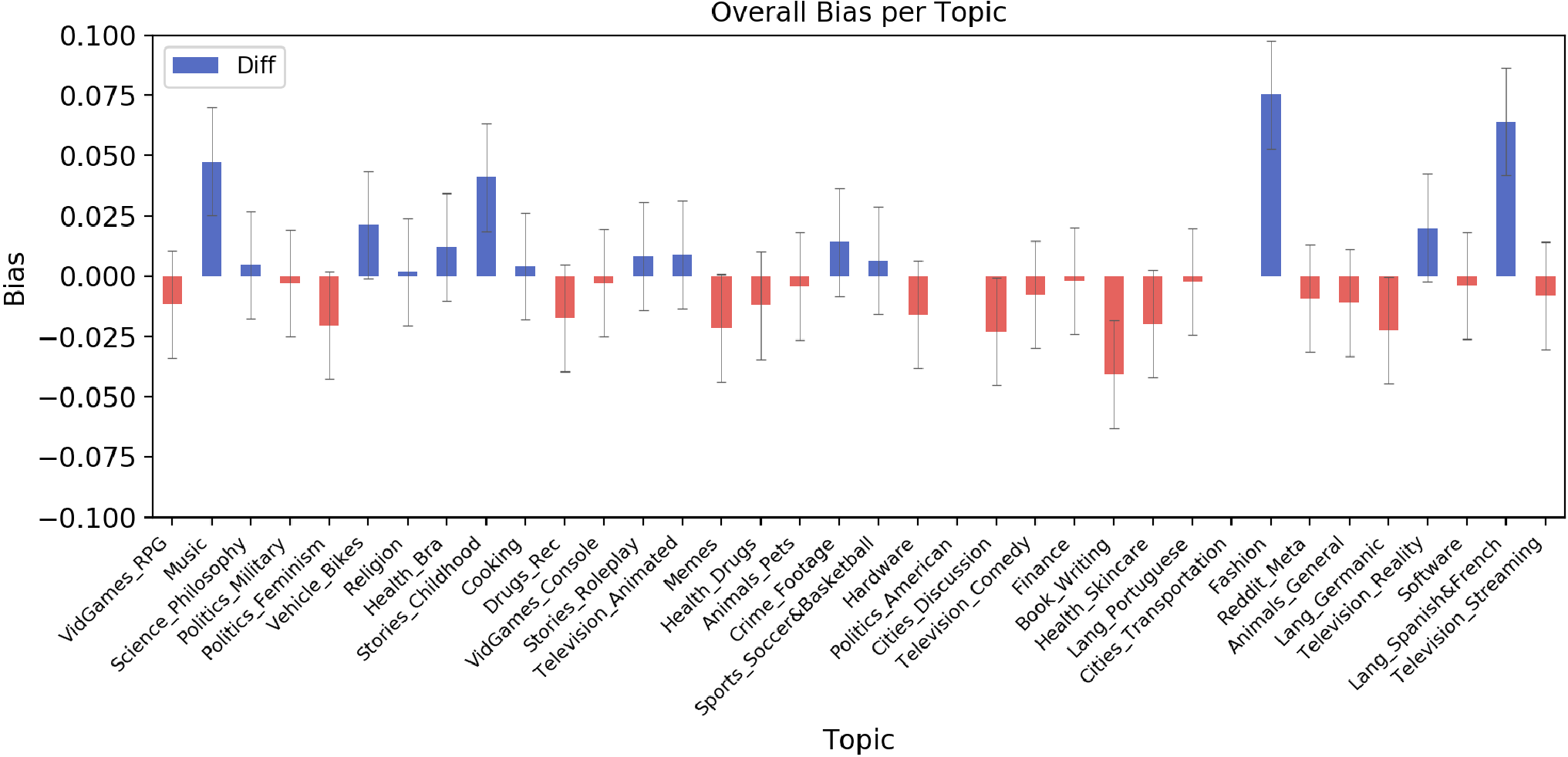 Figure: Measuring the normalized political bias across different LDA topics. Positive values indicate Liberal leanings, while negative values indicate Conservative leanings.
Key Results: Sports, Feminism, and Accuracy
The study’s most striking find was the efficacy of the SVM (Support Vector Machine) classifier. When trained on topic features, it could predict whether a group leaned Right or Left with remarkable precision.
1. The Politicization of Sports
The data corroborated specific "real-world" survey trends. Most sports topics (Football, MMA) showed moderate conservative leanings. However, Soccer and Basketball were notable exceptions, trending toward the liberal side of the spectrum.
2. The Debate Effect
Interestingly, the topic "Politics Feminism" showed a net conservative bias in the metrics. Why? The authors discovered that these communities often involve high-intensity debate between opposing sides. In these cases, the "Conservative" vocabulary used by dissenters actually shifted the group's linguistic score, highlighting a limitation of purely frequency-based analysis.
3. Classification Performance
The SVM classifier outperformed both Naive Bayes (NB) and Gaussian Processes (GP), particularly when the number of topics was more concentrated (40 vs 200).
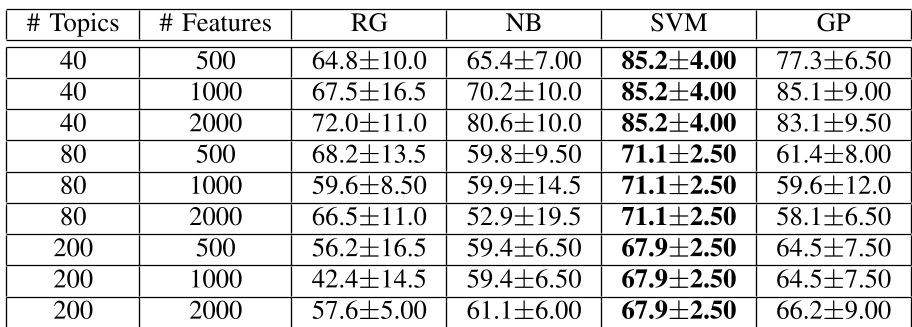 Table: SVM achieved 85.2% accuracy, proving that topic-specific vocabulary is a robust proxy for political orientation.
Critical Insight & Limitations
The core value of this work lies in proving that linguistic homophily—our tendency to use shared "in-group" language—extends far beyond overt political discussions.
Limitations to consider:
- The Debate Trap: The model struggles to distinguish between "supporting" a bias and "debating" against it using the opponent's keywords.
- Time Sensitivity: The data is from 2015-2016. Political language is highly fluid; "memes" used then may be obsolete now.
- User Weighting: The study treats all subreddits with equal weight rather than scaling by the number of active users, which might skew the perception of Reddit's total "average" bias.
Conclusion
This paper serves as a wake-up call for those who believe hobbyist groups are neutral havens. In the digital ecosystem, the communities we choose to join for leisure are often the same places where we adopt subtle linguistic markers of political identity. As we move toward 2026, understanding these "hidden" networks of influence is essential for any comprehensive study of social polarization.