
Do-it-yourself Networks: Bridging the Gap Between Facebook Friends and Wireless Encounters
Do-it-yourself Networks: A Multi-layer Network Approach to the Analysis of Mobile User Egocentric and Sociocentric Behaviors.
This paper introduces a multi-layer network approach to analyze Do-it-yourself (DIY) networks, focusing on the correlation between offline wireless interactions (Detected Social Network) and Online Social Networks (OSNs like Facebook). The core finding is that egocentric degree centrality exhibits significant correlation across layers in small-scale academic environments, suggesting predictability between digital and physical social behaviors.
TL;DR
This research investigates whether your "online importance" translates to "offline influence" in mobile ad-hoc environments. By analyzing six distinct mobility datasets through a multi-layer social network lens, the authors discovered that while your number of friends (degree centrality) correlates well between Facebook and physical encounters, your role as a "bridge" (betweenness) or "hub" (closeness) varies wildly across different social dimensions.
Background: The Rise of DIY Networking
Do-it-yourself (DIY) networks represent a paradigm shift where mobile devices form local wireless clusters independent of the public Internet. In these decentralized environments, the human element is the infrastructure. To make these networks efficient, specifically for tasks like message routing, we need to know who the "central" players are. This paper asks a fundamental question: Can we use a person's Online Social Network (OSN) profile to predict their behavior in a physical DIY network?
The Multi-Layer Logic: Methodology
The researchers treated the problem as a multi-layer network problem.
- Layer 1 (DSN): The "Detected Social Network" based on Bluetooth/WiFi encounters. Edges are weighted by the frequency of contact.
- Layer 2 (OSN): The Facebook friendship graph for the same set of individuals.
By mapping these two layers, the study calculated four types of centrality:
- Degree (Egocentric): How many direct connections you have.
- Betweenness (Sociocentric): How often you act as a bridge between other nodes.
- Closeness (Sociocentric): How "near" you are to everyone else in the network.
- Eigenvector (Sociocentric): How connected you are to other highly-connected people.
 The study utilized six diverse datasets ranging from academic campuses (UNICAL, UPB) to large-scale conferences (SIGCOMM).
Key Insights: Why Online Popularity Matters (Sometimes)
The experimental results revealed a fascinating dichotomy in social behavior:
1. The Stability of Degree Centrality
In academic environments with a limited number of participants (UNICAL, UPB, SASSY), there was a strong positive correlation in degree centrality. If you have many Facebook friends within a group, you are statistically more likely to have frequent physical encounters with that same group. This is a crucial finding for "bootstrapping" DIY networks—one can estimate a node's potential as a relay simply by looking at their OSN degree, which is much easier to collect than historical contact data.
2. The Fragmentation of Sociocentric Measures
For measures like Betweenness and Closeness, the correlation was often low or even negative.
- The Connectivity Gap: In the SIGCOMM and LAPLAND conference datasets, the Facebook graphs were often disconnected (small islands of friends), while the physical contact graph (DSN) was a single large connected component.
- Context Matters: In the "Social Evolution" dataset (students in a dormitory), online and offline behaviors were almost entirely decoupled, leading to correlation values near zero.
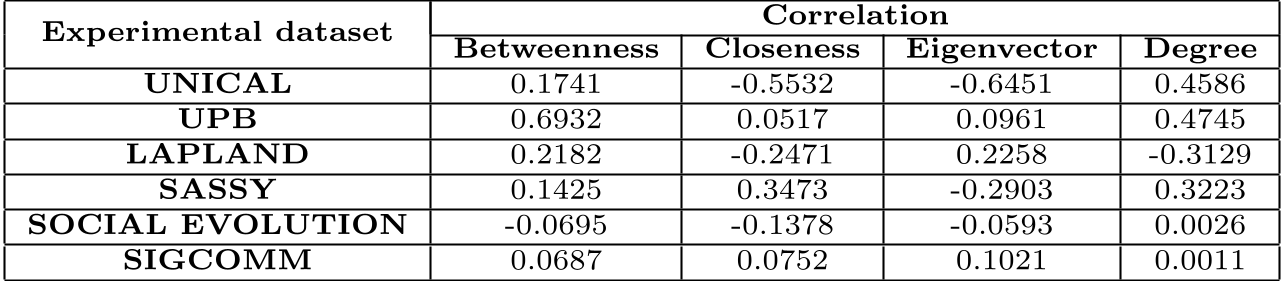 The correlation table shows that while Degree (right column) maintains consistency in several datasets, sociocentric measures (left columns) fluctuate significantly.
Critical Analysis & Future Outlook
The core contribution of this work is the empirical validation that egocentric social measures are more "portable" across layers than sociocentric ones. While you might be a "bridge" in a physical classroom, you might not hold that same topological power in a digital friendship graph.
Limitations:
- The sample sizes in the high-correlation datasets were relatively small (15-24 nodes).
- The study uses snapshots of OSN data which may not reflect the real-time dynamic nature of physical mobility.
The Takeaway for Engineers: When designing routing protocols for opportunistic DIY networks, look at the degree of the nodes. It is the most robust metric that survives the transition from the digital world to the physical world, providing a reliable heuristic for identifying key message carriers in human-centric networks.