
Do People Believe in AI? Decoding the Paradox of Trust in the Era of Industry 4.0
Do people believe in Artificial Intelligence?: A cross-topic multicultural study
This study investigates human trust and perception of Artificial Intelligence through a multicultural survey (Italy vs. USA). Using specific tasks in Healthcare and Cybersecurity, it highlights a paradoxical gap between AI's objective performance and public willingness to delegate critical decision-making.
TL;DR
Even when machines prove to be more accurate than human experts—such as in detecting skin cancer or identifying fraudulent transactions—the general public remains hesitant to hand over the "driver's seat." A cross-cultural study between Italy and the US reveals that while we trust AI to filter our spam and recognize our faces, we still want a human hand on the scalpel.
The Motivation: Accuracy is Not Enough
We live in an era where AI is "drenched" in our daily lives—from Netflix recommendations to AlphaZero. However, there is a mounting "warped perception" of these technologies. The authors of this study recognized a critical friction point: The Technical-Psychological Gap.
In many fields, AI has already achieved "Superhuman" status. For instance:
- Skin Cancer: AI (89% accuracy) vs. Humans (79%).
- Neuroimaging: AI (83%) vs. Humans (63%).
If the data shows AI is safer, why aren't we using it? The researchers posited that trust isn't a monolithic concept; it varies by the "weight" of the decision and the culture of the user.
Methodology: A Tale of Two Countries
The study surveyed 442 participants across two distinct cultures (Italy and the USA) and two macro-areas:
- Medicine (High Stakes): Skin cancer recognition and neuroimaging.
- Cybersecurity (Objective/Technical): Fake news detection, spam filtering, and face recognition.
 Figure: The research explores the intersection of machine learning and human perception.
Key Insights: Where Trust Breaks Down
1. The Reliability Paradox
The study found a sharp divide in perceived reliability. For "cold" tasks like spam detection and face recognition, both Italians and Americans viewed AI as superior to humans. However, when the task involved a "life-or-death" diagnosis, the trend flipped.
Over 70% of respondents would prefer a doctor to make a final diagnosis over an AI, even if they were told the AI was technically more reliable. This suggests that in the "Moral Domain," humans value accountability and empathy over raw statistical probability.
2. Accuracy vs. Interpretability
One of the most profound findings was the cultural divide regarding Black-Box models.
- The Italian Perspective: Strong preference for Interpretability. They would accept lower accuracy if the model could explain why it reached a conclusion.
- The American Perspective: Strong preference for Accuracy. They are more willing to accept a "Black Box" if it yields the correct result more often.
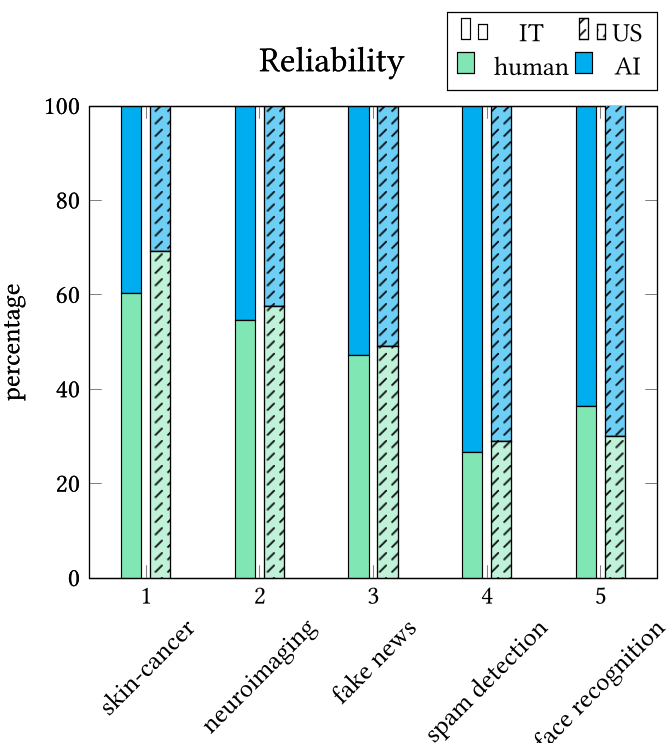 Figure: Divergent national preferences between accuracy and interpretability in medical tasks.
The Future of Investment
When asked where they would "invest" their money, the consensus was clear: Medicine and Cybersecurity. Despite their skepticism, the public recognizes these as the areas where AI can provide the most value to society.
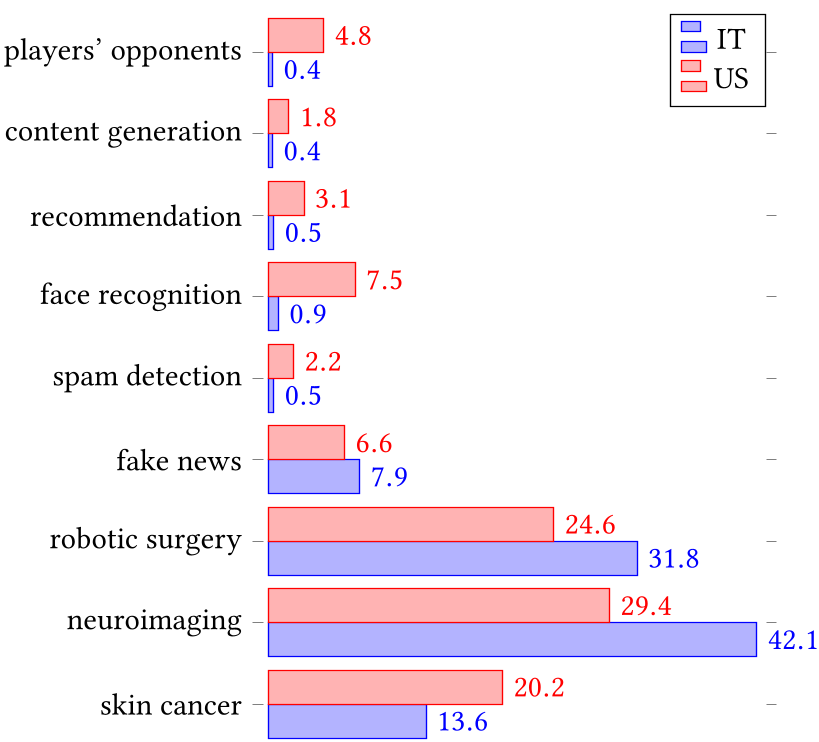 Figure: Participants' ranking of AI applications most worthy of future development.
Critical Analysis & Conclusion
The core takeaway for AI developers is clear: Performance is a prerequisite, but transparency is the bridge to adoption.
Takeaways for the AI Industry:
- XAI is Mandatory: For AI to move from an "auxiliary tool" to a "primary decision-maker" in healthcare, researchers must solve the interpretability problem.
- Context Matters: Trust is not transferable. Success in cybersecurity does not translate to trust in autonomous vehicles or medical robotics.
- Cultural Alignment: AI products must be localized not just in language, but in "trust logic" (e.g., favoring explanation in Europe vs. efficiency in the US).
While we may "believe" in AI's power, we are not yet ready to "believe" in its morality. The path forward lies in Human-Machine Collaboration, where AI acts as the high-precision advisor to the empathetic human expert.
Final Verdict: This 2019 study was early to identify the "Explainability Crisis" that currently dominates AI safety and ethics discussions today.