
SocialConvMF: Bridging Social Trust and Deep Context for Smarter Recommendations
Document Context-Aware Social Recommendation Method
The paper introduces SocialConvMF, a social recommendation method that fuses trust relationships and Convolutional Neural Networks (CNN) into Probabilistic Matrix Factorization (PMF). By combining social network topology with item contextual metadata, it achieves SOTA performance on rating prediction across three major datasets.
TL;DR
SocialConvMF is a hybrid recommendation framework that solves the data sparsity problem by combining Social Media trust networks with Deep Learning-based text analysis. By leveraging a CNN to understand item descriptions and a social-aware prior to model user preferences, it achieves up to a 17% performance boost in rating accuracy compared to traditional social recommendation models.
Problem & Motivation: The Sparsity Wall
In the era of information explosion, Collaborative Filtering (CF) still hits the "Sparsity Wall"—users rarely rate enough items for the system to understand them. While Social Recommendation methods (like SocialMF) tried to bridge this gap by assuming "friends have similar tastes," they remained "content-blind." They focused solely on the user-graph while ignoring the goldmine of information hidden in item descriptions (contextual documents).
The authors argue that a truly robust system must understand both who you trust and what the items are actually about.
Methodology: The Fusion of CNN and SocialMF
SocialConvMF's core innovation lies in its objective function, which balances three distinct signals:
- Ratings (The Signal): The standard Matrix Factorization (MF) objective of reconstructing the user-item rating matrix.
- Social Trust (The Network): Unlike standard PMF, which assumes a zero-mean Gaussian prior for users, SocialConvMF regularizes user latent vectors based on the vectors of their trusted friends.
- Document Context (The Vision): The model uses a Convolutional Neural Network (CNN) to transform raw item description text into a latent vector. This vector acts as the "mean" for the item's potential distribution, effectively guiding the MF process with semantic knowledge.
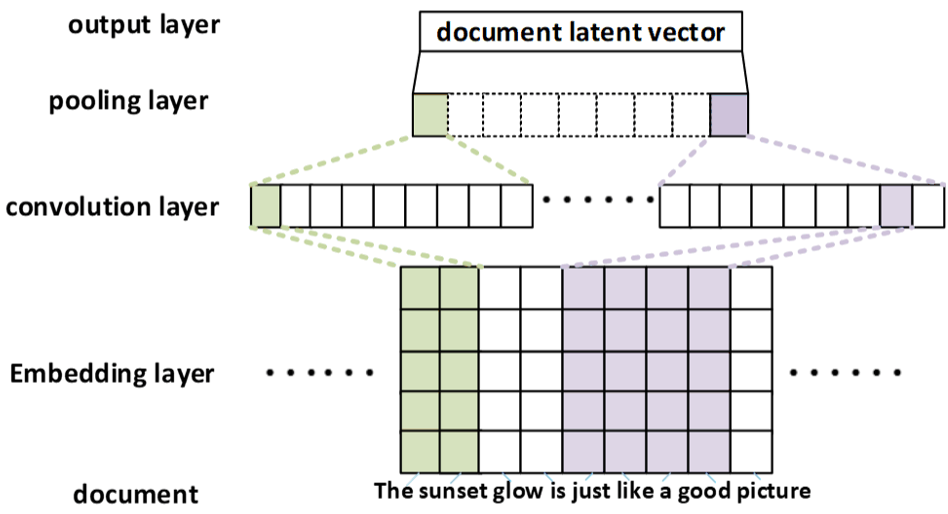 Fig 1. The graphical model showing how CNN weights () and Social Trust () converge to influence the Rating ().
Experimental Breakthroughs
The researchers tested the model on three real-world datasets: FilmTrust, MovieLens, and Epinions.
1. Significant Accuracy Gains
The most striking result was found on the Epinions dataset, which is notoriously sparse (0.036% density). SocialConvMF reduced the Mean Absolute Error (MAE) by 17.71% over the previous SOTA. This suggests that the more sparse the data, the more valuable the "contextual" and "social" anchors become.
2. Sensitivity to Trust and Context
The authors conducted a deep dive into two hyper-parameters:
- (Context Weight): Controls the reliance on CNN features.
- (Trust Weight): Controls the reliance on social links.
The results showed a "Goldilocks zone" for both—setting these too high ignores actual rating data, while setting them too low reverts to standard, noisy matrix factorization.
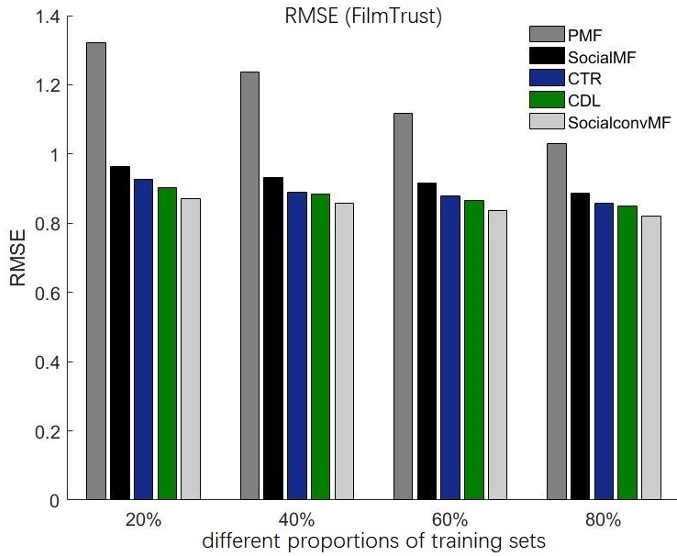 Fig 2. SocialConvMF (lowest curves) consistently outperforms baselines across different data sparsity levels.
Critical Insight & Future Outlook
SocialConvMF succeeds because it treats the Item Latent Vector not just as an abstract ID, but as a semantically meaningful representation derived from human language.
Limitations: While powerful, the model currently treats trust as a static value and uses a basic CNN for text. Modern LLMs (Large Language Models) or Transformers could likely capture even more nuanced "contextual differences." Additionally, the social link is exploited linearly; future work could utilize Graph Neural Networks (GNNs) to capture multi-hop social influence more effectively.
Summary Table of Performance
| Method | FilmTrust (MAE) | Epinions (MAE) |
|---|---|---|
| PMF (Baseline) | 0.7531 | 1.3521 |
| SocialMF | 0.6837 | 0.8607 |
| SocialConvMF | 0.6365 | 0.7077 |
| Improvement | 3.98% | 17.71% |
This work significantly advances the feasibility of deploying recommendation systems in niche domains where high-density rating data is impossible to collect.