
Domain-Aware Scaling Laws: Decoding the Hidden Chemistry of Pretraining Data
Domain-aware scaling laws uncover data synergy
2026-07-01
Summary
Problem
Method
Results
Takeaways
Abstract
This paper introduces Domain-Aware Scaling Laws to quantify "data synergy" in LLM pretraining. By analyzing the composition of 52 open-weight models, the authors establish a framework that measures how domain co-occurrence (e.g., Math and Code) non-linearly impacts downstream performance, significantly outperforming domain-agnostic Chinchilla baselines in predictive accuracy.
## TL;DR
For years, the industry has followed the "Scaling Law" gospel: more parameters and more tokens lead to better models. However, this paper reveals that **not all tokens are created equal**. By introducing **Domain-Aware Scaling Laws**, the authors show that data domains like Code, Math, and Science interact chemically—sometimes amplifying each other (synergy) and sometimes canceling each other out (interference). Their framework allows researchers to predict model performance based on data mixture alone, turning data curation from an art into a precise science.
## The Motivation: Tokens are not Identical
Traditional scaling laws (like Chinchilla) assume for a fixed token count $D$, the loss $L$ is predictable. However, empirical evidence suggests a "synergy gap":
- Adding **Code** often boosts **Math** reasoning.
- Certain **Web** data can interfere with **Legal** or **Medical** precision.
The authors argue that the standard data term $B \cdot D^{-\beta}$ is insufficient because the scaling exponent $\beta$ should actually depend on the *composition* of the data.
## Methodology: The Anatomy of Data Synergy
The authors decompose data synergy into two layers:
### 1. First-Order Synergy (Domain $\rightarrow$ Benchmark)
This measures how much a specific domain (e.g., Code) helps a specific task (e.g., HumanEval) beyond its raw token count. They modify the data scaling exponent:
$$\beta_{j} + \gamma_{j,k}$$
Where $\gamma$ is the synergy coefficient. If $\gamma > 0$, the model learns faster per token from that domain.
### 2. Second-Order Synergy (Domain $\leftrightarrow$ Domain)
This is the paper's most novel contribution. It captures the **"bonus tokens"** generated when two domains co-occur. For example, if you have both Math and Code in your mixture, the model perceives an "effective" data size larger than the actual token count.
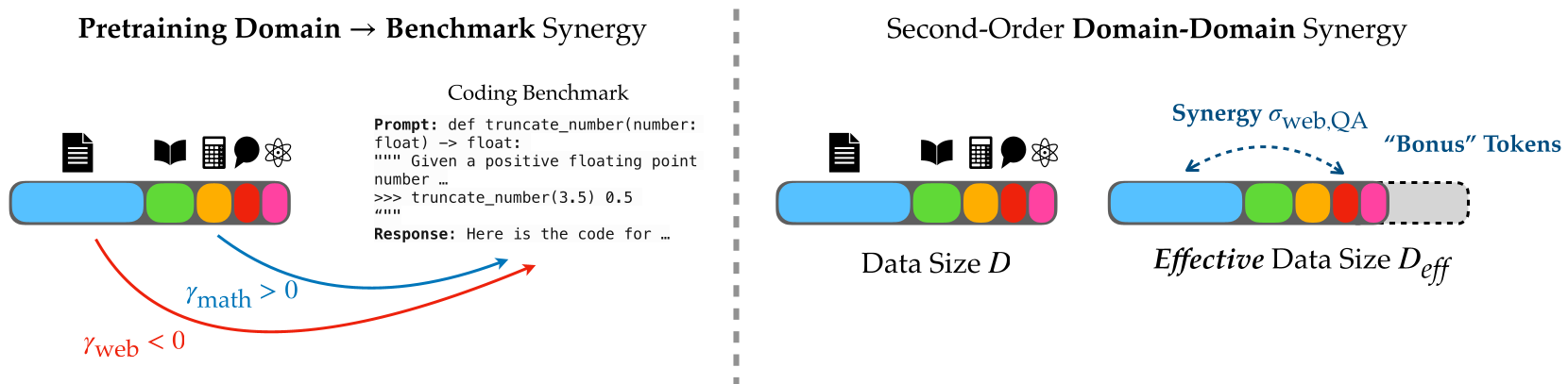
*Figure 1: Visualizing how domain distribution creates "Bonus Tokens" through pairwise interactions.*
## Core Results: Proving the Synergy
Using observational data from 52 open-weight models (including Pythia and OLMo), the authors extracted a "Synergy Matrix."
- **Strongest Allies**: Code $ imes$ Science and Code $ imes$ Math shown the highest second-order positive synergies.
- **Interference**: Books and Encyclopedia often showed negative synergy on specialized coding tasks, suggesting they might "dilute" the model's focus.
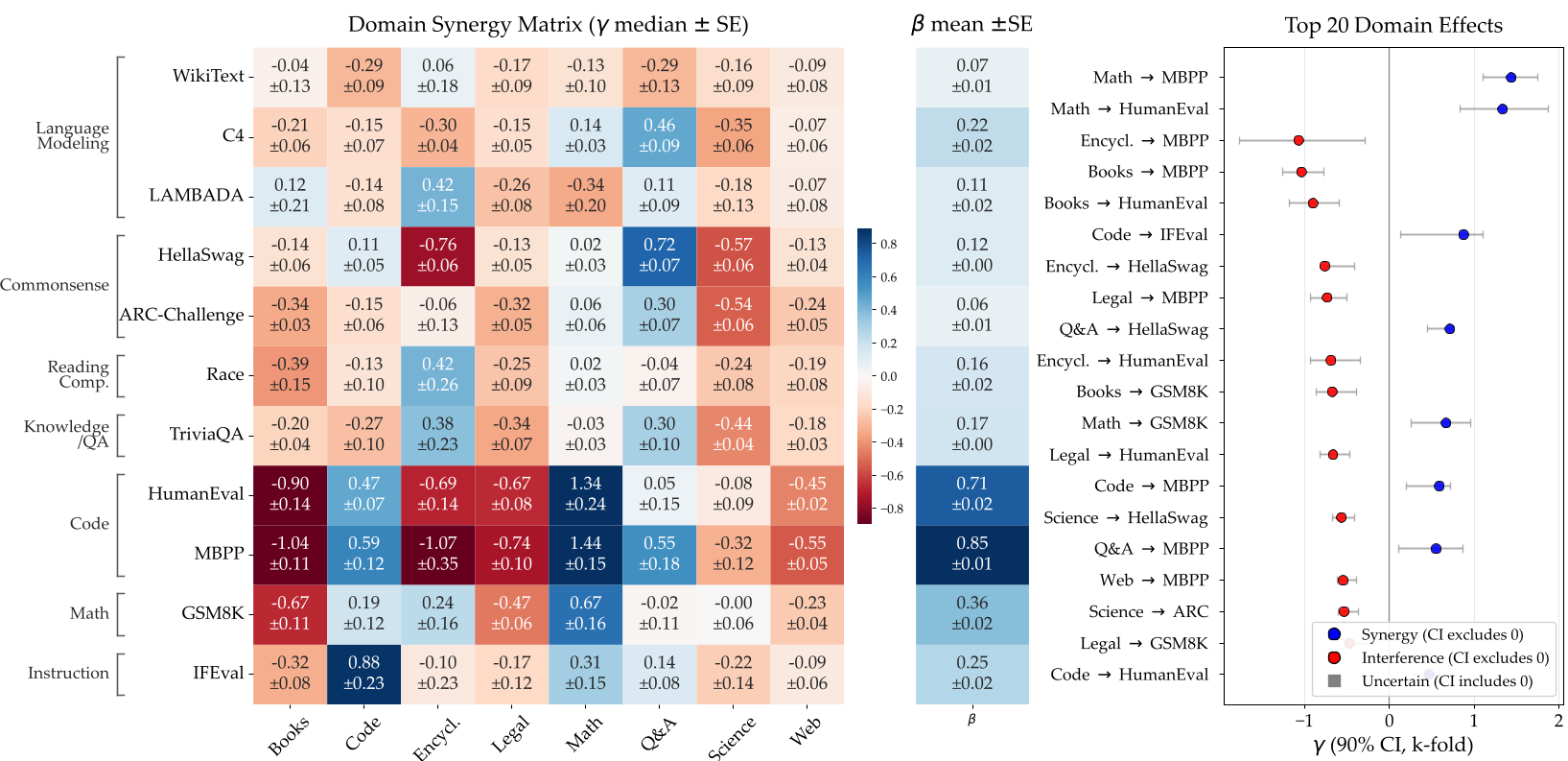
*Figure 3: The Estimated Domain-Benchmark Synergy Matrix. Warm colors indicate performance boosts; cool colors indicate interference.*
The predictive power is striking. On the **HumanEval** benchmark, the standard Chinchilla law achieved an $R^2$ of only 0.41. By adding domain awareness, the $R^2$ jumped to **0.92**, meaning we can now predict coding performance with high accuracy simply by looking at the pretraining pie chart.
## Validation: Can We Optimize Mixtures?
To prove these weren't just correlations, the authors trained new models (30M and 150M) using their predicted "Optimal" vs "Anti-optimal" mixtures.
| Benchmark | Optimal Mixture (BPB) | Anti-optimal (BPB) | Performance Gap |
| :--- | :--- | :--- | :--- |
| **HumanEval** | 0.721 | 1.058 | **+21.9% Error** |
The results validated the theory: models trained on "Optimal" mixtures (high in synergistic domains) crushed the baseline and anti-optimal models, even at larger scales.
## Critical Analysis & Outlook
### Limitations
- **Observational Noise**: The study relies on public mixture metadata, which can be imprecise.
- **Low Dimensionality**: Most current LLMs use similar "Base" mixtures (mostly Web), which limits the variety of data combinations explored.
### The Takeaway
This work marks a shift from "Scaling Laws" to "**Composition Laws**." In the race for AGI, the winner may not be the one with the most GPUs, but the one who understands the fundamental "chemistry" of their data. For practitioners, the message is clear: **Analyze your domain synergies before you hit 'train'.**
## References
*Hamidieh, K., Mackey, L., & Alvarez-Melis, D. (2026). Domain-Aware Scaling Laws Uncover Data Synergy.*