
Beyond Popularity: A Semantic Approach to Domain-Based Trust in Social Networks
A Preliminary Approach to Domain-Based Evaluation of Users' Trustworthiness in Online Social Networks
This paper presents a preliminary framework for evaluating domain-based user trustworthiness in Online Social Networks (OSNs), specifically Twitter. By integrating semantic analysis via AlchemyAPI and a customized TF-IDF weighting mechanism, the authors propose a method to distinguish user expertise in specific knowledge domains rather than applying a generic reputation score.
TL;DR
Not all "influencers" are created equal. This paper argues that trustworthiness in Online Social Networks (OSNs) should not be a single global score but a domain-specific metric. By combining Semantic Analysis, a customized TF-IDF for domains, and temporal factors, the authors provide a framework to identify true subject-matter experts while filtering out "noisy" users and spammers.
Context: The Fallacy of Global Reputation
In the current OSN landscape, we often equate "trust" with follower counts or general engagement. However, academic intuition suggests that expertise is finite; no one is a master of every domain. Existing models often fall into the trap of the "Million Follower Fallacy," where popularity masks a lack of specific credibility. This paper shifts the focus from who you are to what you know and how consistently you speak on it.
Why Generic Metrics Fail
The authors identify three critical gaps in prior work:
- Domain Blindness: A user might be highly reputable in "Stock Trading" but irrelevant in "Visual Arts."
- Semantic Shallowness: Traditional topic modeling (like LDA) uses "bag-of-words" which misses the hierarchical relationships between concepts.
- Static Evaluation: Trust is not permanent; a user’s behavior and expertise evolve or diminish over time.
Methodology: The Semantic Trust Framework
The proposed approach moves through three sophisticated layers of analysis:
1. Semantic Domain Inference
Instead of simple keyword matching, the framework uses AlchemyAPI to link tweets to specific taxonomies (e.g., /finance/investing/stocks). This allows the system to understand the intent and category of content with high precision.
2. The Distinguishing Metric (DF-IDF)
The most novel contribution is the adaptation of the TF-IDF (Term Frequency-Inverse Document Frequency) algorithm for users and domains.
- Logic: If a user posts in every single domain, their weight in any specific domain is penalized.
- Intuition: Real experts focus. Spammers spray and pray.
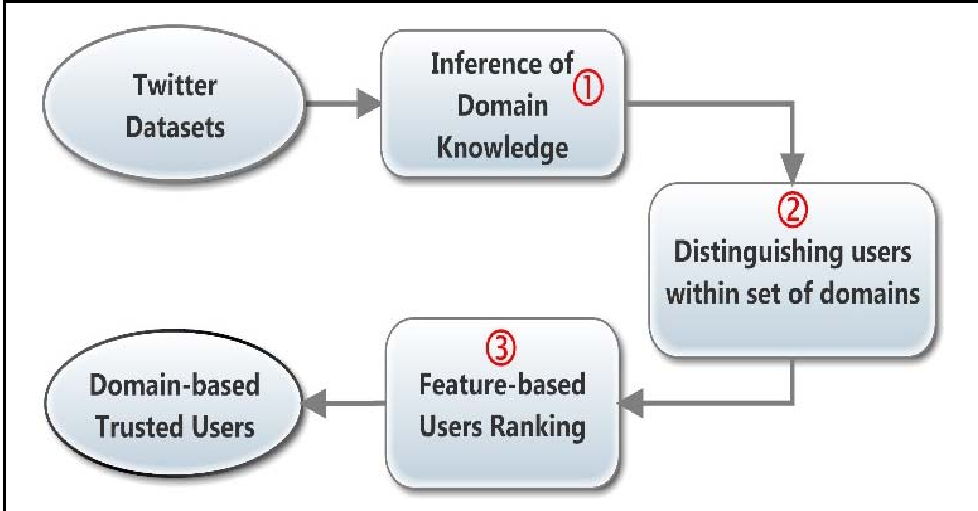 Figure 1: The multi-step pipeline from raw Twitter data to semantic inference and final trust calculation.
3. Holistic Social Attributes
The model consolidates four key ratios to calculate a final Domain Trust (DT) score:
- DR (Retweet Ratio): Measures how much a user's domain-specific content is amplified.
- DL (Likes Ratio): Measures general appreciation of the content.
- DP (Replies Ratio): Measures the conversational engagement generated.
- TFF (Follower-Friends Ratio): Acts as a baseline reputation indicator to identify balanced, legitimate accounts versus aggressive "follow-back" spammers.
Experiments: Quantitative Insights
Through synthetic datasets, the authors demonstrate how the Distinguishing Value (W) influences the final rank.
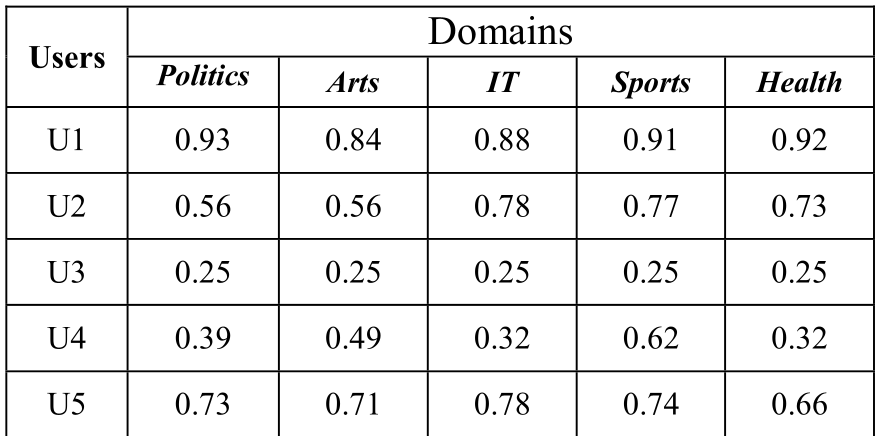 Table 10: Final Trustworthiness values showing how specialized users (U2) maintain higher trust in their domains compared to generalist users (U3).
Key Finding: A user with fewer total tweets but high domain focus (U2 in Health) can achieve higher trustworthiness than a high-volume user who lacks focus. This proves the DF-IDF component successfully filters out the "noise" of high-frequency posters.
Critical Analysis & Future Outlook
While this "preliminary approach" is logically sound, it relies heavily on external APIs for semantic mapping. The authors acknowledge that the next step is a graph-based model (an evolution of TwitterRank) that allows trust to propagate through follower networks.
Takeaway for the Industry: As AI-generated content makes "generic" influence easier to fake, domain-specific, time-aware metrics will become essential for recommendation engines and expertise retrieval systems. Reputation is no longer about how many people follow you; it's about who trusts you in a specific field, and for how long.