
CD-Speller: Leveraging Social Network Theory for Robust Domain-Specific Query Correction
Domain-specific Noisy Query Correction using Linguistic Network Community Detection
The paper introduces CD-Speller, a novel spelling correction framework for domain-specific noisy queries (e.g., SMS, tweets). It leverages the Louvain community detection algorithm on a linguistic network to achieve state-of-the-art correction accuracy in low-resource FAQ retrieval tasks.
TL;DR
The sheer volume of "noisy" text—riddled with abbreviations like gr8 for great or pkg for package—breaks traditional search engines. CD-Speller reformulates this NLP headache as a graph problem. By using community detection (the Louvain method) on a network of words, it outperforms industry giants like HunSpell by over 300% in specific domain tasks.
Background: The Infrastructure of "Text-Speak"
As mobile devices dominate information access, our language has evolved into a compressed, noisy format. While Google can rely on massive query logs to "guess" what you meant, domain-specific engines (like a corporate FAQ or a railway helpdesk) don't have that luxury. These systems face a "cold start" problem in query correction: they have limited data and high technical jargon requirements.
Motivation: Why Traditional Spell-Checkers Fail
Industry-standard tools like HunSpell (used in Chrome and LibreOffice) rely heavily on morphological rules and generic dictionaries. They struggle with:
- Context Blindness: They don't understand the specific "slang" or abbreviations of a niche domain.
- Data Scarcity: They cannot learn from the limited query logs of a specialized enterprise system.
The author's insight was to treat words like people in a social network. If "gud" and "good" frequent the same "circles" of similarity, they belong in the same community.
Methodology: The CD-Speller Architecture
The process follows a three-step pipeline that bridges linguistic distance with graph theory.
1. Constructing the Linguistic Network
Instead of looking at words in isolation, CD-Speller builds a weighted graph where every word is a node. The edge weights are determined by a tripartite similarity function:
- String Edit Distance: Standard Damerau-Levinshtein distance.
- Phonetic Encoding: Using Double Metaphone to catch words that sound the same but look different.
- Consonant Skeleton: Comparing the core "bones" of words (e.g., "pkge" vs "package").
2. Community Detection (The Louvain Method)
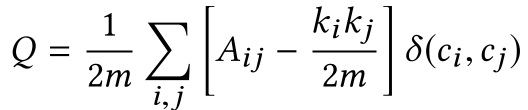
Once the graph is built, the system applies the Louvain Method to optimize modularity (). This partitions the graph into clusters where nodes are more densely connected to each other than to the rest of the network.
3. Automated Error Correction
If a word is not found in the domain corpus or a standard lexicon, it is flagged as "noisy." The system then looks within that word's specific community to find the most "central" or strongly connected node that is a valid word.
 Figure 1: Conceptual visualization of word communities detected in a linguistic network.
Experimental Results: Crushing the Baseline
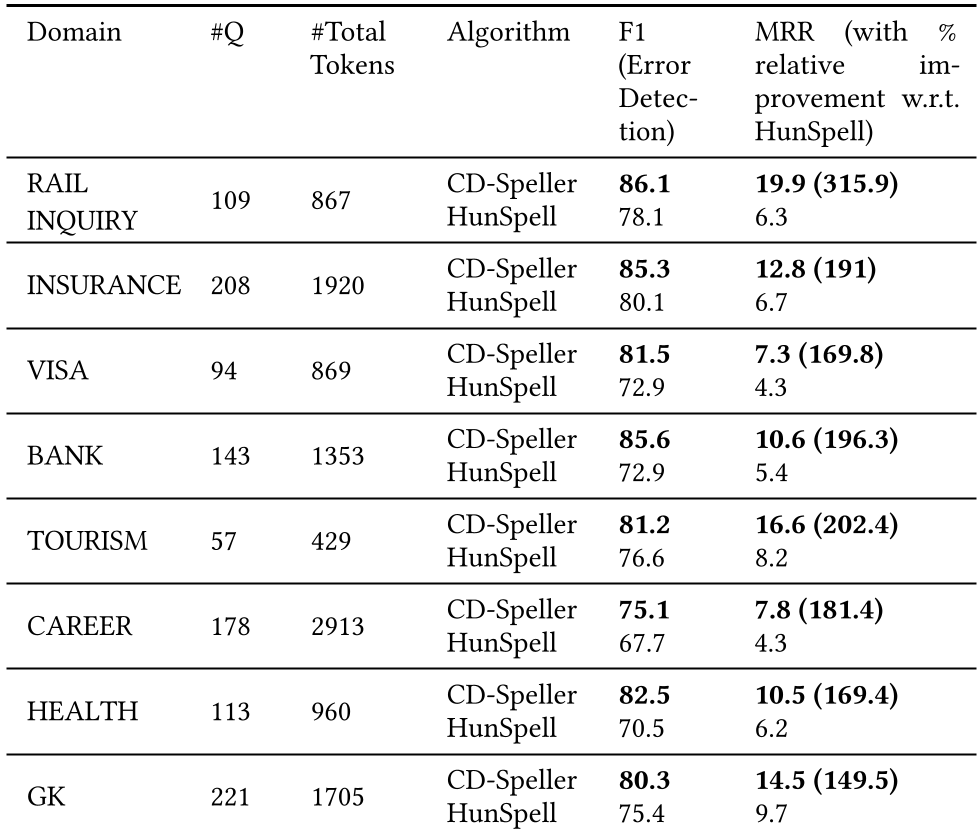
The authors tested CD-Speller against the FIRE 2013 dataset (FAQ Retrieval using Noisy Queries) across 8 domains, including Insurance, Banking, and Tourism.
| Domain | Algorithm | MRR Improvement |
|---|---|---|
| Rail Inquiry | CD-Speller | +315.9% |
| Banking | CD-Speller | +196.3% |
| Health | CD-Speller | +169.4% |
The results were decisive. In the Rail Inquiry domain, the Mean Reciprocal Rank (MRR)—a measure of how high the correct suggestion appears in the list—jumped from 6.3 with HunSpell to 19.9 with CD-Speller.
Critical Analysis & Conclusion
Takeaway: CD-Speller proves that in domain-specific contexts, the "social context" (similarity patterns) of tokens is more valuable than generalized linguistic rules. By using community detection, the system creates a self-organizing dictionary that adapts to the specific noise patterns of its users.
Limitations: Since the approach relies on graph construction, the computational overhead of building the linguistic network for massive datasets could be a bottleneck. Furthermore, it assumes that the correct version of a noisy word exists somewhere in the domain corpus or lexicon to act as a community anchor.
Future Outlook: As we move toward LLM-based retrieval (RAG), the principles of CD-Speller could be integrated into the "indexing" phase, ensuring that noisy user queries are normalized before they even hit the vector database, drastically improving retrieval precision for enterprise bots.