
The Power of the Few: How Dominance Accelerates Social Consensus
Understanding How Dominance Affects the Emergence of Agreement in a Social Network: The Case of Naming Game
This paper introduces dominance-based variants of the Naming Game (NG), a multi-agent model for opinion formation. By weighting opinions based on agent popularity (degree) or evolutionary success, the authors propose the NGD and NGS models, significantly accelerating consensus in social networks compared to the standard NG.
TL;DR
In social networks, not all voices carry the same weight. This paper reimagines the Naming Game (NG)—a classic model of how societies reach agreement—by introducing Social Dominance. By allowing influential agents or successful opinions to "weight" the conversation, the researchers achieved consensus significantly faster than standard models, effectively breaking the "deadlocks" often seen in modular networks like Facebook.
From Equality to Influence: The Motivation
Most opinion dynamics models assume a "democratic" playing field where every agent starts with the same level of influence. However, real-world networks (from Twitter/X to corporate hierarchies) are characterized by hubs—individuals with massive reach.
The authors argue that the standard Naming Game is too slow because it allows weak opinions to linger indefinitely. By introducing a Dominance Factor, they hypothesize that the "survival of the fittest" opinion can be accelerated, leading to a more efficient path to global consensus.
The Mechanism: NGD vs. NGS
The researchers propose two distinct ways to model dominance within the local negotiation process:
- NGD (Degree-based Dominance): An opinion’s strength is initially determined by the Topological Dominance of its creator. If a "hub" (a node with many connections) invents a word, that word starts with a high weight.
- NGS (Success-based Dominance): Focuses on Evolutionary Dominance. Every opinion starts small, but every time a communication "succeeds" (the hearer agrees), the opinion gains weight.
The Preferential Rule
Instead of choosing an opinion at random from their inventory, agents in these models use a Preferential Selection Rule: This means the more dominant an opinion is, the more likely it is to be voiced, creating a positive feedback loop.
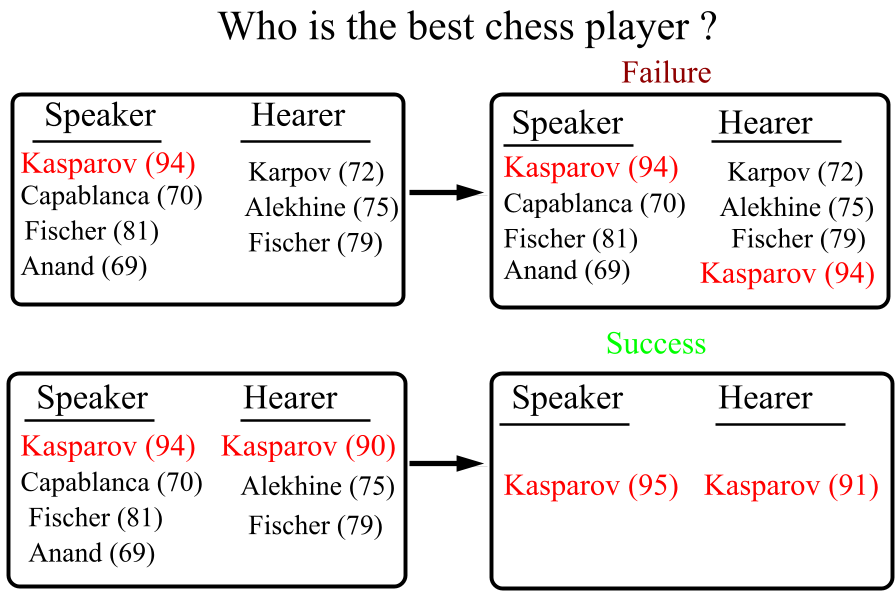 Fig 1: Unlike basic NG, the hearer copies the high-weight opinion upon failure, and both increment the weight upon success.
Breaking the Scalability Barrier
The most striking result lies in the Convergence Time (). In the standard Naming Game, the time to reach consensus scales super-linearly with the population size ( or higher).
In the NGD model, the scaling drops to nearly linear (). This is a massive improvement for large-scale systems. The dominance of a few high-degree nodes allows them to act as "opinion anchors," rapidly synchronizing the network.
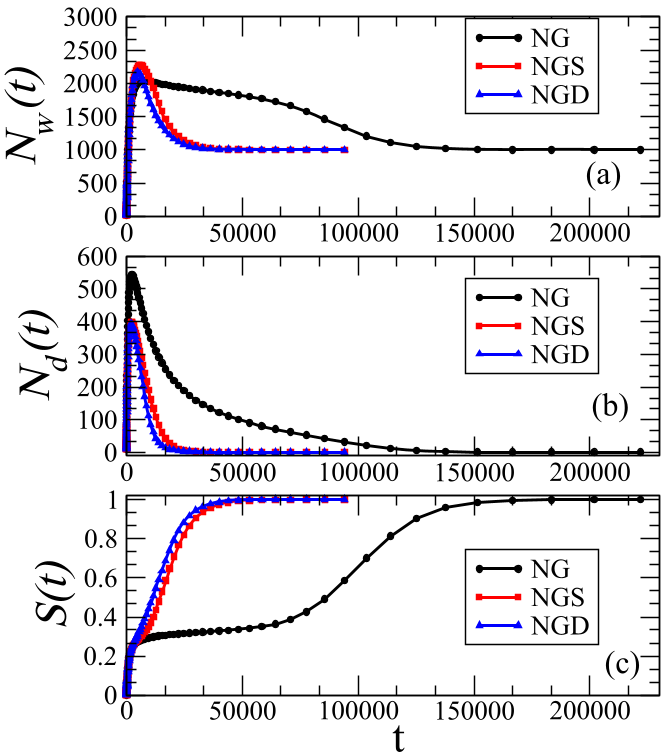 Fig 2: Scaling of convergence time () for NGS vs. standard NG. The dominance model (NGS) demonstrates a significantly lower slope.
Real-World Validation: The Facebook Case Study
The authors tested their models on a snapshot of Facebook (63k nodes, 1.6M links). Real social networks are "modular"—they contain tight-knit communities where opinions get trapped.
- Standard NG: Becomes trapped in a "metastable state." Even after 800 million games, the community couldn't reach a single opinion, plateauing with about 7 competing ideas.
- Dominance Models: Successfully pushed through these modular barriers. By giving more weight to certain opinions, the "tug-of-war" between communities was resolved much faster.
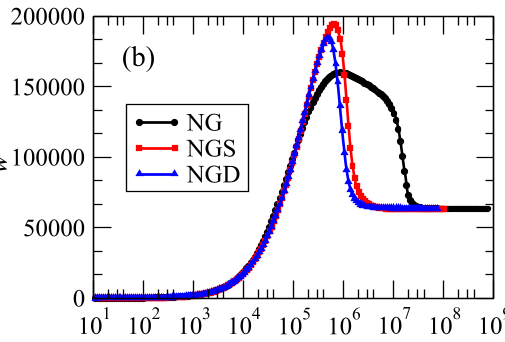 Fig 3: On Facebook data, the NGD and NGS models (red and blue lines) drop to a single opinion () while the standard NG (black line) remains stuck.
Critical Analysis & Takeaways
This work provides a robust framework for understanding why some opinions "go viral" and dominate while others vanish.
- Insight: Dominance acts as a filter. High-dominance opinions force low-dominance ones out of the system quickly, ensuring that the "competition for survival" is limited to only the most influential ideas.
- Limitation: The model assumes agents are cooperative. In real-world political landscapes, "stubborn" agents may refuse to adopt a dominant opinion regardless of its weight.
- Future Work: Integrating "trust" (where agents only weigh opinions from certain sources) or applying this to weighted graphs would be the logical next step in making these simulations even more lifelike.
Conclusion: If you want a network to agree, don't treat every node as equal. Leverage the hierarchy.