
Strategic Positioning: Finding Stability in the Domination Game
On domination game analysis for microeconomic data mining
This paper introduces the "Domination Game," a novel framework combining game theory with microeconomic data mining to model competition among manufacturers. It proposes an iterative algorithm to find pure Nash equilibria in a multidimensional product space, achieving stable market share configurations.
TL;DR
In the competitive landscape of microeconomics, how do manufacturers choose product features to maximize market share while accounting for rivals? This paper formalizes the Domination Game, proving that a stable market state (Nash Equilibrium) always exists and can be found efficiently. By treating product attributes as coordinates in a high-dimensional space, the authors provide a rigorous algorithmic framework for strategic decision-making.
The Motivation: Data Mining Meets Game Theory
Traditional data mining is often "passive"—it finds patterns in historical data. However, as Kleinberg famously argued, the real value of mining lies in utility. In a market, utility is contested. If Manufacturer A changes their product specs to capture more customers, Manufacturer B will likely react.
The authors identify a gap: while we have "Skyline Queries" to find the best products, we lacked a robust way to model the equilibrium where no manufacturer can further improve their share. The challenge is the "Pure Nash Equilibrium," which in many games, doesn't even exist or is NP-hard to find.
Methodology: The Geometry of Competition
1. The Market Model
- Customers & Products: Both are points in a -dimensional space (e.g., Price, Weight, Performance).
- Domination: A product dominates a customer if it meets or exceeds all the customer's requirements (e.g., lower price AND higher speed).
- The Constraint: Manufacturers can't just make the "perfect" product; they are bound by a Profit Constraint Hyperplane. Improving one attribute usually means sacrificing another.
2. The Potential Function Breakthrough
The core technical contribution is the proof of convergence. The authors define a potential function using a harmonic series: Where is the -th harmonic number and is the set of customers dominated by exactly products. They elegantly show that when one manufacturer improves their share, the global potential increases, guaranteeing that the game is acyclic and must terminate at a Nash Equilibrium.
3. Efficient Search: The Customer Search Tree
Searching for the "Best Response" in continuous space is impossible. The authors prove that the optimal position is always defined by a subset of customer requirements (the Effective Dominating Point).
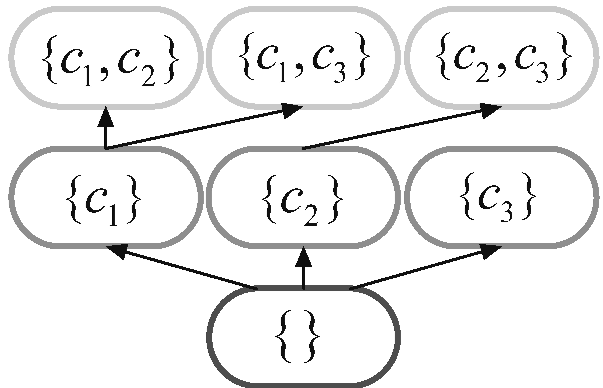
By building a lattice of customer combinations and applying Upper Bound Pruning, they skip millions of irrelevant configurations.
Experimental Results
The authors tested their algorithms (DFS vs. BFS vs. Naive) across various data distributions (Anti-correlated, Clustered, etc.).
- Speed: The DFS-based search is significantly faster, often by 100x compared to naive discretization.
- Scalability: The iterative process scales linearly with the number of manufacturers, suggesting it can handle real-world market sizes.
- Social Welfare: They proved the "Price of Anarchy" is bounded—any equilibrium achieved is at least 50% as effective as the theoretical maximum possible customer coverage.

Critical Analysis & Insights
Why it works
The genius of this work lies in the mapping of a discrete combinatorial problem (which customers to cover) onto a continuous geometric constraint (the hyperplane). The use of the Harmonic Potential Function is a classic "potential game" trick, but applied here to a novel microeconomic context.
Limitations
- Attribute Homogeneity: The model assumes "smaller is better" for all attributes, which doesn't fit every market (e.g., some people want a larger screen).
- Dimensionality Curse: While the algorithms are polynomial in (customers), they remain exponential in (attributes). For products with dozens of specs, further optimization is needed.
Future Outlook
As we move toward AI agents that handle B2B negotiations and product design, the Domination Game provides the math to ensure these agents don't just "optimize in a vacuum" but actually reach stable, profitable strategies in a competitive ecosystem.