
Dormant Bots: The Silent Influencers of the 2018 U.S. Senate Election
Dormant bots in social media: Twier and the 2018 U.S. senate election
This paper identifies and analyzes "dormant bots" on Twitter—accounts that exhibit no posting behavior but maintain large follower/friend networks to influence the 2018 U.S. Senate election. By utilizing a structure-based detection method, the researchers uncovered a network where nearly 47% of followers for incumbent senators were newly created, leading to the suspension of 70 million accounts by Twitter.
TL;DR
Researchers at Johns Hopkins and Accenture identified a massive network of "dormant bots"—accounts that don't tweet but follow key political figures to manipulate social media algorithms. This study revealved that nearly half of the followers for 2018 U.S. Senate incumbents were suspicious, leading to a massive Twitter purge of 70 million accounts and a 23% drop in the company's stock price.
Background: The War Against Behavioral Detection
For years, social media platforms and researchers played a "cat and mouse" game using behavioral forensics. If an account tweeted 50 times an hour or used specific inflammatory keywords, it was flagged. However, the 2018 U.S. Senate election cycle saw the rise of a more insidious tactic: Dormancy.
The core insight of this paper is that a bot doesn't need to speak to be dangerous. By simply existing and following specific personas, these accounts can:
- Artificially Inflate Popularity: Making a candidate look more mainstream than they are.
- Manipulate SEO: Influencing search results so specific content ranks higher.
- Pre-position for Ambush: Staying "under the radar" until a critical moment (like an election eve) to suddenly activate and drown out opposing narratives.
Methodology: Decoding the "Spikes"
The researchers analyzed the follower networks of 25 incumbent senators (21 Democrats, 4 Republicans). They noticed a massive surge in account creations starting in late 2017.
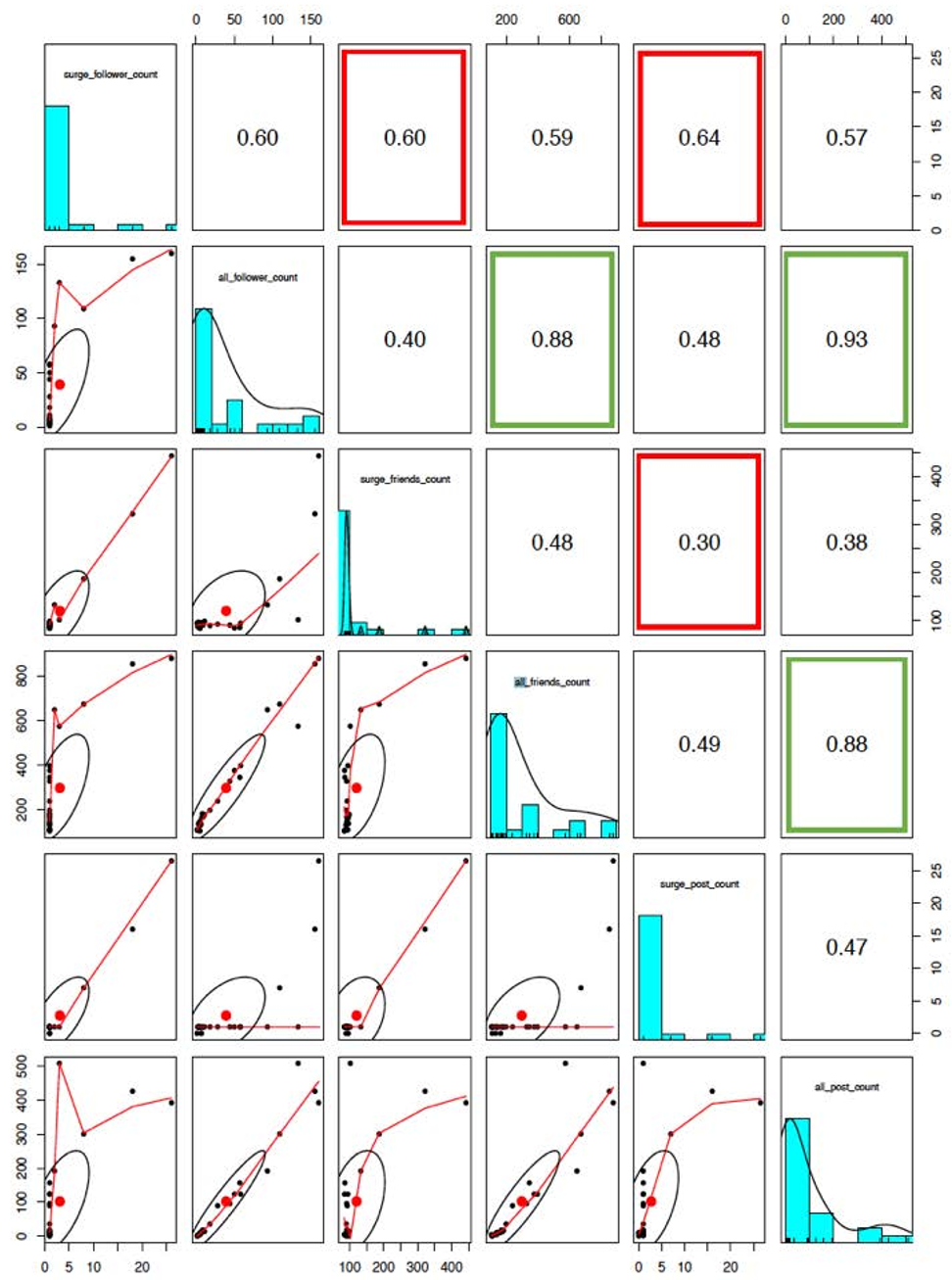
The Structural Red Flag
In healthy social networks, there is a strong correlation between followers, friends, and posts. Typically, the more you post, the more your network grows.
The researchers used Kendall’s Rank Correlation to prove that for accounts created after July 2017, these correlations collapsed:
- Follower-Post Correlation: Dropped from 0.93 (normal) to 0.64 (suspicious).
- Friend-Post Correlation: Plummeted to a staggering 0.30.
This statistical decoupling indicates that these accounts were growing their networks through automation rather than organic social interaction.
Deep Dive: The Data of Silence
The scale of the "dormant bot" problem was staggering.
- 41% of the accounts created after the July 2017 spike had zero posts.
- These silent accounts strangely maintained an average of 99 friends.
- Democratic candidates were targeted disproportionately, with 11 times more new suspicious followers than their Republican counterparts.
When the 59% of accounts that did post were run through Indiana University's Botometer, roughly 72% were flagged as bots. By combining the "silent" accounts with the "active bot" samples, the authors estimated that up to 83.5% of the new followers were non-human.
Results and Real-World Impact
Unlike many academic papers that remain in PDF archives, this work had immediate, tangible consequences:
- Government Action: Findings were shared with the FBI in April 2018.
- The Great Purge: Twitter was served a court order to suspend these dormant networks, resulting in the elimination of 70 million accounts.
- Market Shock: The massive reduction in "active users" (as some bots were counted in metrics) led to a 23% decline in Twitter's stock value shortly after.
Critical Analysis & Conclusion
The value of this research lies in its simplicity. By ignoring what users were saying and focusing on the structure of their existence, the authors exposed a massive vulnerability in social media integrity.
Limitations
While the correlations are strong, "silence" isn't a perfect proof of bot-hood. Some humans are "lurkers" who follow accounts but never post. However, the sheer volume of lurkers following specific politicians simultaneously makes the lurker-theory statistically improbable.
Future Outlook
As AI becomes better at mimicking human speech (via LLMs), behavioral detection will become even harder. This paper suggests that Network Topology—the "who follows whom"—remains one of the most robust ways to identify coordinated inauthentic behavior.
The takeaway for platforms is clear: stop looking at the messages; start looking at the silence.