
Social Tension: A Physics-Inspired Framework for Link Prediction
Double Bounded Rough Set, Tension Measure, and Social Link Prediction
The paper introduces a physics-inspired "Tension Measure" for social link prediction by treating social relations as elastic strings. It leverages a novel "Double Bounded Rough Set" (DBRS) to mathematically quantify four distinct structural forces—two attractive and two repulsive—to predict the formation or deletion of social links.
TL;DR
Researchers have introduced a novel "Tension Measure" that treats social relations like physical strings under stress. By identifying four structural forces—two that pull nodes together and two that push them apart—and using a new mathematical framework called Double Bounded Rough Sets, this method significantly improves our ability to predict NOT ONLY who will become friends, but also which existing friendships are likely to dissolve.
Background: Beyond Simple Similarity
Most link prediction algorithms assume that if you and I share many friends, we are likely to meet. This is the "Common Neighbors" logic. However, social dynamics are more complex. Sometimes, a very tight-knit, insular group actually prevents its members from reaching out to others—a repulsive force the authors call "intra-neighborhood connectivity."
The core insight of this paper is that a relationship is a result of a struggle between attraction (common friends and mutual acquaintances) and repulsion (being "satisfied" with an existing dense local group).
Methodology: The Physics of Social Strings
The authors define Tension (T) as the resultant force acting on a relationship. To calculate it, they partition the neighborhood of two nodes into a structure inspired by Rough Set Theory.
1. Double Bounded Rough Set (DBRS)
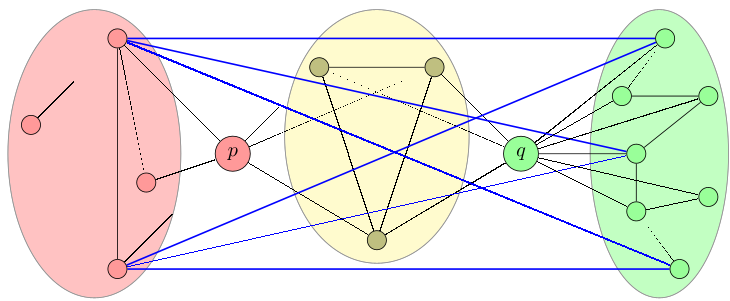
Standard Rough Sets use a lower and upper bound. But in a relation between node and node , we have three distinct zones:
- Core: Neighbors of both and .
- Left Boundary: Neighbors of only.
- Right Boundary: Neighbors of only.
The authors proposed DBRS to mathematically isolate these three zones, allowing them to measure the density of links within and between them.
2. The Four Forces
- (Positive): Link density among common neighbors. High density here "pulls" and together.
- (Positive): Links between 's exclusive friends and 's exclusive friends (inter-neighborhood). This represents "peer pressure."
- & (Negative): Link density within 's or 's exclusive circles (intra-neighborhood). If these circles are too dense, the nodes stay "busy" within their groups and feel no pull toward each other.
The final Tension is calculated as:
Experiments and Results
The researchers tested this on nine massive real-world datasets, including Facebook, Twitter, and Flickr.
Key Findings:
- Correlation: Positive tension appeared in over 91% of existing links across all datasets.
- Predictive Power: The algorithm demonstrated superior Effectiveness (E) and F-Score compared to traditional methods like Adamic-Adar or Jaccard Coefficient.
- Link Deletion: Unique to this method, a negative tension score in an existing link serves as a "red flag" for future removal, a feature most similarity-based models lack.
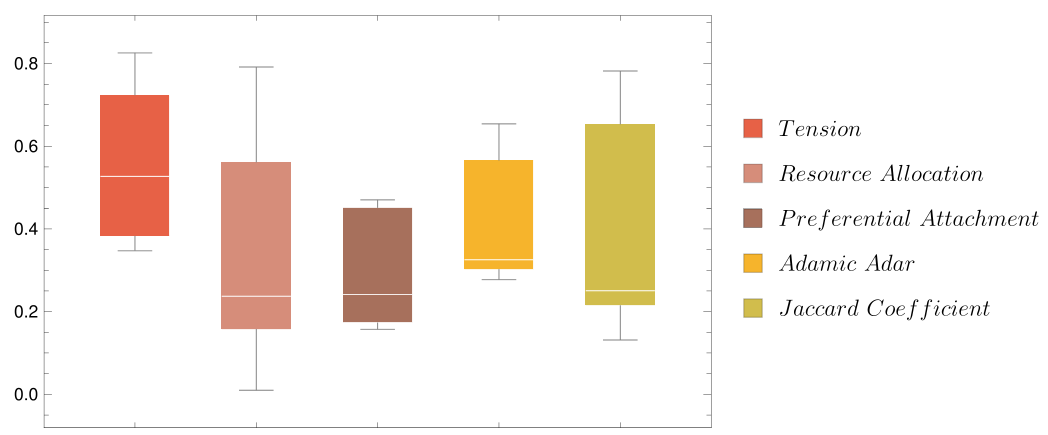 The chart above illustrates the Effectiveness (E) of the Tension Measure compared to SOTA baselines. The Tension Measure consistently maintains higher median scores across diverse network types.
Critical Insight & Conclusion
The "Tension Measure" is a departure from purely statistical counting. It introduces a structural psychology into link prediction.
Takeaway: The success of this method proves that a "slack" or "repulsive" local structure is just as informative as a "supportive" one. While the algorithm is computationally more expensive (slower execution time), its ability to predict network evolution (both additions and deletions) makes it a powerful tool for understanding how social fabrics either tighten or unravel over time.
Limitations
- Computational Complexity: The method is significantly slower than simple neighbor counting, making it challenging for real-time recommendations in billion-node graphs without further optimization.
- Cold Start: For nodes with a degree < 2, the structural tension often results in zero, rendering the model ineffective for very sparse regions of a network.
Future Outlook
This DBRS framework could be extended to multi-modal networks (e.g., users and products) or used to improve "Influence Maximization" strategies by filtering out links that, despite existing, have negative tension and are therefore "inactive."