
Double Dip Map-Reduce: Solving the Computational Nightmare of Cross-Validation
Double dip map-reduce for processing cross validation jobs
This paper introduces "Double Dip Map-Reduce," a cloud-based architecture designed to accelerate k-fold cross-validation for large-scale machine learning datasets. By leveraging AWS and a two-stage Map-Reduce cycle, the authors successfully parallelize the training and validation of a web page segmentation algorithm across massive corpora.
TL;DR
Cross-validation is a gold standard for model evaluation but scales poorly with data size. This paper presents a cloud-native architecture that utilizes two back-to-back Map-Reduce cycles on AWS to parallelize both the training and the validation phases. For massive datasets, this approach cuts processing time from months to days.
Background: The Scalability Wall
In machine learning, we often face a dilemma: we need k-fold cross-validation to ensure our model generalizes well, but as our corpus reaches tens of gigabytes, the "cross-over" rounds become a computational black hole. A typical 30GB corpus, if processed sequentially, would take over 3,000 hours (125 days) to validate. This leads many researchers to "cheat" by using faster but less reliable heuristics.
The authors of this paper argue that we don't need to change the math; we need to change the infrastructure.
The "Double Dip" Insight
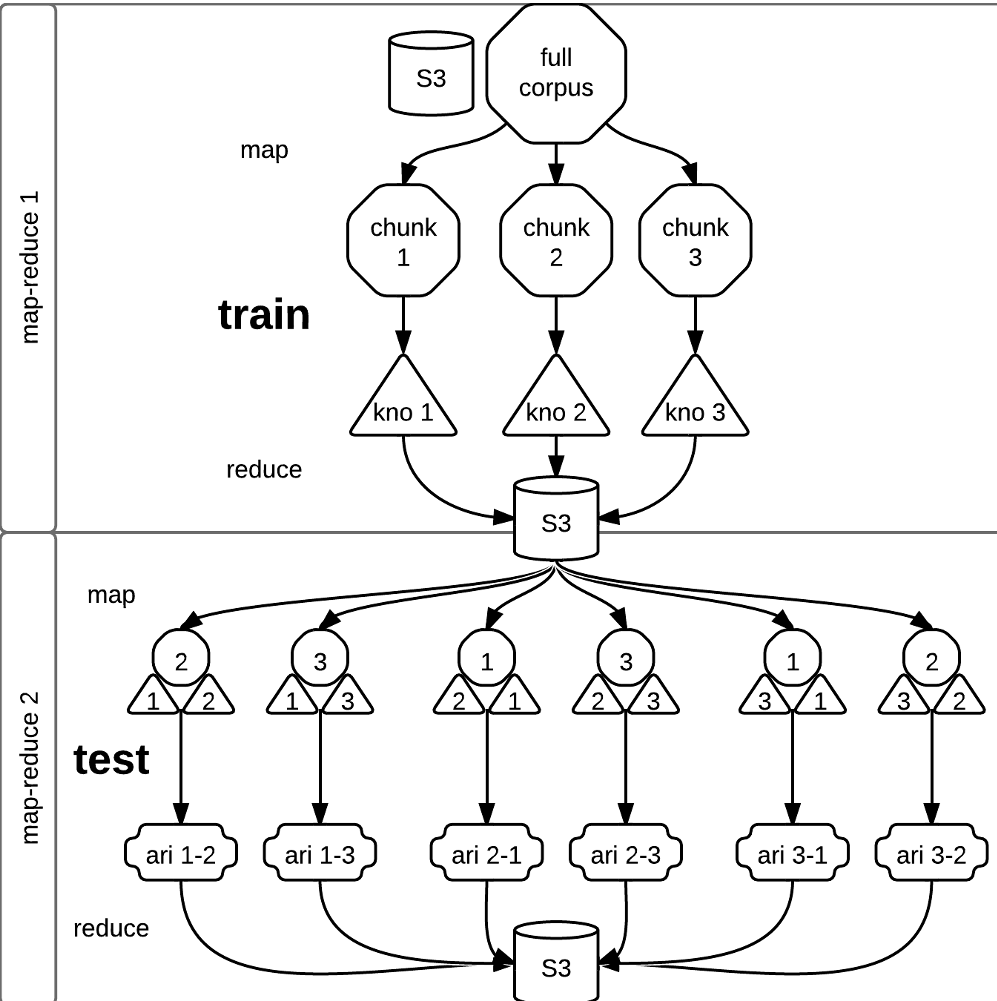
The core innovation lies in the Double Dip Map-Reduce strategy. Most distributed systems use one Map-Reduce pass to train a model. However, cross-validation is inherently a two-step iterative process.
- Phase 1 (Training): The corpus is split into chunks. Each "Mapper" node trains a specific chunk and outputs a
.kno(knowledge) file. - Phase 2 (Cross-Validation): This is the "Second Dip." The system takes the knowledge files and tests them against the other chunks. This creates distinct test jobs that are distributed across a pool of cloud workers.
Overcoming Cloud Hurdles
Transitioning from local scripts to the cloud wasn't seamless. The authors highlighted several "real-world" engineering challenges:
- Non-Linear Scaling: They initially assumed training time would grow linearly with data size. In reality, moving from 5MB to 50MB chunks caused a much steeper increase in latency, necessitating smaller chunk sizes.
- The S3 Bottleneck: A critical bug was discovered where the AWS S3 API only listed the first 1,000 files by default. This meant their second phase was missing 80% of the results until the API calls were properly paginated.
- Data Consistency: Distributing the workload revealed that much of their 30GB corpus was incorrectly encoded (non-UTF-8), causing 25% of the nodes to fail during the training phase.
Performance Comparison
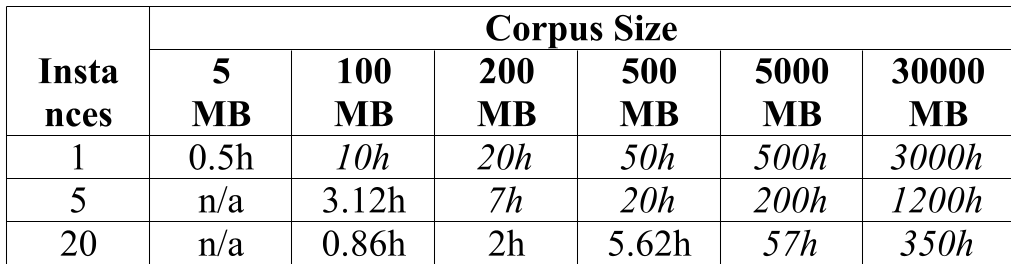
The results show that while cloud computing doesn't significantly lower the total machine hours (you still pay for the compute), it drastically reduces wall-clock time (Time-to-Insight).
| Instances | 500 MB Corpus | 30,000 MB (30GB) Predicted |
|---|---|---|
| 1 Instance | 50 hours | 3,000 hours |
| 20 Instances | 5.62 hours | 350 hours |
Critical Analysis & Conclusion
The Double Dip Map-Reduce approach is a pragmatic solution for the "Big Data" era of machine learning. It doesn't require a new algorithm; it wraps existing "Black Box" scripts into a scalable cloud wrapper.
Takeaways:
- Infrastructure as a Solution: When an algorithm is , horizontal scaling via cloud workers is often the only path to feasibility.
- Reliability Over Speed: By automating the full cross-validation process, we eliminate the need for heuristics, leading to better-quality models.
- Future Work: The authors plan to expand this to larger public corpora and provide a web-service interface to allow other researchers to "Double Dip" their own cross-validation jobs.
Despite being an earlier work in the cloud era (2012), the fundamental logic remains highly relevant for data scientists struggling with large-scale model evaluation today.