
The Architecture of Value: How Social Connectivity Spontaneously Creates Money
A Doubly Structural Network Model and Analysis on the Emergence of Money
This paper introduces the Doubly Structural Network (DSN) model, a multi-agent framework explaining the emergence of money from a barter economy. By integrating inter-agent social networks with inner-agent commodity recognition networks, the model achieves a SOTA theoretical explanation for how "proto-money" gains general acceptability through self-organization, validated via mean-field dynamics and bifurcation analysis.
TL;DR
Why does a specific object—be it a gold coin, a seashell, or a digital bit—suddenly become "money"? This paper argues that the answer lies not in the object itself, but in the architecture of the social network. Using a "Doubly Structural Network" (DSN) model, the researchers prove that money emerges as a self-organized "hub" in our collective recognition, triggered specifically by the density of our social connections.
Context: Beyond the "Metallic" vs. "Legal" Debate
For centuries, economists have debated the origin of money. Is it a government fiat (Legal Theory)? Or does it require physical properties like durability and scarcity (Metallic Theory)?
The authors observe that history contradicts both: money has emerged in stateless societies (tribes, POW camps) and has taken forms as diverse as salt, giant stones, and cigarettes. The "Non-Metallic" theory suggests money is a spontaneous specialization. The challenge was building a mathematical model that captures this "micro-macro" loop where individual recognition and social interaction feed into each other.
Methodology: The Doubly Structural Network (DSN)
The paper's innovation is the DSN. Instead of agents being simple nodes, each agent "holds" an internal graph representing their personal view of commodity exchangeability.
- External Structure (): The social network (who talks to whom).
- Internal Structure (): The recognition network (which goods the agent believes can be traded).
The Micro-Mechanisms of Learning
Money emerges through a specific social learning process defined by:
- Imitation: "I see my neighbor successfully trade A for B, so I now accept A too."
- Trimming: "I avoid circular trades; I want a direct path to value."
- Fluctuations: Conceiving new trade ideas and forgetting old ones.
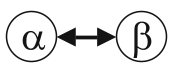 Fig 1: The DSN structure showing inter-agent social links and inner-agent commodity recognition.
The "K" Factor: Connectivity as a Catalyst
The researchers derived Mean-Field Dynamics to analyze how the average acceptability of a commodity changes over time. They discovered a bifurcation point based on —the average degree (number of neighbors) of the social network.
- Small (Sparse Society): Barter persists. No single commodity can gain enough momentum to become "general."
- Critical (Cohesive Society): A "Star-shaped" recognition graph emerges. One commodity spontaneously breaks symmetry and becomes the medium of exchange.
- Large (Hyper-connected Society): Multiple proto-moneys can coexist (Double Emergence).
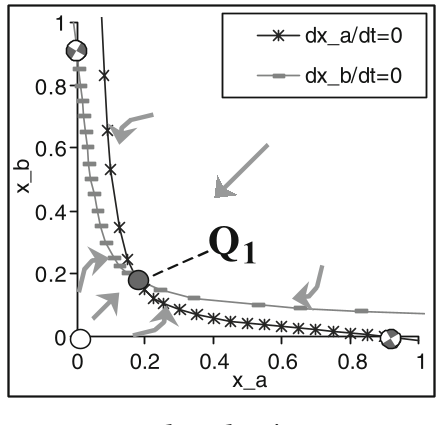 Fig 2: Isocline analysis showing the transition from a single stable equilibrium (no money) to multiple equilibria (emergence).
The Merchant Effect: The Power of Hubs
A fascinating finding in their agent-based simulation was the role of Hub Agents (Merchants). When just 5% of the population acts as highly connected hubs, money emerges much earlier and more stably than in a regular, uniform social network. Efficiency in the "social network" directly facilitates efficiency in the "economic network."
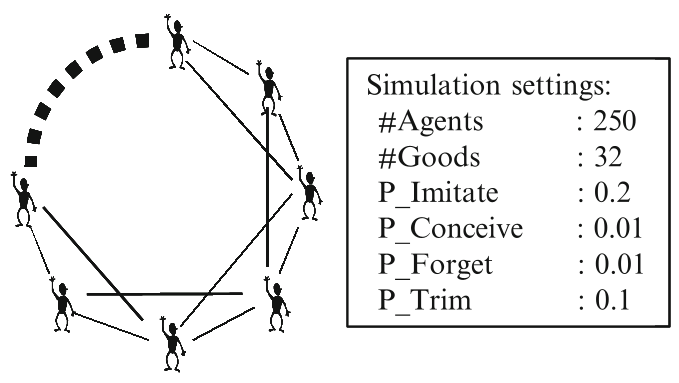 Fig 3: Percentage of money emergence vs. network degree. Darker areas represent non-monetary barter states.
Takeaways & Future Outlook
This work provides a rigorous mathematical foundation for the Non-Metallic Theory. It proves that even if all commodities are identical (no "gold" vs. "lead"), money will still emerge simply as a consequence of social topology.
Why it matters today: In the era of decentralized finance (DeFi) and virtual "points" (like airline miles or social tokens), this model suggests that the success of a new currency depends less on its technical "backing" and more on the topology of the network it is deployed within. If you want to create money, don't just look at the code—look at the connections.
Limitations: The current model treats the social network as static. In reality, the emergence of money likely changes the social network (people seek out those who accept money), a dynamic the authors plan to address in future "Dynamic Society" models.