
Beyond the Concrete: How Graph Theory Teaches 12-Year-Olds the Art of Abstraction
Draw a social network
This paper investigates the feasibility of teaching Graph Theory to grade six students (12-year-olds) to improve their mathematical abstraction skills. By introducing concepts like planarity and social network representation, the researchers observed a significant shift in how students visualize complex relationships using simplified, abstract models.
TL;DR
Can a 6th grader master the fundamentals of Computer Science? This study proves that through Graph Theory, 12-year-olds can successfully transition from "literal" thinking to "abstract" modeling. By learning to represent social networks, students moved away from drawing realistic faces (complex vertices) toward mathematical nodes, effectively adopting the "Inductive Bias" necessary for advanced STEM fields.
Background: The Abstraction Gap
In current primary education, "graphs" usually mean bar charts or pie graphs—tools for data visualization, not structural reasoning. The authors argue that by the age of 12, children move from the concrete operational stage to the formal operational stage. This is the perfect window to introduce Graph Theory, which strips away the "noise" of the real world to reveal the underlying architecture of relationships.
Motivation: Why Social Networks?
The researchers chose Social Networks as the pedagogical hook. Why? Because every middle schooler understands friendship. By framing people as vertices and friendships as edges, the study anchors an abstract CS concept in a high-stakes, real-world context for the students. The goal was to see if students could overcome two major "literal" hurdles:
- Object Literalism: Feeling the need to draw a person when the task asks for a representation of a person.
- Spatial Literalism: The assumption that "lines shouldn't cross," which limits students to only drawing planar graphs.
Methodology: The 5-Week CS Sprint
The intervention was structured into five distinct one-hour lessons:
- Basics: Rules for relational graphs (naming conventions, edge starts/ends).
- Geometry of Relationships: Isomorphism (recognizing the same structure in different layouts) and Planarity.
- Optimization: Minimum Spanning Trees (finding the most efficient path).
- Social Dynamics: Identifying "clusters" and shortest paths in social networks.
- Logic: Graph coloring and scheduling.
 Typical "pre-instruction" student drawings often included superflous details of faces or complex bodies.
Key Results: Achieving Mathematical Maturity
The most striking discovery was the transformation of the Vertex. In the pre-test, many students drew detailed human figures (Complex Vertices). After only five lessons, the treatment group's use of complex vertices dropped to zero.
- Vertex Complexity: A Chi-square test () confirmed a massive shift toward simple geometric shapes.
- Edge Crossings: Post-instruction, students were more comfortable with "crossed lines," realizing that the connection is more important than the crossing on the paper—a fundamental step toward understanding non-planar graphs.
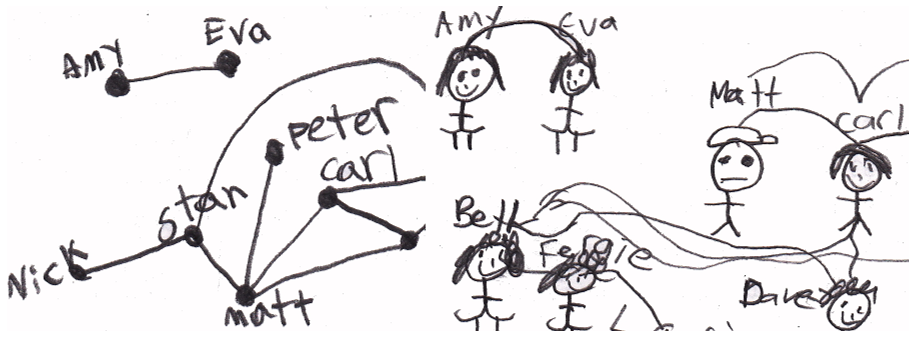 Figure 1: The evolution from artistic representation (left) to mathematical abstraction (right).
Critical Analysis & Takeaways
The "Invisibility" of CS in Schools
This paper highlights a missed opportunity in global curricula. Graph theory doesn't require expensive hardware or complex coding syntax; it requires a pencil, a piece of paper, and a shift in mindset.
Limitations
The study notes a small sample size (n=79) and some data gaps in the control group. Furthermore, "fatigue" might play a role—students might draw simpler shapes just because they are faster. However, the qualitative engagement of the students suggests a genuine cognitive shift.
Conclusion
If we want to prepare the next generation for an AI-driven world, we must teach them how to model reality, not just copy it. Graph Theory provides the perfect "middle-ware" between basic arithmetic and complex computer science.