
Unmasking the Dread Pirate Roberts: A Forensic Deep Dive into the Silk Road's Bitcoin Wealth
How Did Dread Pirate Roberts Acquire and Protect his Bitcoin Wealth?
This paper investigates the financial activities of Ross William Ulbricht (Dread Pirate Roberts), the operator of the Silk Road marketplace, using graph-based data mining on the public Bitcoin blockchain. The authors successfully traced the evolution of Ulbricht's holdings and identified that the FBI failed to seize approximately 78% of his total estimated commissions.
TL;DR
In this seminal data mining study, researchers Dorit Ron and Adi Shamir (co-inventor of RSA) dismantle the perceived anonymity of Ross Ulbricht, the operator of the Silk Road. By tracing the public Bitcoin transaction graph backwards from FBI-seized accounts, they expose a sophisticated network of wallets, revealing that the FBI only captured a fraction (approx. 22%) of his massive digital fortune.
Background: The Digital Pirate's Treasury
The Silk Road was the eBay of the dark web, fueled by TOR and Bitcoin. Its operator, Dread Pirate Roberts (DPR), built a fortune on commissions. When the FBI arrested Ross Ulbricht in 2013, they seized his laptop and roughly 144,000 BTC. While this seemed like a total victory, the authors of this paper asked a critical question: Is that all there was?
The Core Problem: The Illusion of Anonymity
Bitcoin addresses are pseudonymous, not anonymous. While a name isn't attached to a wallet, every transaction is a public "digital breadcrumb." The difficulty lies in the "Tumblers" and "Mixers" used by Silk Road, designed to shatter the links between incoming payments and outgoing wealth. Modern law enforcement often stops at what they can find on a physical hard drive, leaving the vast majority of the "transaction graph" unexplored.
Methodology: Graph Tracing and Behavioral Fingerprinting
The authors utilized a "Backward Tracing" approach. Starting with the known FBI seizure address (which provocatively received funds in 446 transactions of 324 BTC each—the telephone keypad code for "FBI"), they mapped the preceding structure.
1. Parallel Account Shuffling
The authors noticed a striking pattern: Ulbricht moved massive amounts of Bitcoins simultaneously from one set of 15 accounts to another. This "parallel movement" serves as a behavioral signature, strongly suggesting a single entity controls all 15 addresses.
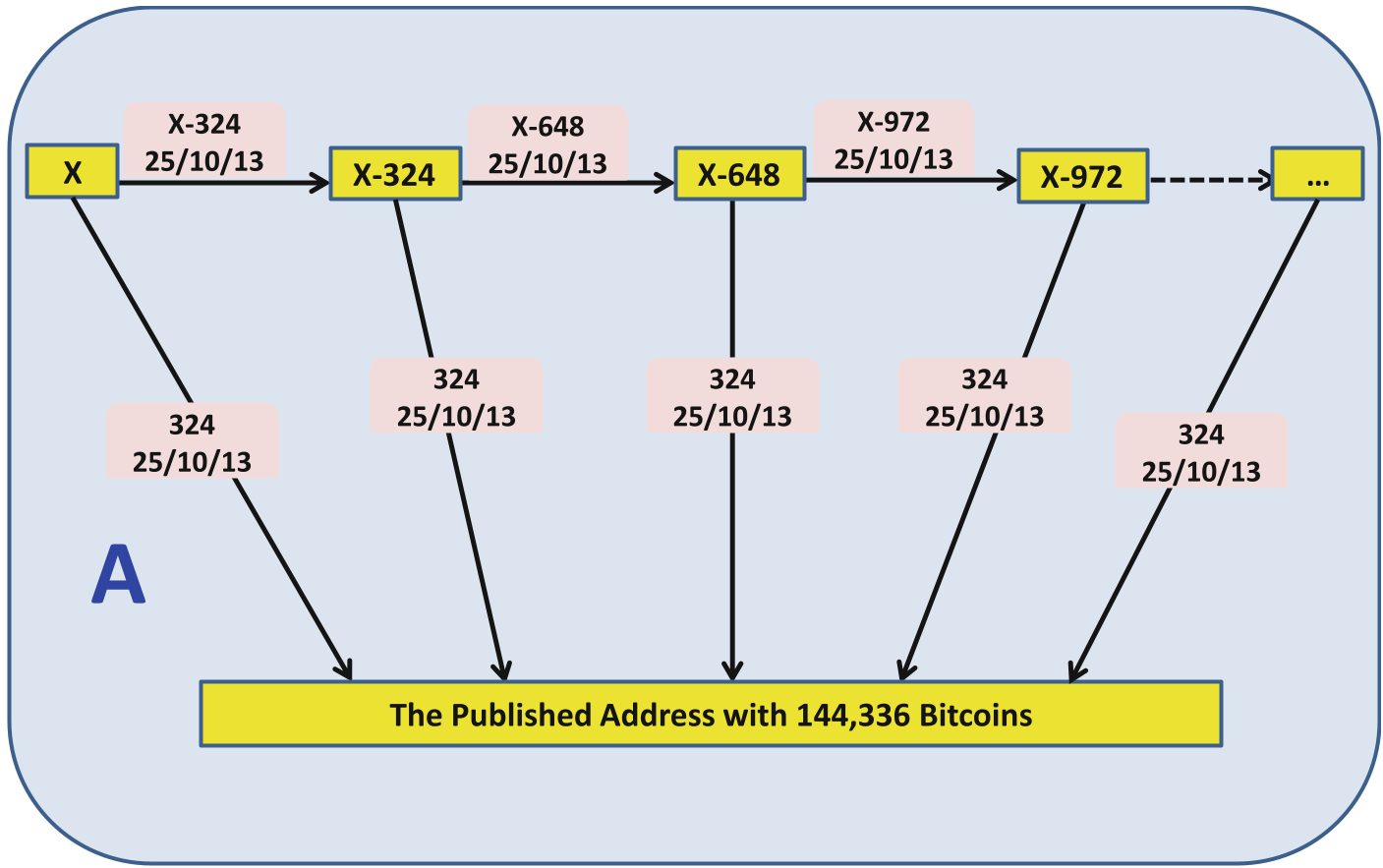 Figure: The structure of accounts immediately preceding the FBI seizure, showing the flow of thousands of Bitcoins.
2. The 50 BTC Fixed-Amount Heuristic
By backtracking the 15 primary accounts, they found a trail of addresses that consistently sent exactly 50 BTC. This regularity allowed the researchers to bypass "small-noise" transactions and focus on the backbone of Ulbricht's capital.
Results: What the FBI Missed
The findings were staggering. Based on the Silk Road's total sales volume (~9.5 million BTC), DPR should have collected around 633,000 BTC in commissions.
| Key Metric | Discovery |
|---|---|
| Estimated Total Commissions | ~633,000 BTC |
| Seized by FBI | 144,336 BTC (22%) |
| Identified Movement prior to arrest | ~70,000 BTC |
| Missing Months (May, June, Sept 2013) | Close to 0 identified BTC |
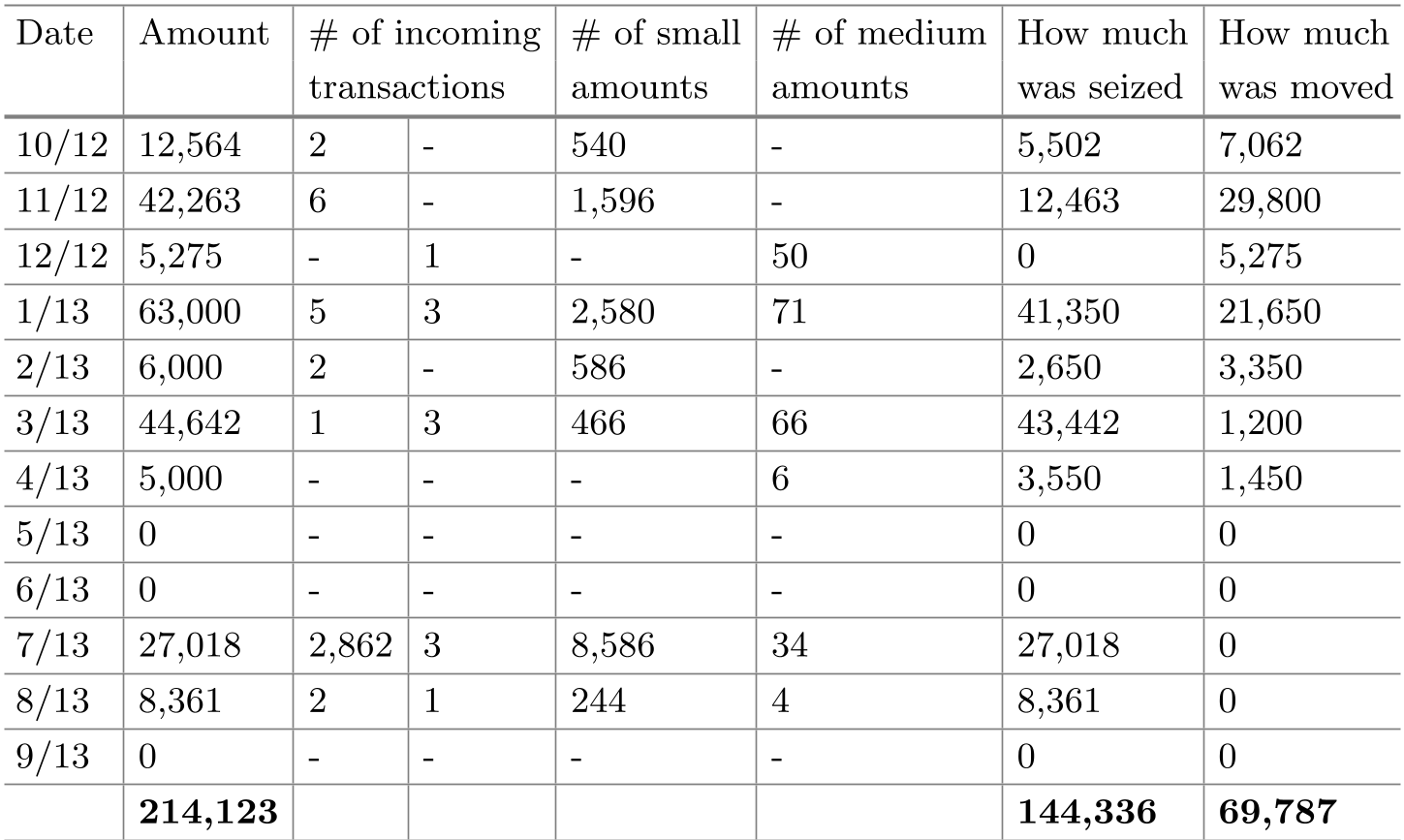 Table: Monthly breakdown of newly identified BTC wealth versus what was actually seized.
The "missing months" are particularly telling. The authors hypothesize that Ulbricht likely used a different, unseized computer or wallet during those periods, meaning hundreds of millions of dollars in Bitcoin remained—and perhaps still remain—beyond the reach of the law.
Critical Insight: The Power of Data Mining
This paper serves as a proof of concept for "Blockchain Intelligence." It demonstrates that you don't need a search warrant for a hard drive to map out a criminal empire's financial structure.
Limitations:
- Conjecture vs. Proof: Without the private keys found on a laptop, these links remain "statistically likely" rather than "proven."
- Adversarial Evolution: Since this paper, "Tumblers" have become significantly more sophisticated, making simple graph tracing harder.
Conclusion
The case of the Silk Road was a watershed moment for Bitcoin. Ron and Shamir's work proves that while the "Pirate" was clever in his protection of wealth, the inherent transparency of the ledger he chose ultimately became his clearest witness. For future investigators, the lesson is clear: the physical seizure of a wallet is only the beginning of the hunt.