
DREC: Strengthening the Foundation of Crowdsourcing Science through Structured Reporting
DREC: towards a Datasheet for Reporting Experiments in Crowdsourcing
This paper introduces DREC (Datasheet for Reporting Experiments in Crowdsourcing), a structured reporting framework designed to standardize the documentation of crowdsourcing-based user studies. The authors propose a six-dimension taxonomy and evaluate the current state of reporting by auditing a sample of CSCW papers from 2013 to 2019, identifying critical gaps in reproducibility and ethical transparency.
TL;DR
Reproducing a crowdsourcing experiment is notoriously difficult because researchers rarely report how they interacted with the crowd. This paper presents DREC, a datasheet framework designed to fill this void. By analyzing years of CSCW publications, the authors reveal a startling lack of transparency in ethical approvals, worker environments, and raw data sharing, providing a roadmap for more rigorous future research.
The "Invisible" Variables of the Crowd
In traditional laboratory experiments, the environment is controlled. In crowdsourcing, the "laboratory" is a complex socio-technical system. Factors such as the worker's browser type, the reputation filter set on Amazon Mechanical Turk, or the specific time of day the task was launched can all sway results.
The authors argue that the current "free-text" method of describing experiments in academic papers is insufficient. Without a standardized checklist, researchers often omit "implicit" platform features—like automated rejection criteria—that are essential for anyone trying to replicate the study.
Methodology: The DREC Taxonomy
The DREC framework organizes the complexity of crowdsourcing into six logical pillars. This taxonomy was derived not just from literature, but by analyzing the technical capabilities of modern platforms like Toloka.
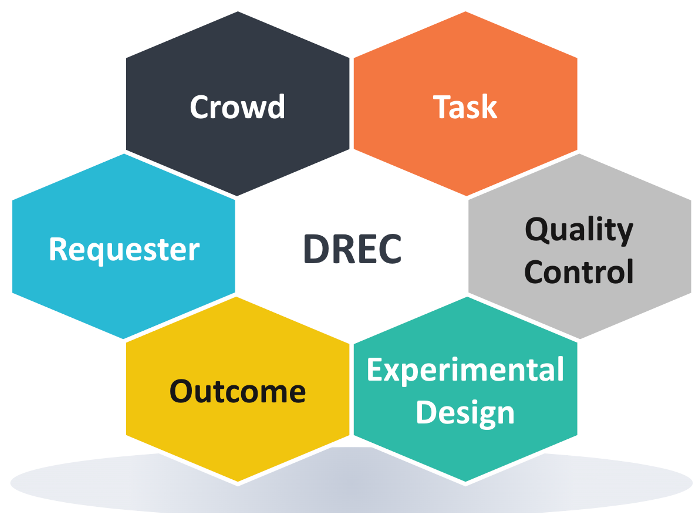
The Six Dimensions of DREC:
- Crowd: Who are the workers? (Reputation, sampling, environment).
- Tasks: What did they see? (Interface, instructions, reward strategy).
- Quality Control: How was "noise" filtered? (Gold questions, honey pots, timeout limits).
- Experimental Design: The "Scientific" core (RQs, variables, pilot studies).
- Outcome: What was produced? (Output datasets, discarded data, demographics).
- Requester: The ethical footprint (Payment fairness, informed consent, institutional approval).
The State of the Field: A Reality Check
The authors performed a meta-analysis on 15 representative CSCW papers. The results (visualized below) highlight a massive disparity between "Textbook" science and "Crowd" science.
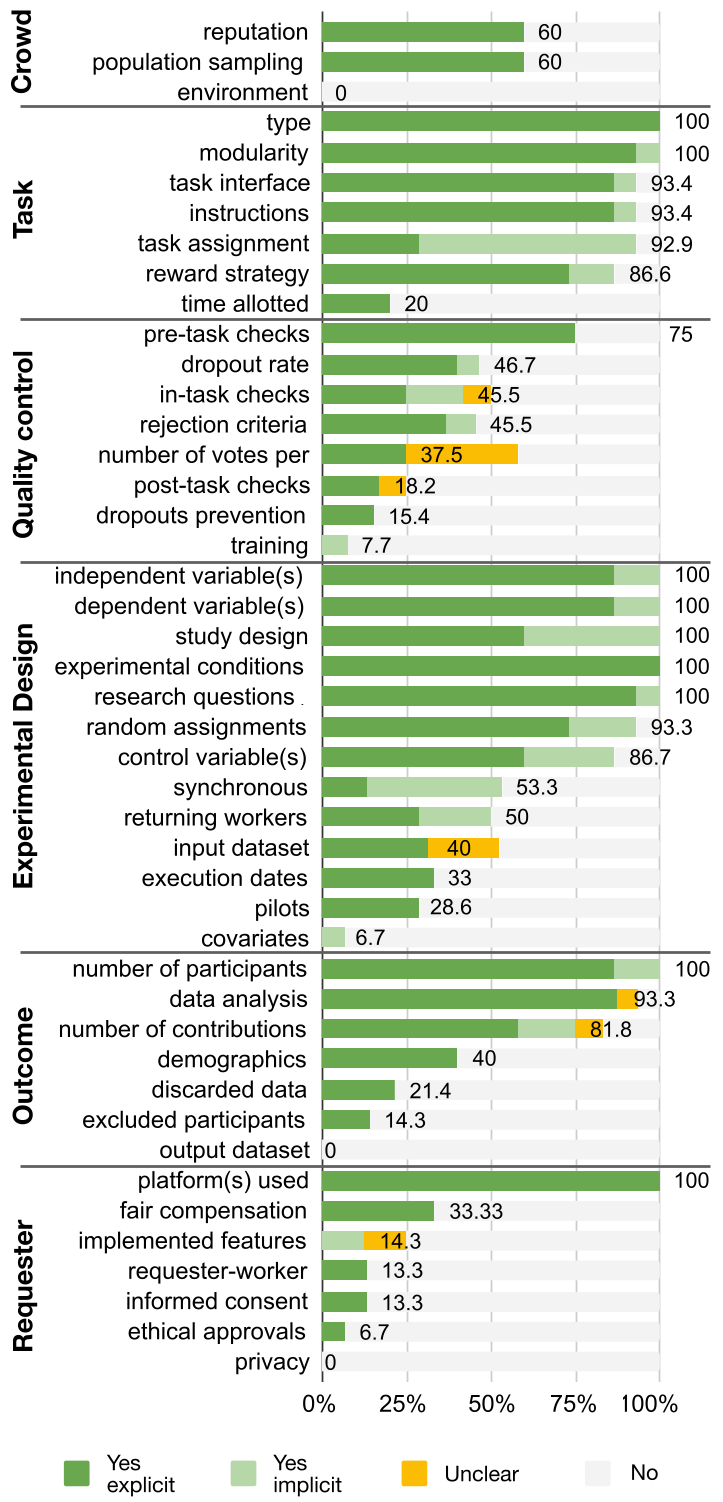
Key Findings from the Audit:
- The Ethical Gap: While 87% of papers discussed reward strategies, only 7% reported ethical approvals and 0% reported on privacy measures.
- The "Implicit" Trap: Many researchers rely on platform defaults for task assignment and quality control but fail to document these defaults in their papers.
- Interface Ambiguity: While 93% showed screenshots of the task, screenshots often fail to convey the dynamic logic (e.g., validation scripts) behind the UI.
Critical Insight & Future Outlook
The most striking takeaway is the neglect of the human element. Aspects like "Return Workers" and "Worker Demographics" are poorly reported (40% or less), yet we know that "non-naïveté" (workers becoming too familiar with common experimental traps) can significantly bias behavioral data.
DREC isn't just a administrative hurdle; it’s a tool for Scientific Integrity. By moving toward "Datasheets," the crowdsourcing community can ensure that a study conducted in 2024 remains replicable and verifiable in 2030, regardless of changes in platform UI or worker populations.
Limitations
The study is currently limited to a small sample (15 papers) from a single community (CSCW). Future work needs to validate if the DREC taxonomy is flexible enough for diverse tasks like image segmentation, creative writing, or complex collaborative crowdsourcing.
Final Takeaway
If you are running a crowdsourcing experiment, stop relying on "standard practice" descriptions. Use a structured datasheet to document the hidden variables—your future reviewers (and your future self) will thank you.