
DRFLogitBoost: Bridging Bagging and Boosting via Double Randomization
DRFLogitBoost: A Double Randomized Decision Forest Incorporated with LogitBoosted Decision Stumps
The paper introduces DRFLogitBoost, a hybrid ensemble method combining a double-randomized decision forest with LogitBoosted decision stumps. By utilizing Out-of-Bag (OOB) samples to train a boosting module and enriching the feature space of base learners, it achieves SOTA-level predictive performance in binary classification tasks.
TL;DR
DRFLogitBoost is a hybrid ensemble architecture that fuses the variance-reduction power of Decision Forests with the bias-reduction efficiency of LogitBoost. By utilizing a "double randomization" process—where Out-of-Bag (OOB) samples are used to generate auxiliary features—the model achieves superior accuracy and robustness in challenging tasks like credit scoring and extreme weather forecasting.
Problem & Motivation: The Bias-Variance Tradeoff
In the world of ensemble learning, Bagging (Bootstrap Aggregating) is the gold standard for reducing variance, while Boosting is the master of reducing bias. However, practitioners often face a dilemma:
- Bagging Scenarios: When using small resamples to maintain diversity, the bias of individual trees remains high.
- Boosting Scenarios: Traditional AdaBoost uses an exponential loss function that is notoriously sensitive to noise and outliers.
The authors' insight was to ask: Can we use the data that Bagging "throws away" (the OOB samples) to build a secondary learner that helps the primary model see better?
Methodology: The Double Randomization Loop
DRFLogitBoost operates on a unique two-stage randomization pipeline:
- First Randomization: Generate a standard bootstrap resample to train a base decision tree.
- Second Randomization: Take the samples excluded from the first step (the OOB samples) and train a Real LogitBoost model using "decision stumps" (single-level trees).
- Feature Augmentation: The class probabilities generated by the LogitBoost module are appended to the original features. This transforms the input from to , effectively providing the decision tree with "expert advice" as additional dimensions.

Why Logistics?
Instead of standard AdaBoost, the authors use LogitBoost because it optimizes the binomial log-likelihood. This makes the model significantly more robust in "noisy" problems where labels might be misclassified or data is messy.
Experiments & Results
The researchers tested the model against heavyweights like Rotation Forest (RotF) and Random Subspace Neural Networks (RSM-NN) across two critical domains.
1. Credit Score Classification
DRFLogitBoost showed remarkable consistency across multiple datasets (Australian, German, Japanese credit data). While RSM-NN occasionally led in specific error types, DRFLogitBoost maintained the highest overall AUC, which is the most reliable metric for binary classification.
2. Extreme Rainfall Forecasting (Rare Event Detection)
Predicting extreme rainfall (>50mm) is difficult because the event is rare. Standard accuracy (Fraction Correct) is often misleading.
- DRFLogitBoost AUC: 0.8160
- Random Forest AUC: 0.6596
- LogitBoost AUC: 0.5389
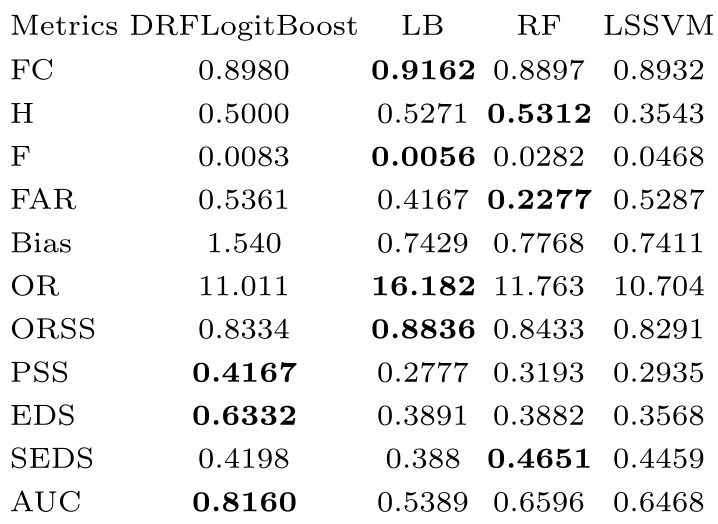
The model achieved an EDS (Extreme Dependency Score) of 0.6332, nearly doubling the performance of traditional Random Forests, proving its capability in handling imbalanced, high-risk data.
Critical Analysis & Conclusion
DRFLogitBoost succeeds because it increases the feature space sparsity and diversity. By incorporating the LogitBoost module, it adds a "second opinion" to every tree in the forest, lowering the collective bias without sacrificing the stability of bagging.
Takeaway: If you are working with tabular data where reliability is as important as accuracy (like Finance or Climate), the strategy of using OOB samples for feature augmentation is a powerful alternative to standard GBDT or Random Forests.
Limitations: The computational cost is higher than a standard Random Forest due to the nested boosting training for each tree. Future work could explore optimizing this overhead via parallelization or more efficient base learners.