
The Intelligent Co-Pilot: Revolutionizing Driving Persistence for the Older Generation
Driver Persistence, Safety and Older Adult Self-efficacy: Addressing Driving Challenges Using Innovative Multimodal Communication Concepts
This paper introduces an innovative multimodal "Co-Pilot" driver assistance system designed specifically to support older adult driver persistence. By integrating AR, haptic feedback, and spatial audio, the system maintains safety while promoting self-efficacy and positive aging.
TL;DR
As the global population ages, maintaining mobility is critical for independence. This paper presents a novel Multimodal HMI "Co-Pilot" system. Rather than replacing the driver, this AI-driven partner uses spatial audio, haptic seats, and adaptive automation to bridge the gap between physical decline and road safety, ensuring older adults can keep driving longer and safer.
Problem & Motivation: The "Cessation" Crisis
For many older adults, the car is the primary link to social participation. However, age-related deterioration—ranging from reduced reaction speeds to medical vulnerabilities—often leads to total driving cessation.
Current Advanced Driver Assistance Systems (ADAS) often fall into two traps:
- Full Automation: Which can strip away a sense of agency and self-efficacy.
- Intrusive Alerts: Visual and auditory warnings that often distract or overwhelm drivers whose "cognitive budget" is already stretched thin.
The authors' core insight is that driving assistance should be a collaborative partnership. The goal is not "Driverless" but "Driver Persistence."
Methodology: The Co-Pilot Framework
The system logic is built around the concept of an invisible, vigilant "friend." The technical architecture relies on Data Fusion from interior and exterior sensors to address six Interpretation Challenges (ICs):
- Distraction & Fatigue
- Medical Events (e.g., Stroke/Heart Attack)
- Task Support (e.g., Parking)
- Intoxication/Medication effects
Multimodal HMI Innovation
The core of the methodology lies in how the system "talks" to the driver without being annoying.
- Spatial Audio (Earcons): Sounds that appear to come from the direction of a hazard (e.g., a cyclist to the left).
- Haptic Feedback: Steering wheel and seat vibrations that signal urgency or magnitude of obstacles.
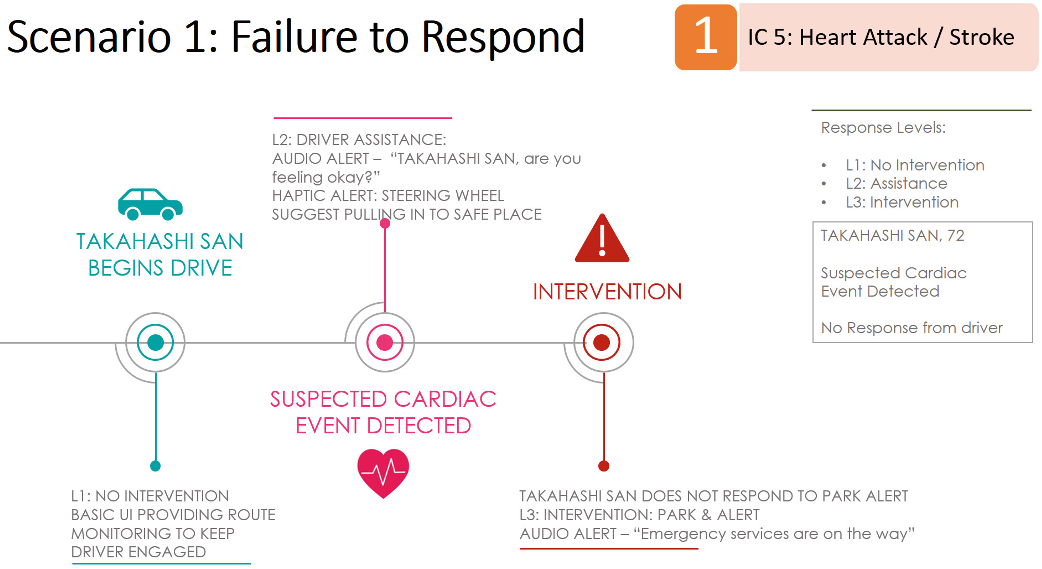
- Adaptive Automation: The system shifts authority only when impaired states are detected, following a tiered response: No Response → Task Support → Safety Critical Intervention.
Experiments: Defining the User
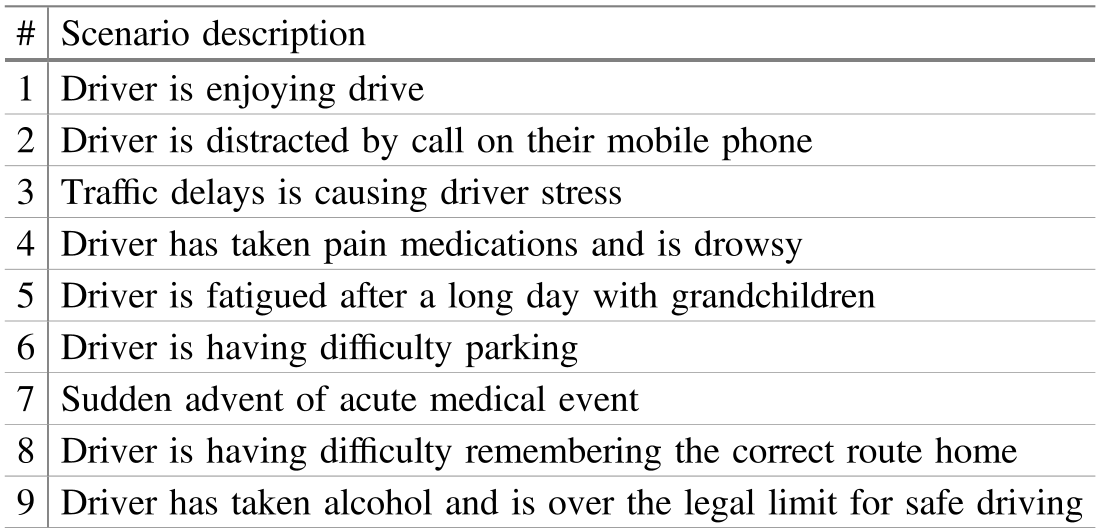
The researchers utilized the TILDA (Longitudinal Study on Ageing) dataset to create 9 user personae. These personae represent a spectrum of health, cognitive ability, and driving habits. By mapping these to 6 Interpretation Challenges, they developed a workflow where the HMI adjusts specifically to the user's sensory profile (e.g., if a driver has hearing loss, the system prioritizes haptics).
Critical Analysis & Conclusion
Takeaway
The shift from "Autonomous Vehicle" to "Augmented Driver" is a significant ethical preference. By focusing on Self-Efficacy, this research caters to the psychological need for independence in the elderly.
Limitations & Future Work
While the conceptual framework is robust, the paper currently relies heavily on qualitative modeling and secondary data. The next critical step—as noted by the authors—is testing in a driving simulator to measure the actual reduction in cognitive load. Furthermore, the transition of control (the "Handover Problem") remains a high-risk area that requires more granular AI logic to ensure the driver knows exactly when the Co-Pilot has taken over.
This work sets a high bar for Ethical HMI, proving that technology's best role isn't always to replace humans, but to empower them.