
Beyond Harmonics: Powering the Next Generation of Fluxgate Sensors via RTD
Effects of Driving Mode and Optimal Material Selection on a Residence Times Difference-Based Fluxgate Magnetometer
This paper presents a Residence Times Difference (RTD) based readout technique for fluxgate magnetometers, diverging from traditional second-harmonic spectral analysis. By characterizing transitions between saturation states in the time domain, the authors achieve high sensitivity (up to 125,000 s/A/m) using significantly lower excitation power and frequency than conventional methods.
TL;DR
This research redefines fluxgate magnetometer readout by moving from the frequency domain to the time domain. By measuring the Residence Times Difference (RTD) of a core's bistable states, the researchers achieved high sensitivity with minimal power consumption, leveraging nonlinear dynamics and optimal material selection like METGLAS 2705A.
Background & Motivation: The Power Barrier
For decades, fluxgate magnetometers have been the gold standard for measuring DC or low-frequency magnetic fields. However, the traditional method—extracting the second harmonic from the frequency spectrum—is power-hungry. It requires "overdriving" the core with high-amplitude signals to get a clean spectral signature.
The authors of this paper identify a missed opportunity in the bistable nature of magnetic cores. Instead of fighting the nonlinearity, they use it as the primary sensing mechanism. By viewing the core as a particle in a "double-well potential," they show that an external magnetic field skews the wells, making the system "stay" longer in one state than the other.
Methodology: The Physics of the Double-Well
The core of the methodology lies in the relationship between the external field () and the residence times ( and ).
1. The Potential Energy Function
The magnetization of the core follows a potential . When we apply a periodic excitation (triangular or sinusoidal), we effectively rock this potential back and forth.
- Symmetric case: Without an external field, the time spent in saturation () and saturation () is identical.
- Asymmetric case: An external DC field shifts the potential, creating a "Residence Times Difference" ().
2. Driving Modes: Triangular vs. Sinusoidal
The paper provides a rigorous mathematical derivation for sensitivity .
- Triangular Driving: Offers constant sensitivity regardless of the target field level, simplifying signal processing.
- Sinusoidal Driving: While more complex, it offers divergent sensitivity (effectively infinite in theory) when the excitation amplitude is tuned exactly to the switching threshold.
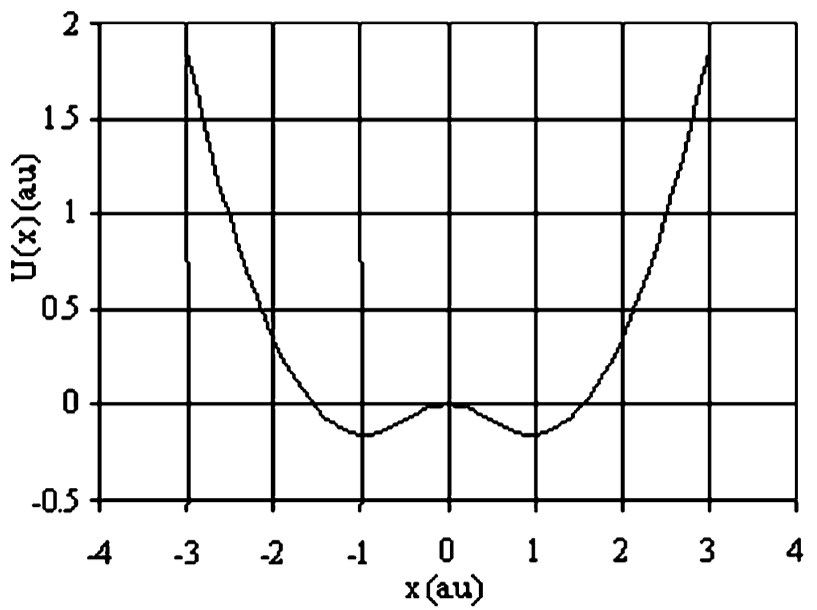 Figure 1: (a) The double-well potential model; (b) How a triangular wave + DC field creates different residence times.
Experiments and Material Insight
The team developed a PCB-based prototype using cobalt-based METGLAS alloys. A critical finding was the Coercive Field () Dependency. In ideal theory, is constant. In reality, as you lower the excitation amplitude to save power, the hysteresis loop becomes less "sharp," which can degrade the RTD measurement.
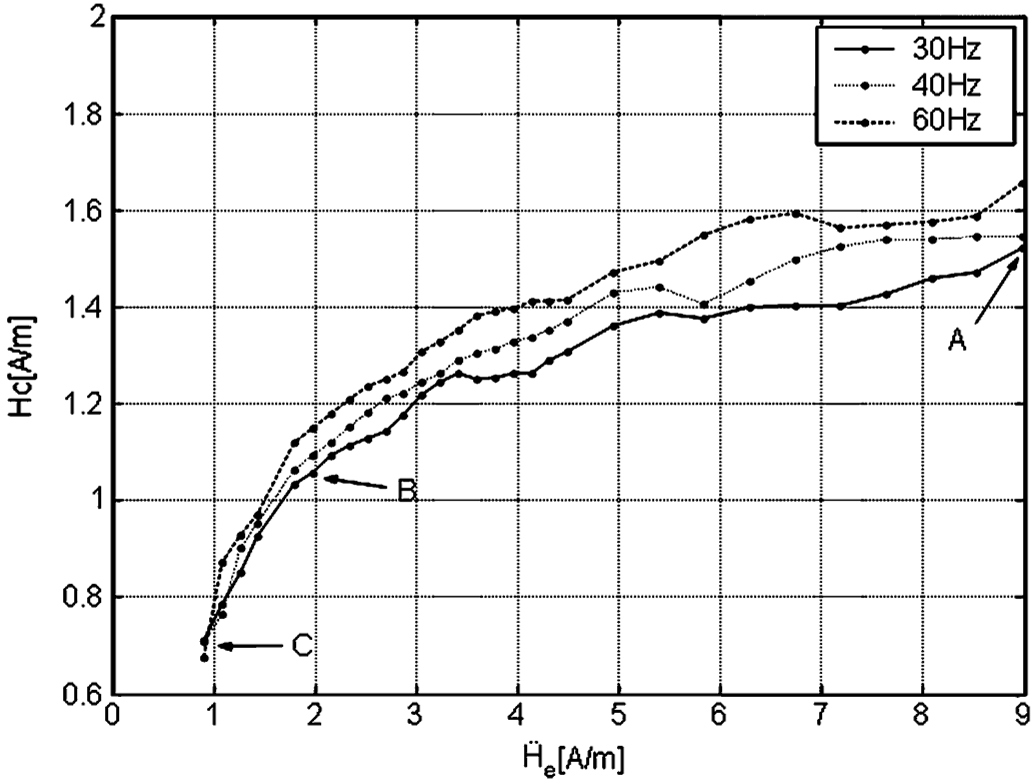 Figure 7: The experimental mapping of how the coercive field changes with bias amplitude—a vital consideration for tuning optimal sensitivity.
Top Performer: METGLAS 2705A
Through a comparative study of different materials, the authors found that 2705A outperformed the standard 2714A. It maintained a sharper hysteresis loop at lower driving amplitudes, allowing the sensor to operate closer to the theoretical sensitivity limit without losing signal integrity.
Results: Breaking Benchmarks
The experimental results validated the analytical models:
- Sensitivity: At 60 Hz, the prototype achieved 4.4 ms/A/m (~125,000 s/T).
- Accuracy: The residuals between the mathematical model and experimental data (shown in the heatmaps) indicate the model is highly robust, only diverging at extremely low "starvation" amplitudes where the core fails to switch states.
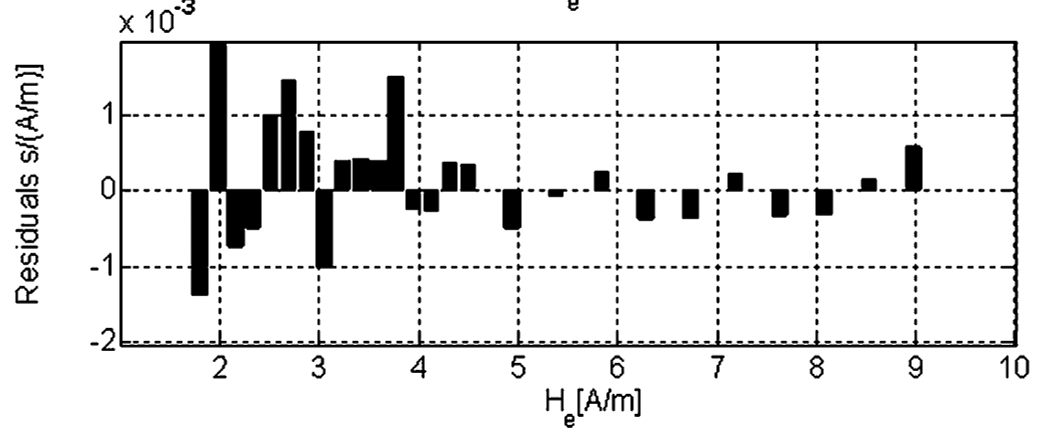 Figure 8: Actual vs. Expected sensitivity for sinusoidal excitation, showing the characteristic "U" shape predicted by the nonlinearity.
Critical Insight & Conclusion
The true value of this work is the democratization of high-precision magnetic sensing. By shifting the complexity from the analog hardware power stage to the digital time-processing stage, the authors have paved the way for sensors that can run for years on a single coin battery.
Limitations: The system is highly sensitive to temperature-induced changes in the core's hysteresis (Curie point effects), and the time-domain readout requires high-resolution clocks to capture nanosecond differences in residence times accurately.
Future Outlook
As we move toward IoT and wearable diagnostics, the RTD-fluxgate principles will likely be applied to miniaturized "Lab-on-a-Chip" magnetic beads detection or low-power navigation systems, where every microwatt counts.