
Bloomberg Media's Elastic Paywall: Maximizing Revenue via Propensity Modeling
15640_Driving Subscriptions Through User Behavior Modeling and Prediction at Bloomberg Media.
Summary
Problem
Method
Results
Takeaways
Abstract
Bloomberg Media developed a data-driven subscription strategy utilizing a Subscription Propensity Model and an Elastic Paywall. The system uses Logistic Regression on clickstream data to predict user conversion likelihood and dynamically adjusts the monthly free article limit for individuals, resulting in a 40% surplus over year-end subscription goals.
## TL;DR
Bloomberg Media moved away from a static "10 free articles" rule to a personalized, machine-learning-driven subscription model. By combining a **Subscription Propensity Model** with an **Elastic Paywall** engine, they achieved a 40% surplus on their subscription goals without cannibalizing advertising revenue.
## The Motivation: Moving Beyond "One-Size-Fits-All"
In 2018, Bloomberg launched its digital paywall with a simple rule: 10 free articles per month for everyone. While initial numbers were strong due to loyalists, conversion rates eventually plateaued. The team identified a fundamental mismatch:
* **Static Friction**: A "hard" paywall for casual readers drove them away (losing Ad revenue).
* **Missed Opportunity**: A "soft" paywall for core readers meant they never felt the "itch" to subscribe.
The goal was to find the "Goldilocks zone" for every user: block enough content to trigger a subscription but not so much that the user stops visiting.
## Methodology: The Two-Pillar Approach
### 1. Subscription Propensity Model
The researchers leveraged user clickstream data—including article interactions, geography, and device metadata—to predict the probability of a user subscribing.
* **The Class Imbalance Challenge**: Only 0.025% of users typically subscribe. A model that predicts "No One Subscribes" would be 99.975% accurate but useless. The team used **AUPRC (Area Under Precision-Recall Curve)** as the primary metric to ensure the model actually identified potential buyers.
* **Model Selection**: Despite testing Neural Networks and Decision Trees, **Logistic Regression** emerged as the production winner for its balance of performance and explainability.
### 2. The Elastic Paywall Engine
Instead of using the propensity score in isolation, Bloomberg integrated it into a dynamic decision engine.

*Note: The system factors in current propensity, engagement trends, and the previous month's paywall height to set a new limit.*
The logic is intuitive: if a user has high propensity but low engagement, we nurture them with more content. If they have high propensity and high engagement, we lower the paywall height to "nudge" them toward payment.
## Experimental Results & Business Impact
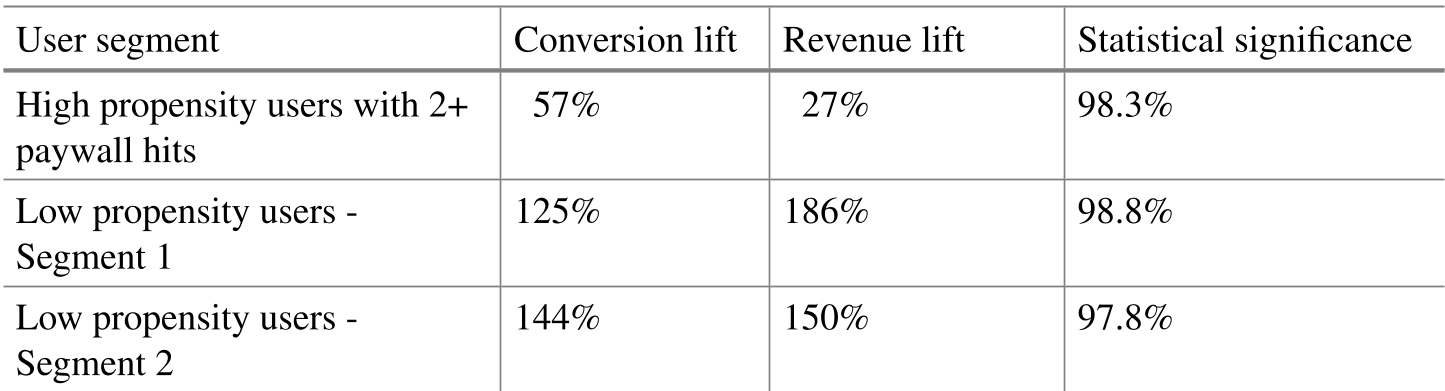
The results from A/B testing were stark, demonstrating that personalized targeting works across the board.
### Performance for High Propensity Users
| Metric | Improvement |
| :--- | :--- |
| **Conversion Lift** | +114% |
| **Revenue Lift** | +25% |
| **Ad Revenue Change**| +2% |
### Performance for Low Propensity Users
Interestingly, even users labeled as "Low Propensity" saw a massive **125% to 144% conversion lift** when targeted with the right introductory offers and paywall heights.
## Critical Insights: The Ad-Subscription Trade-off
The most significant achievement of this study is the **optimization of the revenue trade-off**. Often, news organizations fear that paywalls destroy the Ad business. Bloomberg’s data shows that by using an "elastic" approach:
1. **Stop Rates Increased**: They successfully blocked more sessions.
2. **Ad Revenue Stayed Stable**: In most segments, Ad revenue actually grew (up to 4%) because users who stayed were more deeply engaged.
## Conclusion
Bloomberg Media's approach proves that AI's best use case in digital publishing isn't just content recommendation, but **commercial orchestration**. By treating the paywall as a dynamic variable rather than a business rule, they transformed a "barrier" into a "personalized pathway" to subscription.
**Future Perspective**: The next frontier for this work likely involves real-time "Intra-session" propensity modeling, where the paywall height adjusts not just monthly, but based on a user's behavior within a single browsing session.