
DRL: Synthesizing Realistic Mobility through Distance, Relationships, and Location
DRL: A New Mobility Model in Mobile Social Networks
The paper introduces DRL (Distance, Relationship, Location), a novel mobility model for Mobile Social Networks (MSNs) that integrates social relationships and spatial dynamics. By incorporating the concept of Community Attraction, the model achieves a high degree of realism, effectively matching real-world contact distributions (Infocom/Cambridge traces) and serving as a robust benchmark for evaluating routing protocols like MaxProp and Prophet.
TL;DR
Current Mobile Social Network (MSN) research struggles with a fundamental gap: synthetic mobility models often feel "robotic." DRL (Distance, Relationship, Location) bridges this gap by introducing a multi-dimensional attraction formula. By combining who you know, where you are, and the time-dependent utility of a destination, DRL creates a movement pattern that is statistically indistinguishable from real-world human traces.
Problem & Motivation: Beyond Random Waypoint
In the world of opportunistic networks, the "how nodes move" determines "how protocols perform." Prior works like Random Waypoint are too chaotic, while existing social models often ignore the extrinsic value of locations.
The authors identify a key insight: human movement is not just about proximity or friendship—it's about the context of the destination. You don't just go to a restaurant because it's close or because your friend is there; you go because it's lunchtime. This temporal "Location Attraction" was the missing piece in the MSN modeling puzzle.
Methodology: The Trinity of Community Attraction
The core of DRL lies in its Community Attraction formula, , which determines the next target for a node:
1. The Social Relationship Matrix (M)
Instead of arbitrary groups, the model initializes relationships using Social Relationship Attributes (e.g., profession, nationality). If two nodes share enough attributes, they are marked as friends ().
2. The Location Attraction Matrix (P)
This is a time-varying matrix. The "Location Attraction" of an office peaks during 9-5, while restaurants peak at mid-day. This simulates the regularity of human activity more accurately than static weights.
 Figure: The Community Attraction formula balancing distance, social ties, and location utility.
Experiments: Validating with Reality
The authors didn't just build a model; they stress-tested it against the "Gold Standards" of mobility data: Infocom 05, Infocom 06, and Cambridge traces.
Protocol Performance
Using THE ONE simulator, they loaded routing protocols including MaxProp, Prophet, and Spray and Wait. The results showed that MaxProp performed best in terms of Packet Delivery Rate and Overhead, confirming that DRL provides a realistic environment for protocol differentiation.
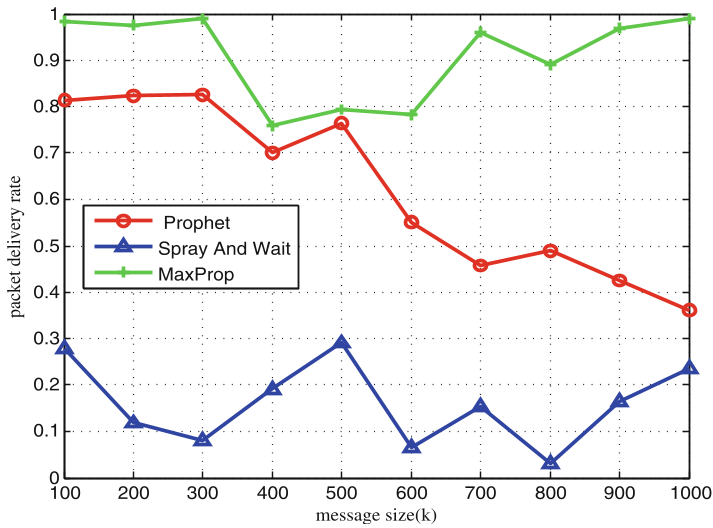 Figure: Packet delivery rate comparison under the DRL mobility model.
Statistical Fit
The most impressive result is the "Power Law" fit. Real-world human movement is characterized by many short contacts and few long ones. DRL's output curves for contact-duration perfectly mirror the Infocom 05 data, proving that the selection rule successfully captures the "Small World in Motion" phenomenon.
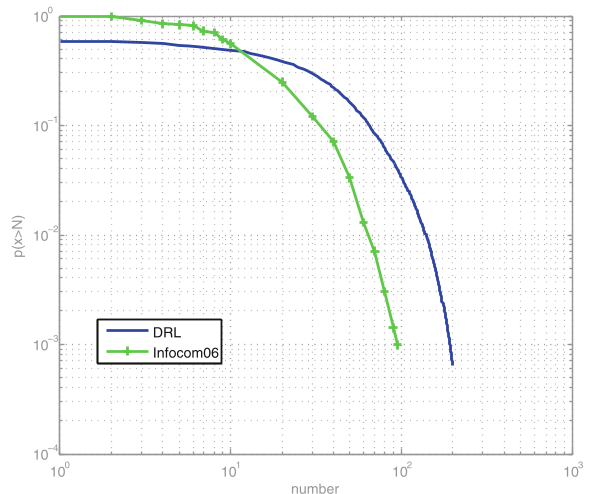 Figure: DRL vs Infocom 05: The high degree of overlap confirms the model's realism.
Critical Analysis & Conclusion
Takeaway: DRL proves that mobility is a product of social hierarchy and geographical utility. By making "Location Attraction" time-variant, the authors have movedsynthetic modeling closer to a "Digital Twin" of human society.
Limitations: While the model uses social attributes for initialization, it doesn't currently account for dynamic relationship changes (e.g., strangers becoming friends after multiple encounters).
Future Outlook: As we move toward 6G and ubiquitous computing, models like DRL will be essential for simulating how "Human-in-the-loop" systems will behave in hyper-dense urban environments.