
DRL-Scheduling: Orchestrating the Cloud with Deep Reinforcement Learning
DRL-Scheduling: An Intelligent QoS-Aware Job Scheduling Framework for Applications in Clouds
2018-01-01
Summary
Problem
Method
Results
Takeaways
Abstract
This paper introduces DRL-Scheduling, an intelligent QoS-aware job scheduling framework for cloud applications using Deep Q-Learning. By treating scheduling as a continuous decision-making process, the model learns to map heterogeneous jobs to specific Virtual Machine (VM) types, achieving a 40.4% reduction in average response time compared to the best baselines on real-world NASA workloads.
## Executive Summary
**TL;DR**: Managing cloud resources is no longer just about allocation; it’s about intelligent, real-time decision-making. Researchers from Shandong University have developed **DRL-Scheduling**, a framework that uses Deep Q-Learning to solve the online job scheduling problem. By moving away from rigid heuristics to an experience-led learning agent, they achieved a **40.4% reduction in response time** on real-world traces.
**Background**: This work shifts job scheduling from a "static optimization" problem to a "dynamic control" problem, positioning itself as a SOTA solution for transactional cloud workloads where job arrival patterns are highly unpredictable.
## The Motivation: Why Heuristics Fail in the Modern Cloud
Traditional scheduling algorithms, such as Round-Robin or even "Earliest Idle," operate under an implicit assumption: that the environment is relatively stable or that the cost of execution is uniform. However, modern clouds are anything but uniform:
1. **Heterogeneity**: A high-CPU VM executes a compute-intensive task much faster than a standard instance.
2. **Performance Fluctuation**: Resource contention and network jitter mean that "1000 MIPS" is an average, not a guarantee.
3. **Dynamic Workloads**: E-commerce or social media traffic spikes unpredictably, rendering static rules obsolete.
The authors argue that a scheduler must be "intelligent" and "QoS-aware"—meaning it should learn the nuances of the hardware and the nature of the jobs simultaneously.
## Methodology: The Core Architecture
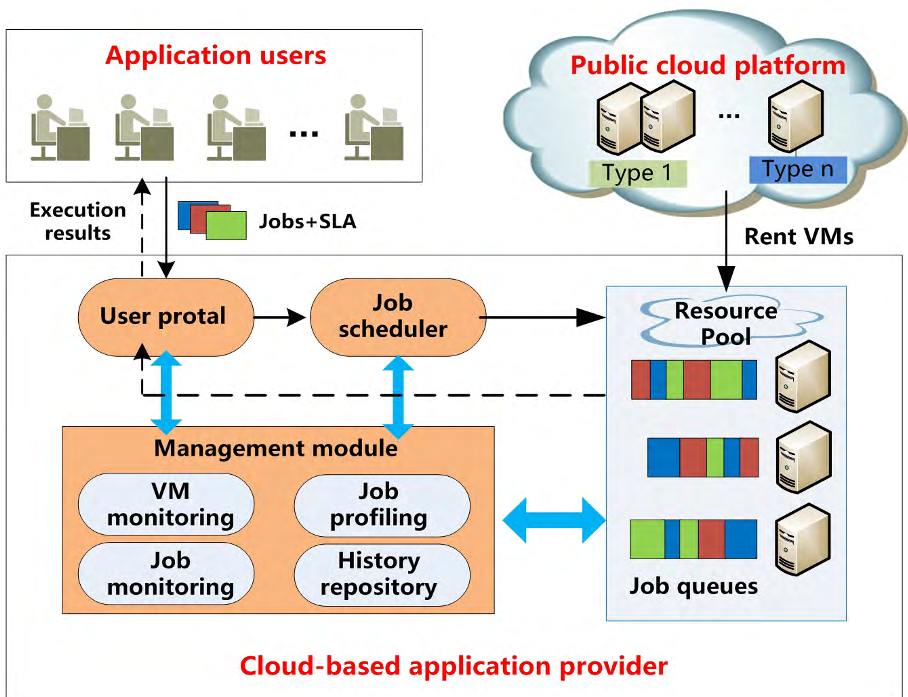
The framework leverages **Deep Q-Networks (DQN)** to handle the massive state space of cloud environments. Instead of a simple table, a Deep Neural Network (DNN) approximates the value (Q-value) of assigning a specific job to a specific VM.
### Key Components:
- **Experience Replay**: To break the correlation between consecutive scheduling events, transitions are stored in a buffer and sampled randomly.
- **Fixed Q-Targets**: A separate "Target Network" is used to provide stable learning targets, preventing the model from chasing its own tail during updates.
- **State Representation**: The agent looks at `[Job Type, Job Size, QoS Requirement, Wait Times on all VMs]`. This provides the necessary context to understand not just "who is free," but "who is best suited."
## Experimental Insights & Results
The researchers tested DRL-Scheduling against five baselines (Random, Round-Robin, Earliest, Best-Fit, and Sensible).
### Proving Adaptability
In **Stable Workload** tests, the DRL agent matched or beat the "Best-Fit" strategy, which is specifically designed to match job types to VM types. However, the real victory came in **Changing Workload** scenarios. When job arrival patterns shifted from stable to "unpredicted" or "on-and-off," the DRL agent maintained a job success rate above **93%**, while baselines like Round-Robin plummeted to 60%.

### Real-World Validation: NASA Traces
Using the NASA Kennedy Space Center trace, which contains over 1 million HTTP requests, the DRL-Scheduling approach demonstrated its efficiency:
- **Response Time**: 158ms (vs. 265ms for the best baseline, Best-Fit).
- **Success Rate**: 98.3%.
## Critical Analysis & Future Outlook
**The Takeaway**: DRL-Scheduling proves that online learning is viable for infrastructure management. By treating the scheduler as an agent that "feels" the pressure of the queues and the urgency of the QoS, we achieve a much more resilient system.
**Limitations**:
- **Cold Start**: The model requires a "training period" (around 30-50 seconds in simulations) where it performs poorly before finding the optimal policy.
- **Fixed Action Space**: The current model assumes a fixed set of VMs. In a true "serverless" or "auto-scaling" environment, the action space itself would be dynamic.
**Future Research**: Integrating this with **Admission Control** (knowing when to reject jobs) and **Elastic Provisioning** (renting more VMs on the fly) would create the ultimate autonomous cloud controller.