
DroidOppPathFinder: Scaling Fitness Recommendations via Opportunistic Social Sensing
DroidOppPathFinder: A context and social-aware path recommender system based on opportunistic sensing
DroidOppPathFinder is a Mobile Social Network (MSN) application designed for fitness path recommendation. It utilizes the CAMEO middleware to integrate opportunistic sensing and multi-dimensional context data (pollution, noise, weather) from local sensors and peer-to-peer data exchange.
TL;DR
DroidOppPathFinder is an innovative path-recommender system that breaks away from centralized data silos. By leveraging the CAMEO middleware and a lightweight Sensor Mobile Enablement (SME) standard, it allows smartphones to exchange environmental data (noise, pollution, weather) directly via opportunistic communications. This creates a decentralized knowledge base where users collaboratively rank fitness paths based on real-time, peer-shared context.
Background & Motivation: Beyond Centralized Sensing
In the traditional paradigm of Participatory Sensing, users manually upload data to a central server. This approach suffers from two major flaws:
- Connectivity Dependence: If a user is in a dead zone or lacks data, the system fails.
- Context Fragmentation: A single device can only sense what is immediately around it; it has no "awareness" of the broader city environment without talking to a global server.
The authors argue that the proliferation of mobile sensors (GPS, microphones) and the rise of Mobile Social Networks (MSN) provide an opportunity to treat users as "human mobile sensors." The goal is to move from simple data collection to Opportunistic Computing, where devices share resources and context autonomously as they pass one another in physical space.
Methodology: The CAMEO Architecture and SME Standard
The breakthrough of DroidOppPathFinder lies in its underlying plumbing. It sits atop the CAMEO (Context-Aware MiddlEware for Opportunistic networks) framework.
1. Lightweight Interoperability (SME)
Existing OGC (Open Geospatial Consortium) standards for sensor webs are too heavy for mobile battery life and processing power. The authors introduced SME (Sensor Mobile Enablement), which translates complex sensor metadata into a mobile-friendly format while maintaining compatibility with legacy SWE (Sensor Web Enablement) servers.
2. Weighted Context-Aware Ranking
The path recommendation isn't just a simple distance calculation. It uses a multi-dimensional analysis:
- Environmental Context: Pollution levels, noise (sensed via microphone), and weather.
- Social Context: User comments, subjective difficulty levels, and ratings.
- Mechanism: A weighted sum normalized between 0 and 1, where users can prioritize their preferences (e.g., "I want the quietest path, regardless of pollution").
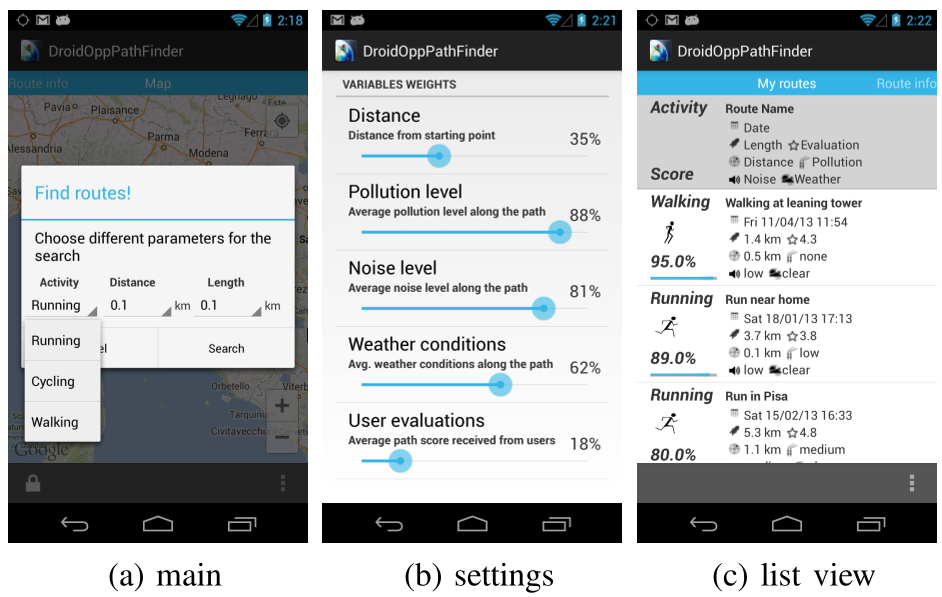 Figure 1: The user interface allows for granular control over path parameters and real-time visualization of environmental layers.
The "Opportunistic" Edge: A Use Case
The power of the system is best illustrated by its node interaction logic. Imagine three nodes (A, B, and C):
- Node A has recently hit a Wi-Fi hotspot and downloaded the latest pollution data.
- Node B has stayed offline but has recorded several new jogging paths.
- Node C has an external noise sensor attached via Bluetooth.
When these users encounter each other in a park, CAMEO automatically synchronizes their databases. Node B now knows about the pollution (from A) and the noise (from C), allowing it to provide a "Context-Aware" recommendation to its user without ever hitting the cellular network themselves.
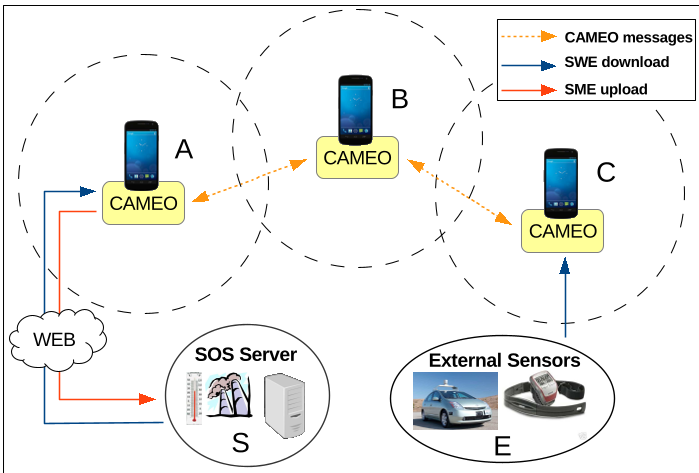 Figure 2: The opportunistic exchange mechanism allows data to propagate through the network via physical proximity.
Critical Analysis & Conclusion
Takeaway
DroidOppPathFinder succeeds in demonstrating that Opportunistic Sensing is a viable additional support for MSN applications. It solves the interoperability issue between heterogeneous mobile sensors and centralized web services, enabling a hybrid model of data collection.
Limitations
- Incentive Models: The paper assumes users are willing to share data. In real-world deployment, "free-rider" problems (users who consume data but don't sense) could limit network efficiency.
- Battery Overhead: While the SME standard is lightweight, constant Bluetooth/Wi-Fi Direct scanning for peer discovery remains a significant power drain.
Future Outlook
As we move toward 6G and Edge Computing, the principles of CAMEO—local processing and opportunistic data exchange—will likely become foundational. Future iterations could integrate Federated Learning to analyze these local sensor patterns without compromising user privacy, making fitness apps not just social, but truly "intelligent" at the edge.