
DroneNet-Sim: Bridging the Gap Between Simulation and Reality in Aerial Video Analytics
DroneNet-Sim: a learning-based trace simulation framework for control networking in drone video analytics
This paper introduces DroneNet-Sim, a learning-based trace simulation framework designed to optimize network protocol and video property selection for drone video analytics. By integrating real-world flight traces with the NS-3 network simulator and machine learning models, the framework achieves high-fidelity video quality prediction (PSNR) and performance matching across diverse UAV mobility scenarios.
TL;DR
DroneNet-Sim is a novel framework that combines NS-3 network simulation with machine learning to solve the unpredictability of drone-to-ground video streaming. By learning from real-world flight traces, it intelligently selects the best network protocols (like QUIC) and video settings to ensure high-quality analytics even in volatile wireless environments.
The "Reality Gap" in Drone Networking
Developing robust networking for Unmanned Aerial Vehicles (UAVs) is a logistical nightmare. Researchers face a "triple threat":
- Regulatory Hurdles: Flight restrictions make large-scale swarm tests nearly impossible.
- Resource Constraints: Limited battery life truncates experimentation time.
- Dynamic Environments: Traditional simulators often fail to model the complex relationship between a drone's physical movement (mobility) and its data link performance.
Prior works often simulated drone flight and network traffic in isolation. However, in video analytics, the choice of a transport protocol (e.g., the low-latency QUIC vs. traditional TCP) and video resolution is deeply coupled with the drone's trajectory and the edge-network's status.
Methodology: The DroneNet-Sim Architecture
DroneNet-Sim moves beyond static simulation by introducing a three-pillar approach: Data, Analysis, and Learning.
1. Synergistic Integration
The framework feeds real-world traces (GPS, height, speed) into the NS-3 simulator. This allows researchers to test how different protocols like HTTP/3 (QUIC) or RTP/UDP handle specific flight patterns without leaving the lab.
2. ML-Driven Decision Making
The core innovation is the use of supervised learning to predict the "optimal scheme." The researchers trained models on a database of 400 real-world traces, categorizing performance into "High," "Medium," and "Low" quality cases.
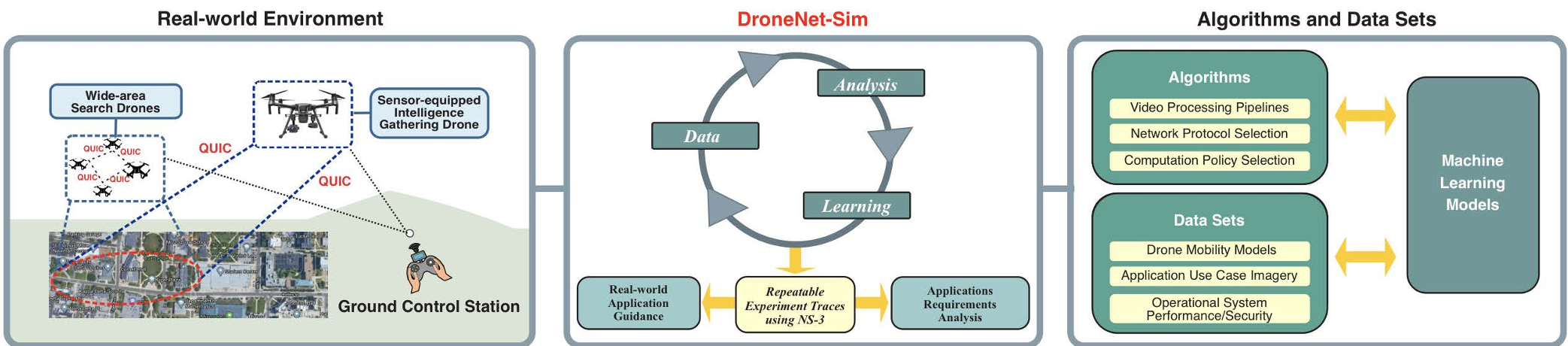 Figure 1: The DroneNet-Sim workflow integrating flight trace generation with ML-based protocol prediction.
Experiments and Key Findings
Protocol Showdown: TCP vs. QUIC
One of the major highlights is the comparative analysis of transport protocols. Using the integrated NS-3 scripting, the authors demonstrated that QUIC consistently offers better Round-Trip Time (RTT) performance in real-world scenarios compared to TCP, which is crucial for low-latency video analytics.
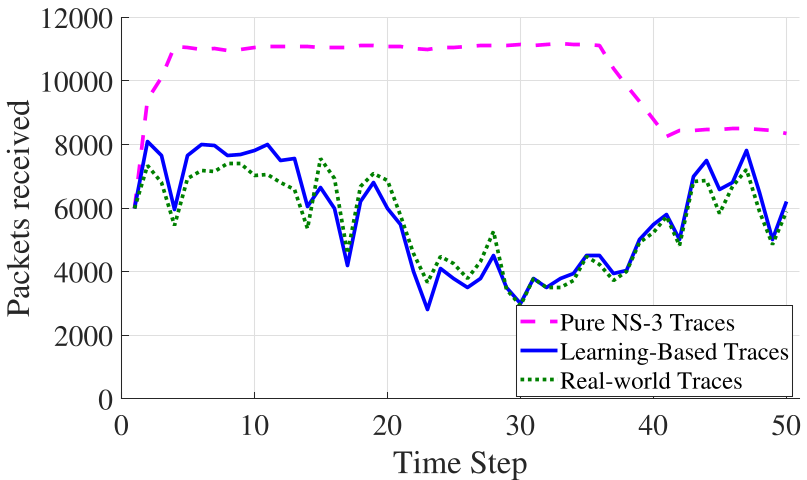 Figure 2: CDF of RTT for TCP and QUIC. The results show that simulation (NS-3) can closely mimic, yet distinguish, protocol performance thresholds.
The Power of Supervised Learning
The study compared several models, including Kernel-Ridge Regression (KRR) and Random Forest Regression (RFR).
- Accuracy: RFR achieved the highest accuracy for protocol selection (>91%).
- Stability: KRR provided the most stable video quality (PSNR) range, suggesting that while RFR is better at guessing the protocol, KRR might be better at ensuring a consistent user experience.
Performance Benchmark
When compared to traditional "Policy-based" estimates (which rely on simple static rules), DroneNet-Sim's learning-based approach showed a massive leap:
- Protocol Prediction Accuracy: Increased from ~46% to 96%.
- Video Quality (PSNR): Improved from ~30 dB to 46 dB, indicating a significant reduction in frame blurring and distortion.
Critical Insight & Conclusion
DroneNet-Sim successfully demonstrates that traces are the key to realism. By "learning" the nuances of how physical movement impacts wireless signal strength, the framework allows for a "Digital Twin" approach to drone networking.
Limitations: Currently, the framework relies heavily on supervised learning from historical data. Future iterations would benefit from Reinforcement Learning (RL), allowing the drones to adapt their transmission strategies in real-time as they encounter unexpected interference or signal drops.
Takeaway: For researchers in smart agriculture or border security, DroneNet-Sim provides a verified playground to optimize their video pipelines before ever hitting the "Takeoff" button.