
DropWat: Achieving Traceback Invisibility by Mimicking Network Chaos
DropWat: An Invisible Network Flow Watermark for Data Exfiltration Traceback
This paper introduces DropWat, an active network flow watermarking technique designed for tracing data exfiltration attacks back to their staging servers. By mimicking natural network congestion through pseudo-random packet drops based on a modified Gilbert model, DropWat embeds an invisible signature that remains detectable even after traversing multiple stepping stones or the Tor network.
TL;DR
Researchers have developed DropWat, the first network flow watermark that is statistically indistinguishable from natural network congestion. By strategically dropping packets to trigger TCP retransmissions, it creates a hidden "timing signature" that allows investigators to trace cyber-attackers across proxy chains and Tor, maintaining over 95% accuracy in high-speed data exfiltration scenarios.
Background: The Traceback Paradox
In Advanced Persistent Threats (APTs), the final stage is Data Exfiltration. Attackers hide their destination (the staging server) using "Stepping Stones" (proxies) or anonymous networks like Tor. Investigators use watermarking—injecting a signal into the traffic—to recognize it at the other end.
The paradox? If you make the watermark strong enough to survive network noise, it becomes visible to the attacker, who can then drop the connection or change routes. If you make it subtle, it gets lost in the "jitter" of the Internet.
The Core Insight: Exploiting TCP’s Reaction
The authors of DropWat realized that we don't need to manually delay packets (which looks suspicious). Instead, they drop them.
- When a packet is dropped, the TCP protocol at the receiver (the Proxy or Staging Server) notices a gap.
- It sends duplicated ACKs, forcing the sender to retransmit.
- This retransmission creates a massive Inter-Packet Delay (IPD) at the destination.
Because packet loss is a "natural" part of the Internet, an attacker observing the stream cannot tell if a packet was dropped by a faulty router or by a DropWat watermarker.

Methodology: The Art of Failing Naturally
To be truly invisible, the drops cannot be random. DropWat uses a Modified Extended Gilbert Model. This model specifically mimics a "bottleneck node"—a router with a full buffer. By following this probabilistic model, the sequence of "drops" passes the Kolmogorov-Smirnov (KS) test, a statistical measure used to see if two distributions are the same.
The Workflow:
- Embedding: A secret key and a timestamp generate a pseudo-random "dropping sequence." Only the investigator knows which packets will be dropped.
- Detection: At the exit point (near the suspected staging server), the detector looks for spikes in IPDs that correlate with the pre-calculated dropping intervals.
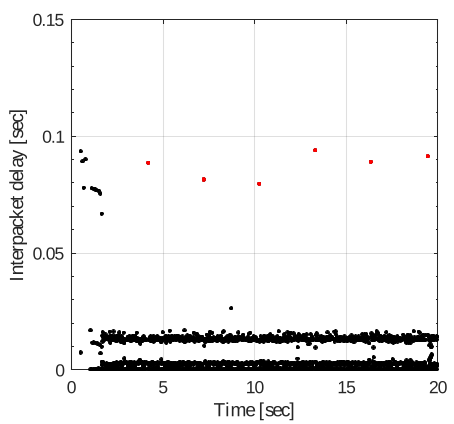
Experimental Results: Performance in the Wild
DropWat was tested across 14 AWS geographic regions and the live Tor network.
- High Speed: Unlike previous methods limited to low-rate traffic, DropWat excels at 2.2 MB/s, typical for large file thefts.
- Tor Robustness: Even with Tor's extreme jitter and delay, DropWat achieved 95% detection accuracy.
- Invisibility: Statistical analysis showed a KS distance of less than 0.0009, meaning the watermark is 99% likely to be mistaken for natural noise.
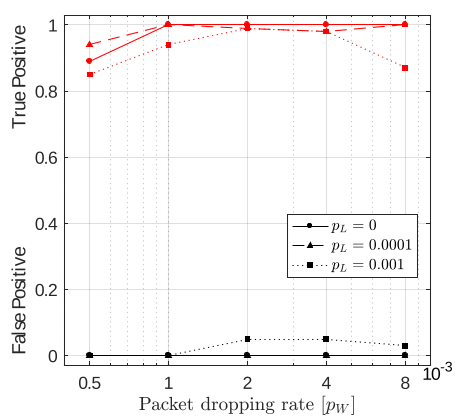
Critical Analysis & Takeaways
DropWat represents a significant "level up" in the cat-and-mouse game of network forensics. Its strength lies in its Inductive Bias: it assumes the network is already noisy and uses that noise as a camouflage.
Limitations:
- Short Flows: It requires a minimum number of packets (approx. to ) to confirm a watermark, making it less effective against tiny "heartbeat" signals.
- Protocol Specificity: It relies heavily on TCP's retransmission logic. An attacker using a custom, non-standard transport protocol that handles loss differently might evade detection.
Future Outlook: The "Mimicry-based Watermarking" established here could likely be extended to other features, such as packet size or protocol-specific flags, potentially leading to a suite of attribution tools that are impossible for attackers to detect.