
Beyond Co-occurrence: Mining Drug-Drug Interactions from Heterogeneous Social Networks
Drug-Drug Interactions Detection from Online Heterogeneous Healthcare Networks
This paper introduces a novel framework for detecting Drug-Drug Interactions (DDIs) by mining Heterogeneous Healthcare Networks (HHN) constructed from social media data (MedHelp). It utilizes meta-path based topological features and logistic regression to outperform traditional homogeneous network models in signal detection.
TL;DR
This study moves beyond simple keyword matching to detect Drug-Drug Interactions (DDIs). By modeling online health community data as a Heterogeneous Healthcare Network (HHN), the researchers used complex relationship paths (e.g., two drugs linked by a shared side effect or user) to predict interactions with 91% accuracy, significantly outperforming traditional network models.
Background: The Limits of Official Reporting
Pharmacovigilance is traditionally a "passive" field. The FDA’s Adverse Event Reporting System (FAERS) relies on voluntary reports that represent only a fraction of actual incidents. Clinical trials, while rigorous, are often too small and short-lived to catch rare drug-drug interactions.
The author's insight is simple but powerful: Health 2.0. Millions of patients discuss their symptoms, medications, and side effects on platforms like MedHelp. This "consumer-contributed content" is timely, public, and reflects real-world drug usage.
Methodology: The Architecture of Healthcare Knowledge
Unlike a standard social network where nodes are just "users," this study constructs a Heterogeneous Network.
1. Network Nodes & Schema
The network consists of four distinct entity types:
- R (Drug): Extracted via FDA and DrugBank lexicons.
- A (ADR): Adverse reactions mapped through Consumer Health Vocabulary (CHV).
- D (Disease): Clinical conditions mentioned by users.
- U (User): The individuals participating in threads.
2. Meta-Path Engineering
The core innovation lies in Meta-Paths. Instead of just looking if Drug A and Drug B appear together (a homogeneous link), the model looks for specific "motifs":
- R–A–R: Two drugs associated with the same Side Effect.
- R–D–R: Two drugs associated with the same Disease.
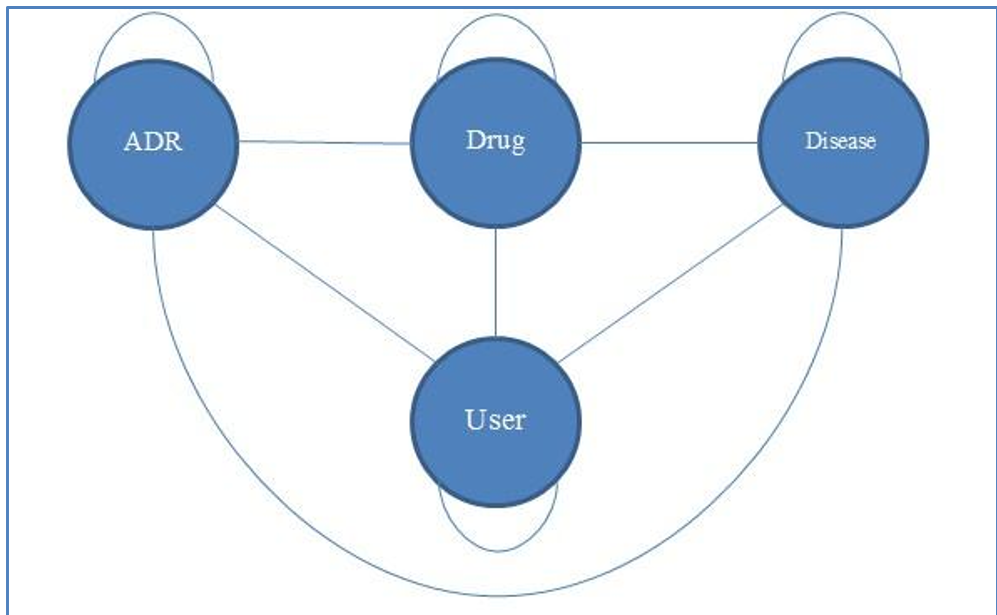
The researchers quantified 16 such symmetric paths (lengths 1 to 4) as features for a Logistic Regression classifier.
Experimental Insights: What Predicts an Interaction?
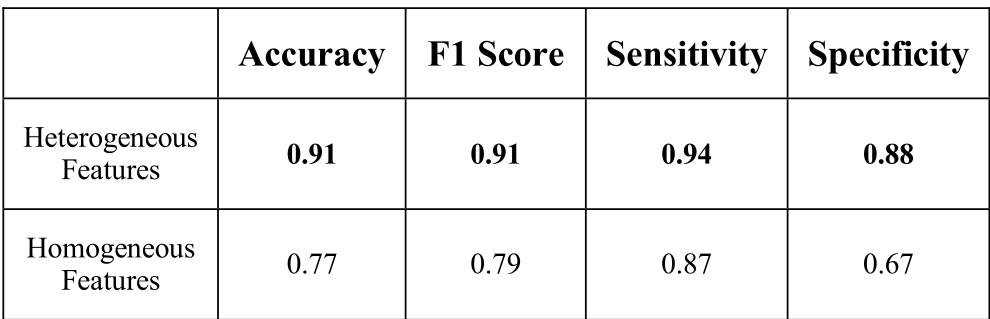
The study compared the Heterogeneous model against a Homogeneous model (which only looks at drug-to-drug paths).
Key Results
- Performance: The heterogeneous approach reached a 91% accuracy in training, vastly superior to the 77% achieved by the homogeneous baseline.
- Predictive Power: The path R-A-R (shared ADR) was found to be 7.31 times more predictive than the simple R-R (direct co-occurrence) path.
The "Biological Logic" of Features
The model discovered that:
- Positive Indicators: If two drugs are linked to the same ADR (R-A-R) or multiple different diseases (R-D-D-D-R), an interaction is highly likely. This aligns with physiological intuition: shared metabolic pathways often lead to shared side effects.
- Negative Indicators: If two drugs are used to treat the same disease (R-D-R), they are less likely to interact. This suggests that drugs in the same therapeutic class are often designed to be compatible or are used as alternatives rather than combinations.
Critical Analysis & Future Outlook
While the results are promising, the study faces a few limitations:
- Slight Performance Drop on Test Set: The accuracy dropped when moving from training to testing. This suggests that Logistic Regression might be struggling with the high-dimensional complexity of meta-paths, potentially requiring more robust models like Random Forests or Graph Convolutional Networks (GCNs).
- Data Sparsity: The DDI signal in social media is "noisy." Determining whether a user co-mention implies a true causal interaction remains a challenge for NLP.
Conclusion: This work proves that the structure of patient conversations is just as important as the content. By mapping the "topological signature" of how drugs, diseases, and side effects co-evolve in digital spaces, we can build early-warning systems for drug safety that are far more responsive than traditional pipelines.