
DS4: Bridging the Gap Between Social Ties and Semantic Discovery in P2P Networks
DS 4 : Introducing Semantic Friendship in Distributed Social Networks
This paper introduces DS4 (Distributed Social and Semantic Search System), a decentralized social networking architecture that integrates social friendships with a novel concept of Semantic Friendship. By leveraging Semantic Overlay Networks (SONs), DS4 achieves high-recall content retrieval (up to 80%) across peer-to-peer nodes without relying on a centralized authority.
TL;DR
DS4 is a distributed social network that solves the "lost content" problem in decentralized systems. By introducing Semantic Friendship—automatically connecting users with similar interests—it achieves an 80% recall rate in content retrieval, far surpassing the 10% recall typical of networks that only search through social friends, all while keeping user data private and local.
Problem & Motivation: The "Friendship Paradox" in Data Retrieval
Centralized platforms like Facebook or LinkedIn offer seamless search but at the cost of data sovereignty and privacy. However, moving to a P2P model usually breaks the search experience.
The authors identify a core "pain point": in a distributed setting, your real-life friends (social ties) rarely have a 100% overlap with your information needs. If you only search through friends, you miss the vast majority of relevant data. Traditional DHT (Distributed Hash Table) solutions fix this by forcing data to specific locations, but they destroy node autonomy—the right of a user to control their own data on their own machine.
Methodology: The Power of Semantic Friendship
The core innovation of DS4 is the FISI+g protocol, which builds a hybrid overlay.
- Interest Identification: Instead of manual tagging, DS4 uses clustering (like K-means) on a user's local files to create a "Centroid Vector" representing their interests.
- Dual-Routing Tables:
- FI (Friend Index): Standard social links.
- SI (Semantic Index): Links to "Semantic Friends" (strangers with similar interests).
- The "Fireworks" Technique: When a query is issued, it doesn't just flood the network. It "explodes" into clusters of high semantic similarity, ensuring high recall with minimal messages.
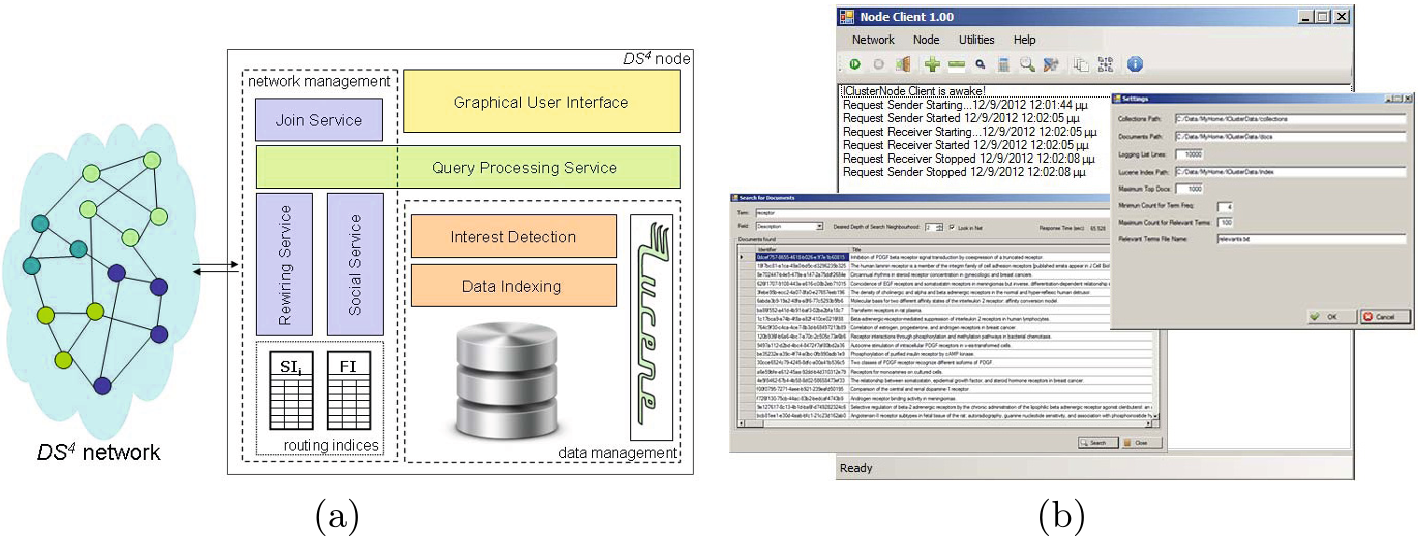 Figure 1: High-level architectural view of a DS4 node, showing the interplay between social and semantic services.
Experiments & Results: Efficiency through Self-Organization
The researchers tested DS4 using a massive crawl of the Delicious bookmarking site.
Recall Transformation
The results are stark:
- FI (Social Only): ~10% Recall.
- FI+i (Informed Social): ~30% Recall.
- FISI+g (Social + Semantic Grouping): ~80% Recall.
Message Efficiency
A common criticism of P2P is "message storms." DS4 proves that as the system ages, it becomes more efficient. Once nodes find their "semantic tribes," the background traffic required to maintain the network drops by over 55%.
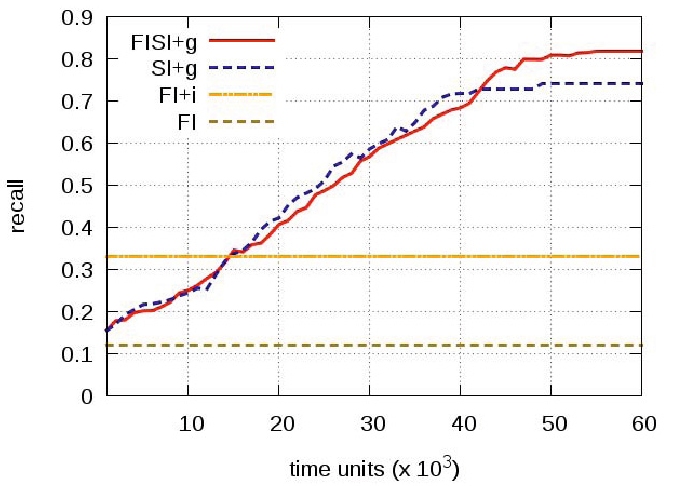 Figure 2: Performance metrics showing how Recall improves over time as the semantic grouping service matures.
Critical Analysis & Conclusion
Takeaway
DS4 effectively argues that for a decentralized social network to survive, it must treat content similarity as a first-class citizen alongside social identity. The "Semantic Friendship" acts as a recommendation engine that powers the search infrastructure.
Limitations
While DS4 handles retrieval brilliantly, it assumes nodes are relatively honest. In a truly open P2P environment, Sybil attacks or "semantic poisoning" (nodes lying about their interests to attract traffic) remain unaddressed.
Future Outlook
The next frontier for DS4 is likely the integration of Federated Learning. If nodes can understand semantic similarity without revealing the raw content of their vectors, the privacy guarantees would be ironclad, making it a "Search Engine" that knows what you like without ever seeing your data.