
DS4: Redefining Search through Decentralized Social and Semantic Synergy
DS4: A Distributed Social and Semantic Search System?
DS4 is a fully decentralized Distributed Social and Semantic Search System built on a Peer-to-Peer (P2P) architecture. It utilizes a novel rewiring protocol to organize nodes into Semantic Overlay Networks (SONs), enabling sub-linear content discovery through a dual-faceted routing approach that addresses both social friends and semantically similar thematic clusters.
TL;DR
DS4 (Distributed Social and Semantic Search System) is a radical departure from centralized platforms like Facebook or X. It proposes a Peer-to-Peer (P2P) architecture where users retain full ownership of their data. By mimicking human social dynamics and thematic interests, DS4 automatically clusters nodes into semantic neighborhoods, allowing "queries to explode" only where they are most likely to find answers.
Background Positioning
In the landscape of social networking, we are currently at a crossroads between convenience and privacy. Centralized servers are the "industry standard," but they present single points of failure and data exploitation risks. DS4 positions itself as a successor to Distributed Hash Table (DHT) models, moving away from rigid addressing toward a fluid, self-organizing Semantic Overlay Network (SON).
The Core Problem: The Privacy-Scalability Paradox
Centralized systems offer great search capabilities but at the cost of user autonomy. Conversely, early P2P networks struggled with content discovery—finding a needle in a haystack of millions of disconnected users is computationally expensive and slow. DS4 argues that the missing link is "Semantic Friendship": the idea that you should be connected not just to people you know (Social), but to people you relate to (Semantic).
Methodology: How DS4 Thinks
The brilliance of DS4 lies in its two-layer routing and its autonomous maintenance.
1. Automatic Interest Discovery
Each node uses a clustering algorithm on its local documents to define its "interests." This happens locally—no data ever leaves the user's machine unless explicitly requested.
2. The Rewiring Protocol (The "Brain")
Nodes don't stay static. They periodically execute a rewiring service that:
- Measures Cohesion: Is my neighborhood still relevant to my interests?
- Refines Connections: If similarity drops, the node "scouts" the network (using Social and Semantic links) to find better peers.
- Maintains Small-World Properties: It keeps "long-range links" to ensure the network doesn't become a set of isolated islands.
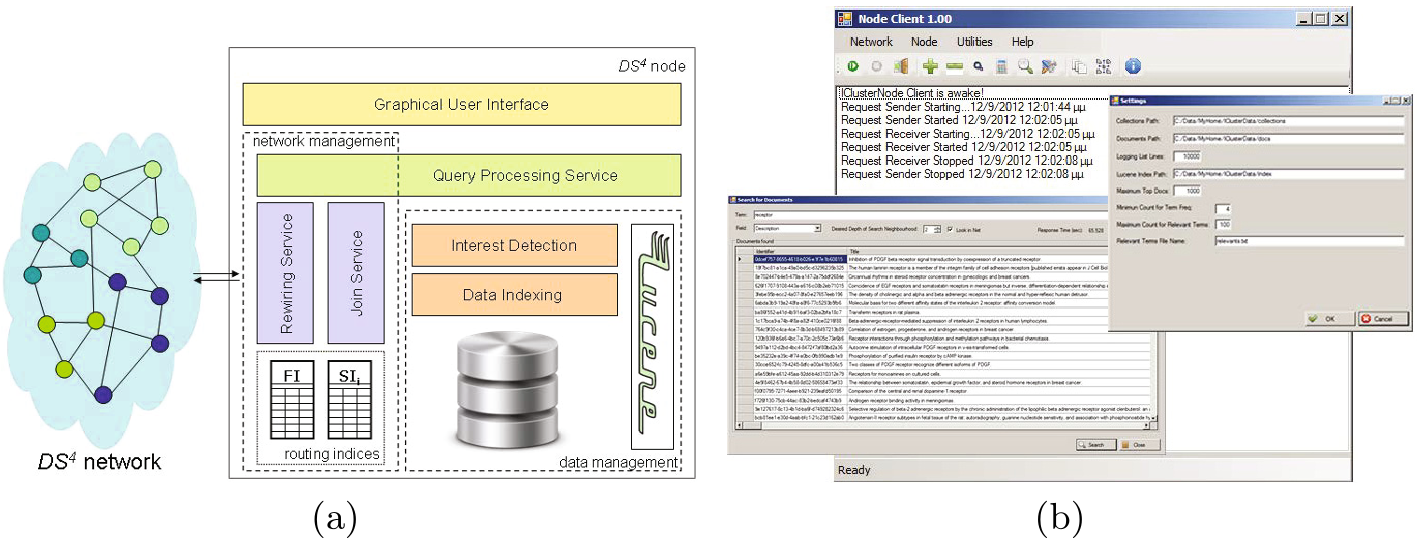 Figure 1: High-level view of a DS4 node architecture and its implementation GUI.
3. Query Processing: The "Fireworks" Technique
When you search for something, DS4 doesn't flood the whole network.
- Narrow Search: It sends the query to a few friends.
- Query Explosion: Once the query hits a node that is actually interested in the topic, the query "explodes," broadcasting to that entire specialized cluster. This maximizes the Hit-Rate while minimizing network traffic.
Critical Analysis & Experiments
The prototype, built using C# and Lucene, focuses on:
- Autonomy: The user does nothing; the "Join" and "Rewire" services handled by the .NET framework manage the heavy lifting.
- Performance: By utilizing the "Fireworks" model, the system avoids the complexity of unstructured P2P search, aiming for the efficiency of structured overlays without their rigidity.
Limitations: The paper focuses heavily on architecture. Real-world performance under "Churn" (users joining and leaving frequently) and the computational overhead of local clustering on mobile devices remain areas for deeper investigation.
Conclusion: The Future is Socially Distributed
DS4 proves that we don't need a central authority to have a "smart" social network. By leveraging the Inductive Bias that people with similar interests tend to hold relevant information, DS4 creates an organic, adaptive, and private digital ecosystem. As data privacy laws tighten globally, the DS4 blueprint—decentralized, social, and semantic—might well be the template for the next generation of the web.
For a technical deep dive into the underlying rewiring strategies, refer to the project's foundational research in Raftopoulou et al. (ECIR 2008).