
DSpark: Overcoming the Efficiency Wall in LLM Speculative Decoding
DSpark: Confidence-Scheduled Speculative Decoding with Semi-Autoregressive Generation
DSpark is a speculative decoding framework that combines a semi-autoregressive drafter (parallel backbone + lightweight sequential head) with a hardware-aware, confidence-scheduled verification strategy. It achieves significant speedups by mitigating suffix decay in draft blocks and dynamically pruning low-confidence tokens to optimize batch throughput, notably accelerating DeepSeek-V4 generation by 60%-85%.
In the race to make Large Language Models (LLMs) faster, Speculative Decoding has emerged as a frontrunner. However, most existing methods hit a plateau: they either draft too slowly or produce poor-quality "parallel" guesses that the main model quickly rejects.
The DeepSeek-AI team's latest work, DSpark, presents a masterclass in co-designing model architecture with system-level scheduling. By introducing a semi-autoregressive drafter and a hardware-aware scheduler, DSpark doesn't just improve latency—it fundamentally shifts the Pareto frontier of high-concurrency LLM serving.
The Core Conflict: Autoregression vs. Parallelism
Speculative decoding relies on a small "draft" model to guess the next tokens, which a large "target" model then verifies in one Go.
- Autoregressive (AR) Drafters: Condition each guess on the previous one. They are accurate but expensive, as their latency scales linearly with .
- Parallel Drafters: Guess all tokens at once. They are lightning-fast but suffer from multi-modal collisions. Without knowing what the first guess was, the second guess might be semantically inconsistent (e.g., guessing "of" at position 1 and "problem" at position 2, resulting in the non-sensical "of problem").
Methodology: The DSpark Breakthrough
DSpark solves this using two pillars: Semi-Autoregressive Generation and Confidence-Scheduled Verification.
1. Semi-Autoregressive Drafter: "A Little Goes a Long Way"
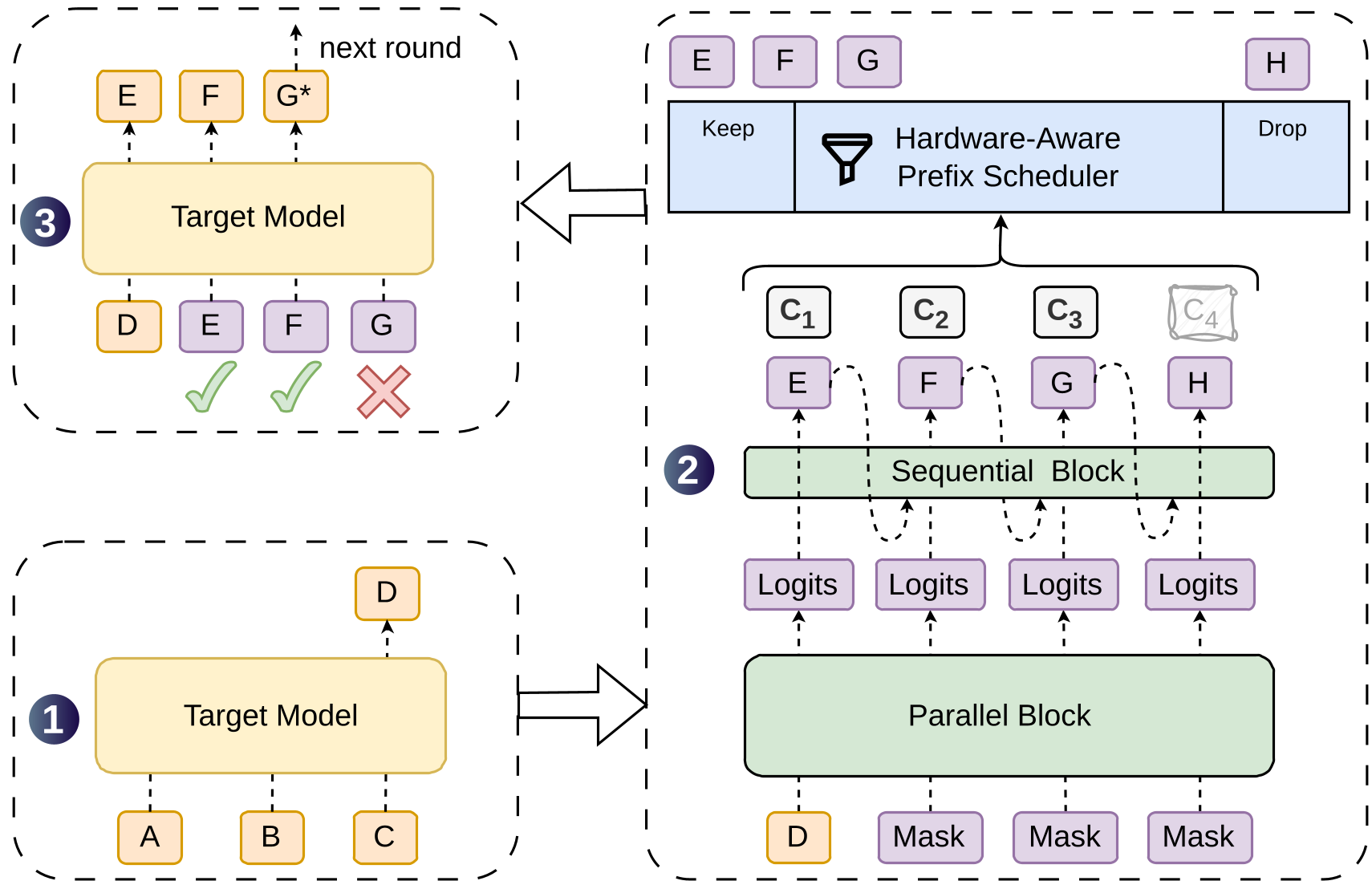
DSpark uses a deep parallel backbone to process context features, but adds a lightweight sequential head (either a Markov or RNN head).
- The backbone captures the "heavy" features in parallel.
- The sequential head injects local dependencies, allowing position to see what was sampled at .
As shown in the architecture below, this allows DSpark to maintain the speed of parallel models while achieving the coherence of autoregressive ones.
2. The Hardware-Aware Prefix Scheduler
Perhaps the most significant contribution is moving away from static verification lengths. In a busy system, verifying a draft token that has only a 20% chance of being accepted is a waste of resources.
DSpark treats this as a throughput maximization problem. It uses a calibrated Confidence Head to estimate the "survival probability" of each draft token. A scheduler then looks at the current GPU load (Steps-Per-Second curve) and decides, "For Request A, I'll verify 5 tokens, but for Request B (higher uncertainty), I'll only verify 2."
Experimental Results: Shifting the Frontier
The results are striking. In offline benchmarks, DSpark consistently beats state-of-the-art drafters like Eagle3 and DFlash.
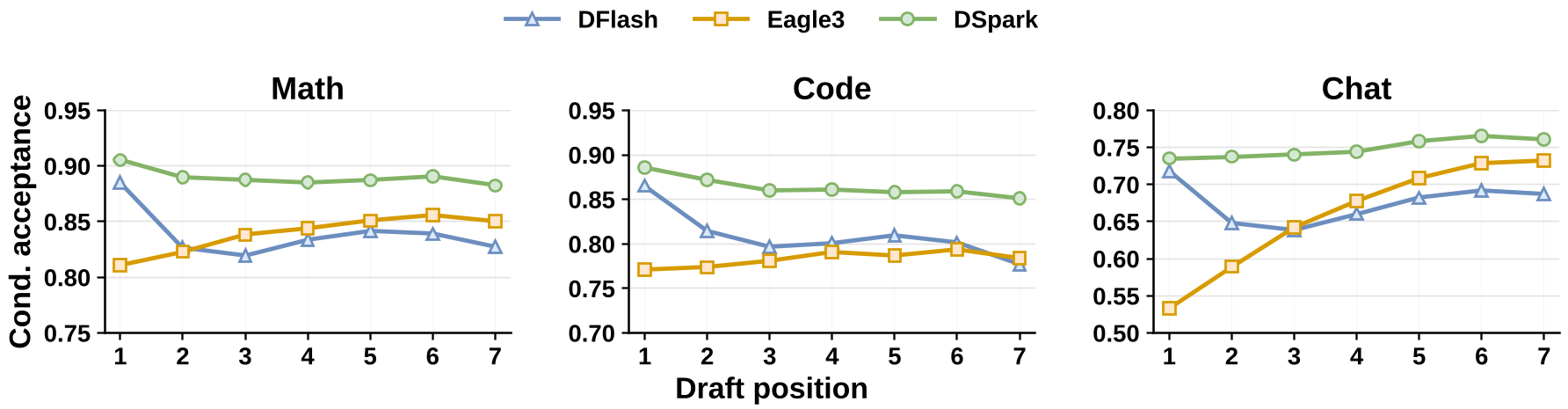
As Figure 2 demonstrates, while DFlash (parallel) suffers from rapid suffix decay, DSpark maintains high conditional acceptance even at the end of the block.
Real-World Production Impact
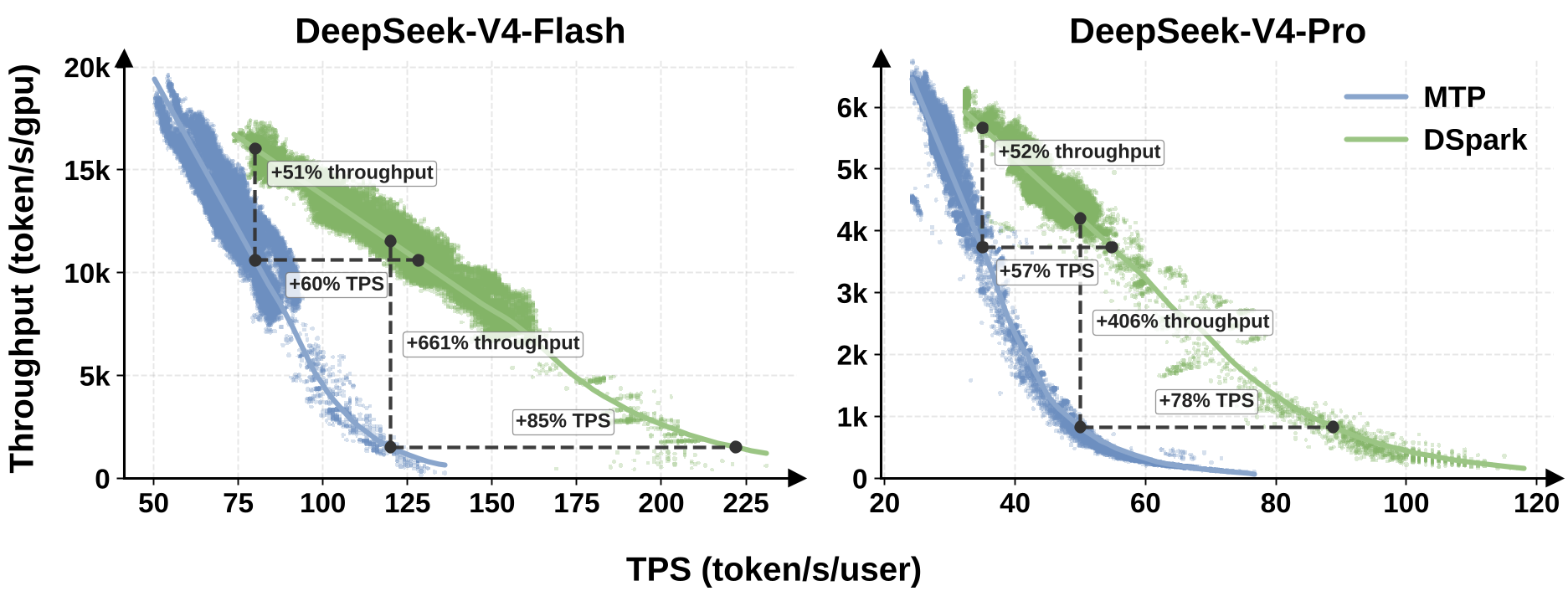
When deployed for DeepSeek-V4, DSpark significantly improved the Serving Pareto Frontier. It achieved:
- 60%–85% speedup in per-user generation speed under matched throughput.
- Robust performance under high-concurrency loads where previous systems would "cliff-dive" in efficiency.
Critical Insights & Conclusion
The success of DSpark stems from its system-centric view. Most research treats speculative decoding as a pure machine learning problem (maximizing acceptance rate). DSpark recognizes it as a resource allocation problem.
Key Takeaways for Practitioners:
- Parameter Efficiency: A shallow 2-layer semi-autoregressive drafter can outperform a 5-layer pure parallel drafter.
- Calibration is Key: Raw confidence scores are often overconfident. Applying Sequential Temperature Scaling (STS) is mandatory for making reliable scheduling decisions.
- Asynchrony: To avoid stalling the GPU (Zero-Overhead Scheduling), scheduling decisions should be based on predictions from 2 steps prior, creating a "causal barrier" that preserves the lossless guarantee.
DSpark represents a significant leap toward million-token context intelligence, proving that the future of LLM efficiency lies in the tight integration of model architecture and hardware-aware systems.