
DTCS: Safeguarding IoT Crowdsourcing Against the "Enemy Within"
DTCS: An Integrated Strategy for Enhancing Data Trustworthiness in Mobile Crowdsourcing
This paper introduces the Data Trustworthiness Enhanced Crowdsourcing Strategy (DTCS), an integrated framework designed to secure Mobile Crowdsourcing Systems (MCS) in IoT. It combines attribute-based group division and a core-selecting incentive mechanism to achieve SOTA performance in defending against internal attacks.
TL;DR
Mobile Crowdsourcing (MCS) is the backbone of smart city services, yet it is highly vulnerable to internal attackers—legal users who lie. This paper presents DTCS, a strategy that utilizes Metagraph-based group logic and Core-selecting auctions to ensure data integrity. It reduces disinformation and maintains high system utility even when legal participants collude to sabotage the network.
The "Trusting a Liar" Problem (Motivation)
In Mobile Crowdsourcing, the biggest threat isn't the hacker trying to break in, but the authenticated user already inside. Current SOTA methods often assume that if a user is certified, their data is reliable. However, internal participants can launch:
- Conflicting Behavior Attacks: Providing correct technical data (like IP) but fake sensing data (like location).
- Collusion Attacks: Multiple legal users banding together to boost each other's reputation while framing honest users.
Furthermore, when users move between different network segments, they often lose their "Reputation History," a phenomenon the authors call the reputation loss problem.
Methodology: The DTCS Architecture
The DTCS strategy isn't a single algorithm but an integrated pipeline consisting of four key modules designed to build a "Web of Trust."
1. ARF-Based Grouping
Instead of treating participants as isolated nodes, the system evaluates Attribute Relevancy and Familiarity (ARF). By comparing attributes like age, hobby, and location, it clusters participants who are logically "linked."
2. Metagraph-Driven Relationships
Traditional graphs only link two nodes. DTCS uses Metagraphs to define set-to-set mappings. This allows the system to calculate:
- Trust between person and person.
- Trust between a person and a whole group.
- Trust between two different groups.
This structural approach ensures that even if a participant moves, their "group belonging" helps maintain their reputation continuity.
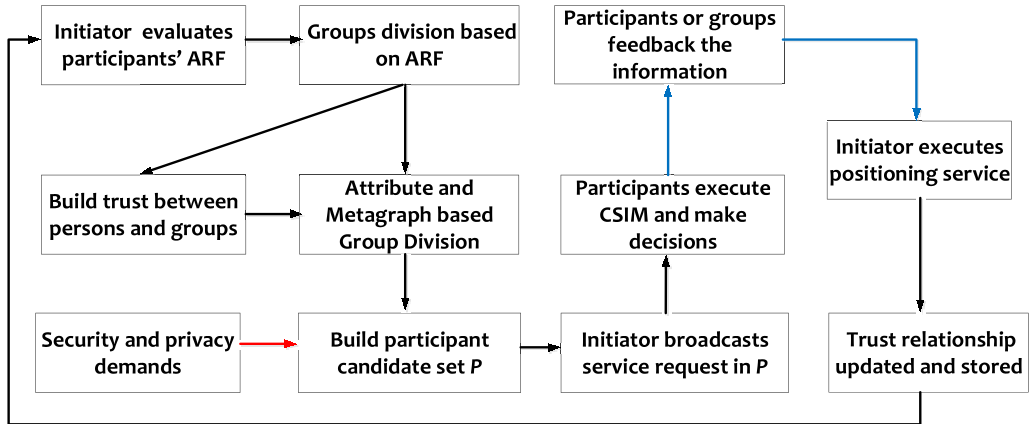
3. Core-Selecting Incentive Mechanism (CSIM)
To prevent collusion, the authors turned to Game Theory. Unlike standard auctions where users might find it profitable to cheat, the CSIM ensures that the outcome is in the "Core."
- Physics/Logic Intuition: In a core-selecting auction, no subset of bidders (colluders) can improve their total utility by deviating from the truthful strategy. DTCS mathematically proves that any participant joining a collusion will earn less than or equal to what they would have earned by being honest ().
Experimental Validation: SOTA Comparison
The authors compared DTCS against TSCM and PPPCM in a simulated environment of 1000 participants.
Performance Under Attack
When subjected to collusion attacks:
- Utility Rate (URCS): DTCS outperformed others significantly. While TSCM's utility crashed by 45%, DTCS remained resilient with a mere 12% decrease.
- Trustworthy Participant Selection Rate (TPSR): DTCS identified malicious actors more accurately, maintaining a selection rate that was 20-23% higher than competitors under heavy attack.
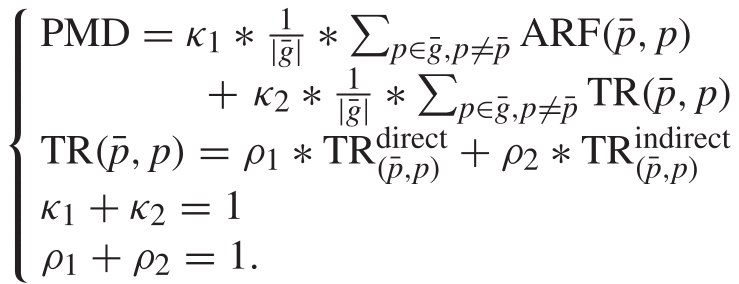 (Note: Above shows the PMD calculation logic used for grouping)
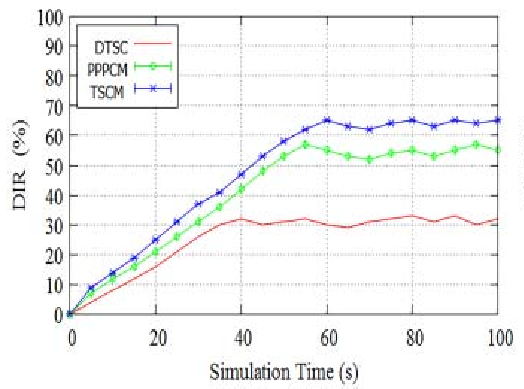 (Figure: Disinformation Ratio Comparison under different attack scenarios)
Critical Insight & Future Outlook
The brilliance of DTCS lies in its realization that reputation is social, but incentives are mathematical. By using Metagraphs to capture the "social" clusters of IoT devices and Core-Selecting auctions to provide the "mathematical" guardrails, it creates a self-correcting ecosystem.
Limitations: The current model relies heavily on the "Sensitivity Level" being set by data owners, which could be a point of failure if the owner is biased. Future work involving Homomorphic Encryption could allow for trust evaluation without even seeing the raw data, adding another layer of privacy to this robust framework.
Takeaway for Practitioners: When building crowdsensing apps, don't just verify who the user is; verify their structural context using group-based trust and ensure your incentive model makes lying mathematically unprofitable.