
DNHP: Breaking the Dimensional Barrier in Social Cascade Modeling
Analyzing Topic Transitions in Text-Based Social Cascades Using Dual-Network Hawkes Process
The paper introduces the Dual-Network Hawkes Process (DNHP), a generative model designed to disentangle text-based social cascades by operating on a "super-graph" of user-topic pairs. Unlike prior methods, DNHP simultaneously captures user-user, topic-topic, and user-topic interactions, achieving state-of-the-art performance in cascade reconstruction and generalization on real-world datasets like US Politics tweets.
TL;DR
The Dual-Network Hawkes Process (DNHP) is a sophisticated generative model that treats social media interactions as events occurring on a two-dimensional grid of users and topics. By decomposing complex social responses into three distinct interaction matrices (user-user, topic-topic, and user-topic), it achieves a 20% boost in identifying "who replied to whom" and provides deep insights into how political conversations transition between subjects.
Motivation: The Content-Timing Disconnect
Traditional social cascade models (like the standard Hawkes Process) often treat the "when" and the "what" as separate entities. They assume that if User A follows User B, they will respond at a fixed rate regardless of the subject.
However, social reality is different: a user might be extremely responsive to political news but ignore sports updates from the same source. Existing SOTA models like HMHP or NHWKS failed to capture this tri-partite relationship—user influence, topic preference, and topic transitions—simultaneously.
Methodology: The User-Topic Super-Graph
The authors propose a "Super-Graph" where each node is a pair . An event (like a tweet) triggers responses not just based on the user network, but on the alignment of the topics.
The Core Equation
The impulse response (the "spike" in activity following an event) is decomposed as:
- (User-User Influence): The raw social tie strength.
- (Topic-Topic Interaction): The likelihood of a conversation moving from topic to (e.g., from "Economy" to "Healthcare").
- (User-Topic Preference): How much user actually cares about topic .
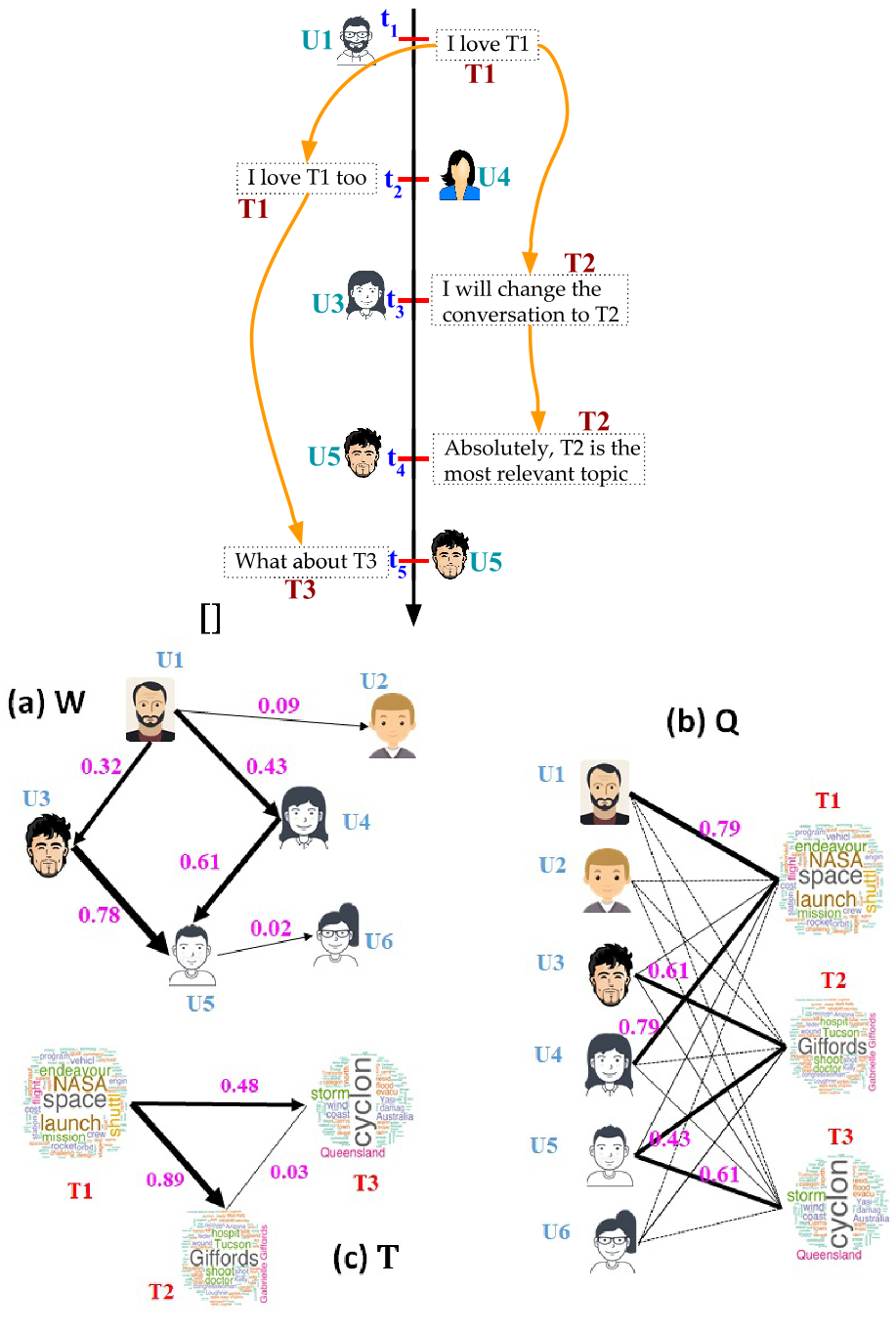 Figure 1: Comparison between standard 1D user networks and the 2D DNHP super-node approach.
To handle the coupling of these parameters during training, the authors employed a Gibbs sampling algorithm, allowing evidence to flow between the user-networks and topic-networks during the learning process.
Experiments & Results: Politics in the Spotlight
The model was tested on USPol, a dataset of 370k tweets from US politicians.
1. Superior Cascade Reconstruction
DNHP achieved significantly higher accuracy in identifying the "parent" tweet of a response.
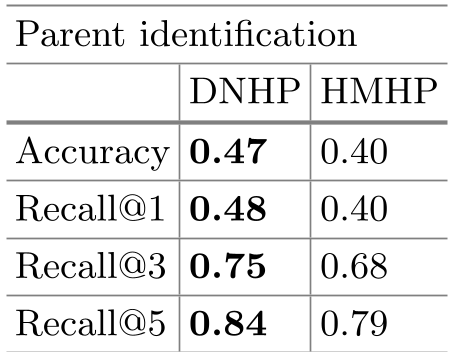 Table 1: DNHP vs HMHP. Notice the steady gain in Recall@1 and Accuracy.
2. Generalization under Data Scarcity
A key takeaway was that DNHP's Log-Likelihood outperformed baselines more significantly when the training data was small. This is due to parameter sharing: by learning general topic-transition rules (), the model can predict responses between users it hasn't seen interact frequently.
3. Sociological Insights
The model revealed fascinating transitions in US political discourse. For instance, the authors observed high transition rates from Economy → Politics and Social → Politics, reflecting how specific policy issues are often "politicized" in responses.
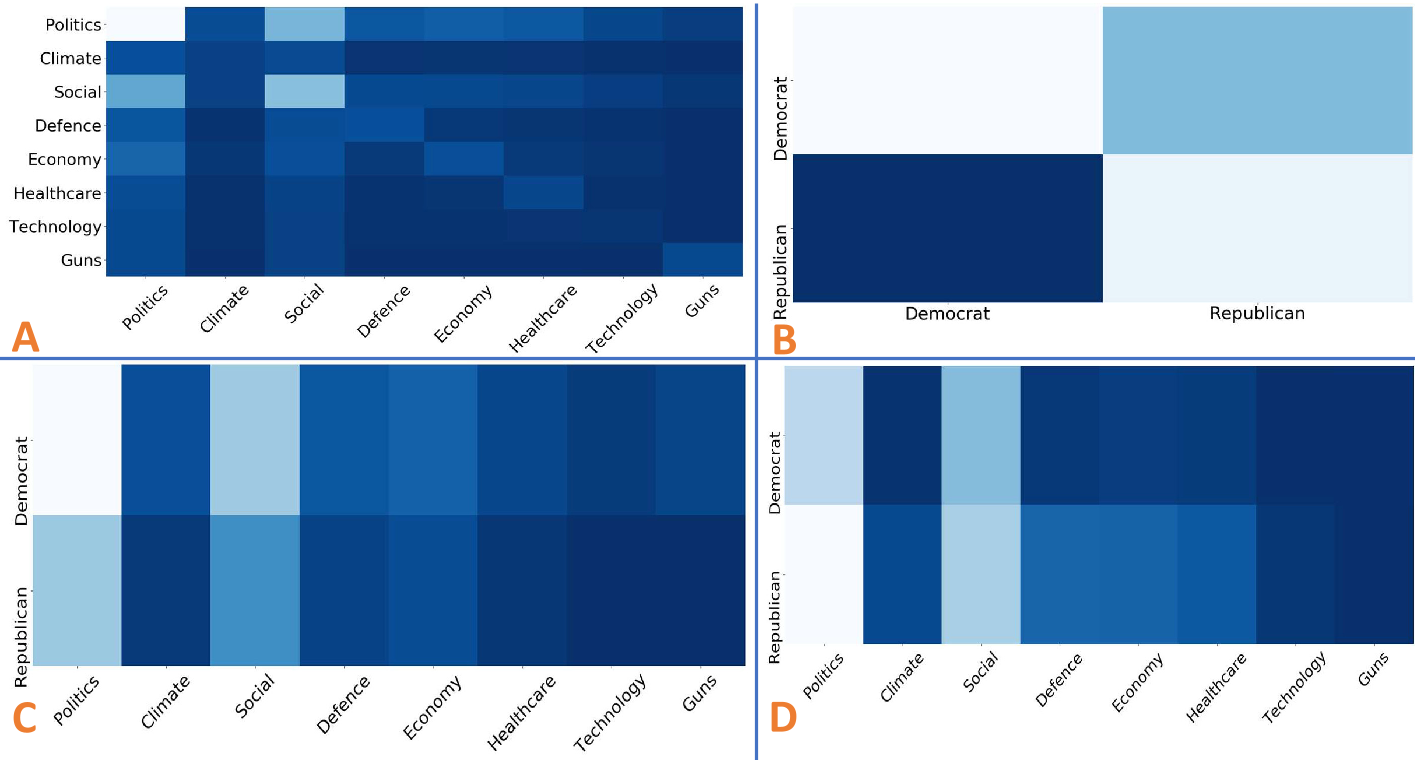 Figure 4: Visualizing how conversations "drill down" from general topic interactions to specific user-to-user anecdotes.
Critical Analysis & Conclusion
Takeaway
The DNHP is a masterful example of how incorporating domain-specific Inductive Bias (the fact that topics drive social responses) into a mathematical framework (Hawkes Processes) leads to better performance than simply throwing more data at a naive model.
Limitations
- Computational Complexity: Gibbs sampling for large-scale networks can be expensive as the number of users or topics grows into the thousands.
- Discrete Topics: The model assumes a fixed number of discrete topics (). Modern approaches might benefit from continuous latent spaces (embeddings) rather than discrete LDA-style topics.
Future Work
The DNHP framework could naturally evolve by replacing the exponential time-kernel with a Neural Hawkes approach (using RNNs or Transformers) to capture more complex temporal dependencies while retaining the dual-network structural benefits.