
DICER: Redefining Social Recommendation through Dual-Side Deep Contextual Modulation
Dual Side Deep Context-aware Modulation for Social Recommendation
The paper introduces DICER (Dual sIde deep Context-awarE modulation for social Recommendation), a novel graph-based framework for social recommendation. It leverages a relation-aware Graph Neural Network (RGNN) to incorporate high-order social and collaborative similarity relations, achieving state-of-the-art performance on benchmark datasets like Ciao and Epinions.
TL;DR
DICER (Dual sIde deep Context-awarE modulation) is a sophisticated social recommendation framework that moves beyond simple friend-aggregation. By constructing high-order collaborative graphs for both users and items and applying a "Deep Contextual Modulation" mechanism, it captures intricate user interests and item attractions. It achieves a significant performance leap (up to 10% improvement) over existing GNN-based social recommenders.
Background & Motivation: Beyond Shallow Context
The core philosophy of social recommendation is "birds of a feather flock together." However, existing SOTA models often treat the recommendation context too "shallowly."
- The User Side Bias: Most models only aggregate a user's friends' interests based on the specific candidate item. They miss the fact that a user’s interest is better reflected by a cluster of similar items, not just one.
- The Item Side Neglect: We often ask "Does the user like this item?" but rarely "How attractive is this item to this specific user's circle?" If my friends have bought a product, that product possesses an inherent "attraction" to me that traditional models fail to quantify.
DICER addresses these by treating the entire high-order graph structure as a "Deep Context" to modulate features.
Methodology: The Core of DICER
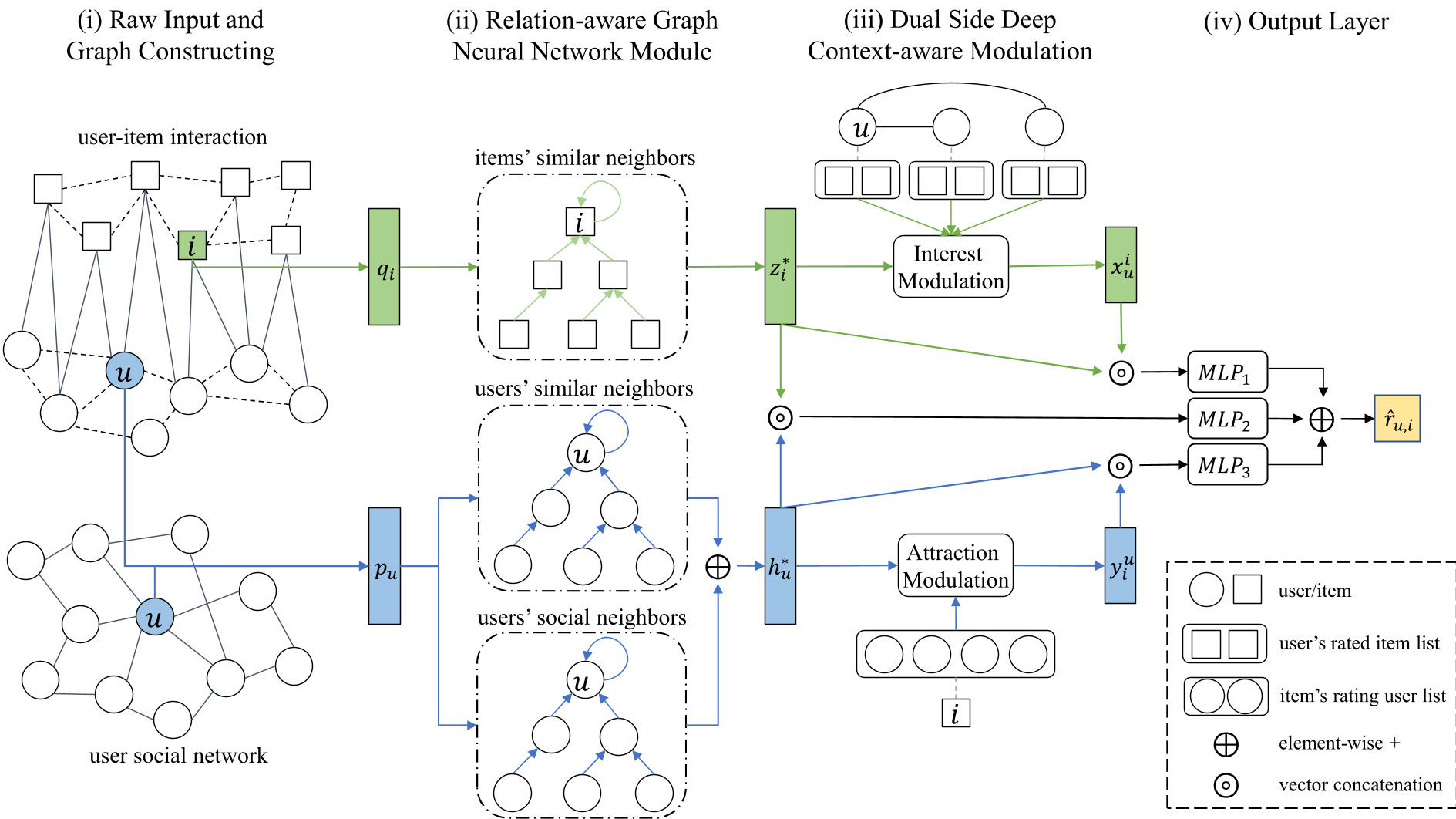
The architecture is divided into four critical modules:
1. Collaborative Graph Construction
Unlike standard models that only use the social graph, DICER builds two auxiliary networks:
- User Collaborative Graph: Connects users with similar consumption habits.
- Item Collaborative Graph: Connects items with similar interaction histories.
2. High-Order Relation Exploitation (RGNN)
The model uses a Relation-aware GNN (RGNN). It recursively propagates information through social, user-similarity, and item-similarity layers. This produces two powerful representations:
- : Graph-enhanced User Preference.
- : Graph-enhanced Item Attribute.
3. Dual-Side Deep Context-aware Modulation
This is the "secret sauce." Instead of simple attention, DICER uses Modulation:
- User Interest Modulation: It uses the item's high-order attribute as a filter to extract the most relevant interests from the user's (and their friends') history using element-wise product and max-pooling.
- Item Attraction Modulation: Conversely, it uses the user's high-order preference to filter the item's past consumer history. If the item was bought by people "like you" or "your friends," it receives a higher attraction score.
Experimental Validation
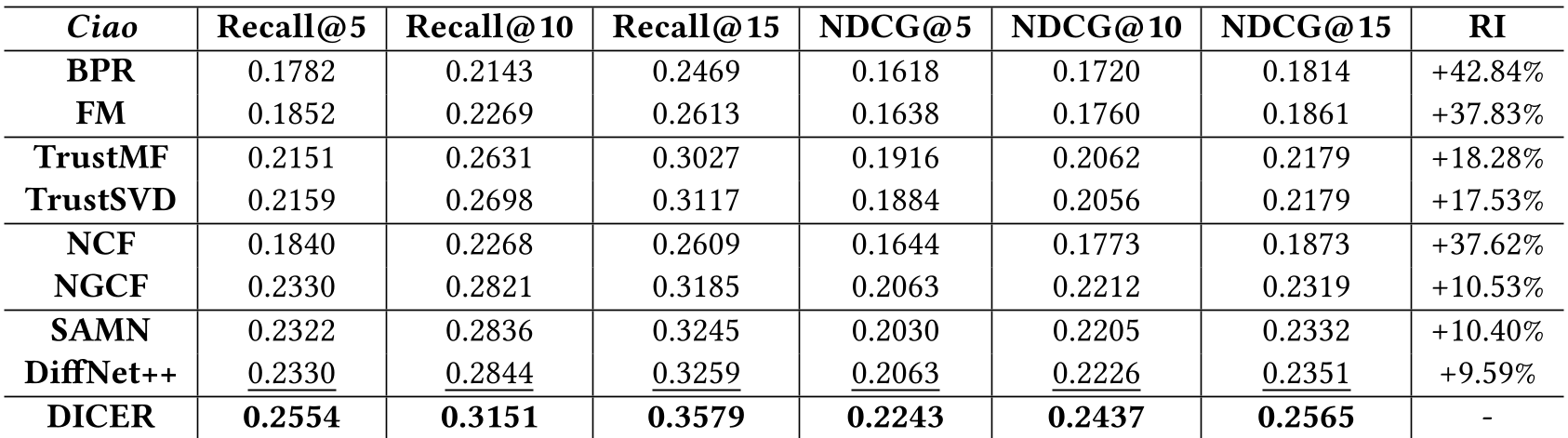
DICER was tested against heavyweights like NCF, NGCF, SAMN, and DiffNet++ on the Ciao and Epinions datasets.
Key Findings:
- SOTA Performance: DICER consistently ranks first across Recall@K and NDCG@K.
- Ablation Insight: Removing the "Item Attraction" component leads to a 5.79% drop in Recall, proving that social signals are just as important on the item side as they are on the user side.
- Modulation vs. Attention: The study found that the specific modulation (max-pooling over element-wise products) outperformed standard attention mechanisms (DICER-attn), likely because it better captures specific feature-level correlations.
Critical Insight & Future Outlook
DICER’s success proves that context is a graph, not a node. By embedding the high-order structural information of the social and collaborative networks into the "modulation" phase, the model effectively filters noise and focuses on the most relevant historical interactions.
Limitations: The model relies on a similarity threshold () to construct collaborative graphs, which might require manual tuning for different domains. Future Work: A promising direction would be automating the similarity discovery or extending this dual-modulation logic to temporal recommendation where the "context" shifts over time.
Editor's Note: DICER represents a shift from "Social Influence" (what my friends do) to "Social Context" (how the social fabric changes the nature of the item itself).