
Seeding vs. Quality: Decoding the Billion-Dollar Marketing Trade-off in Social Networks
Duopoly budget allocation in social networks: A nash analysis approach
This paper presents a game-theoretic analysis of duopoly competition in social networks, where two firms optimize their fixed budgets between "Product Quality" and "Initial Seeding." By utilizing a myopic best response dynamics model, the authors characterize a unique Nash Equilibrium that dictates how firm budget disparity and network topology (e.g., Star vs. Balanced graphs) drive optimal marketing strategies.
TL;DR
In the hyper-competitive landscape of social platforms, firms must decide: do we spend our last million dollars making the app better (Quality), or giving it away for free to influencers (Seeding)? This paper provides a rigorous mathematical framework to solve this. Using a Nash Equilibrium approach, the authors prove that your strategy shouldn't just depend on your budget, but on how much more budget you have compared to your rival and the specific "shape" of your customer network.
Background Positioning
Moving beyond simple "viral spread" models (like SIR or independent cascade), this work positions itself in the realm of Strategic Diffusion. It treats consumers as rational agents who care both about their own preference and what their friends are doing (Network Externality).
Problem & Motivation: The Tug-of-War
Firms A and B have a fixed budget . They face a classic dilemma:
- Quality (q): Makes the product inherently more valuable to everyone.
- Seeding (S): Directly captures "central" nodes to kickstart a chain reaction of consumption.
Existing SOTA methods often struggle to provide a closed-form solution for this competition. The authors identify a gap: How does the network's structure (who follows whom) actually change the optimal split between these two levers?
Methodology: The Core Mechanics
The authors define the agents' utility using a local coordination game. If my friends use WhatsApp, I gain more utility from using WhatsApp too.
The Centrality Vector
The most critical technical insight is the use of the Centrality Vector : This vector dictates where seeding is most effective. Firms should target nodes with the highest first—essentially the "Key Players" who sustain the longest-lasting influence.
 Table 1: The payoff matrix representing coordination between agents.
The Nash Equilibrium
By transforming the competition into a zero-sum game, the authors derive the unique optimal quality: This formula elegantly shows that your optimal quality isn't just a function of your own budget, but the relative centrality () of the agents being targeted by both you and your competitor.
Experiments & Results: The "Budget Gap" Insight
1. The Budget Proximity Effect
When two firms have nearly equal budgets, they enter a "Quality War." They both invest heavily in making their products better because neither has a significant enough advantage to "buy" the network through seeding.
2. The Budget Gap Effect
As the difference between and grows, the competition in qualities becomes "less effective." The firm with the massive budget starts pouring more into Seeding. Why? Because they can capture enough of the network's influencers to make the rival's quality advantages irrelevant.
3. Network Topology: Star vs. Balanced
The paper makes a bold claim about graph structures:
- Balanced Graphs (where everyone has equal influence) are the most "seeds-friendly." If seeding is worth it here, it's worth it anywhere.
- Star Graphs (one hub, many spokes) are the "gatekeepers." If the hub of a star graph isn't worth seeding, seeding is effectively dead as a strategy for that product.
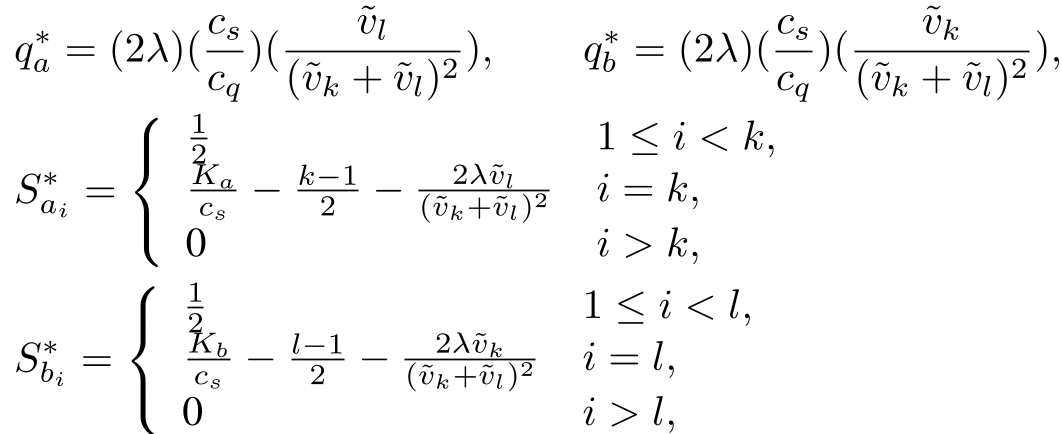 Formula 7: The mathematical characterization of the unique Nash Equilibrium for and .
Critical Analysis & Conclusion
Takeaway
The genius of this paper lies in its tractability. It shows that Market Share is a function of Centrality. If you are a startup competing against a giant, don't just try to match their seeding; you must over-index on quality unless you can find a specific sub-network (cluster) where your relative budget is higher.
Limitations
The model assumes "Myopic Best Response"—meaning agents only look one step ahead. In the real world, "Strategic" agents might wait to see which product wins the "standards war" before committing, a factor not captured here.
Future Outlook
This framework is ripe for application in the "Attention Economy." Imagine applying this to how TikTok and Reels compete for creators (the seeds) versus improving their algorithms (the quality). The Nash analysis here provides the playbook for that multi-billion dollar fight.