
Durkheim’s Legacy: Digital Rites and Social Integration Among Seniors
Durkheim’s Legacy in the Digital Age: The “Elementary Forms” of Digital Communication of Portuguese Senior Users of Social Network Sites
This paper explores the application of Durkheim’s cultural theory to analyze how Portuguese senior citizens use Social Network Sites (SNS). It identifies that digital communication functions as a "mediated rite" of symbolic exchange, fostering social and normative integration within peer groups.
TL;DR
This study moves beyond the "digital divide" narrative to explore why and how Portuguese seniors use social media when they do gain access. By applying Emile Durkheim’s theory of religious rituals to the digital world, the paper argues that for seniors, social networking is not about information—it is a sacred ritual of "being present" that maintains their social identity and emotional stability.
Background: Beyond the Transmission Model
In the study of communication, we often default to the Transmission Model: Person A sends a message to Person B. However, for the elderly, communication is better understood through the Ritual Model. Drawing from Durkheim’s The Elementary Forms of Religious Life, this paper posits that digital interactions (the "Likes," the "Comments," the shared photos) are the digital equivalents of ancient group rituals. They reinforce a "collective sentiment" that keeps the individual integrated into their social tribe.
Problem & Motivation: The Phatic Void
Technological change is often discussed in terms of "risks" (isolation, addiction, fake news) or "barriers" (usability). The author argues that this focus misses the Internal Motivation.
- Isolation Risks: Seniors often face "lost ties" due to retirement or widowhood.
- Ontological Security: This is the sense of order and continuity in an individual’s life. Digital tools are domesticated by seniors to fill this void, transforming "small talk" on Facebook into a critical "social lubricant."
Methodology: The Rituals of the Portuguese Senior
The researcher analyzed data from two major Portuguese surveys involving a representative sample of older adults (65+).
1. The Phatic Inclination
The core concept here is Phatic Communion—speech used to establish a social link rather than to convey facts. The data shows that "Sending Messages" and "Liking" are far more common than posting original news or joining political causes.
2. Architecture of Digital Domesticity
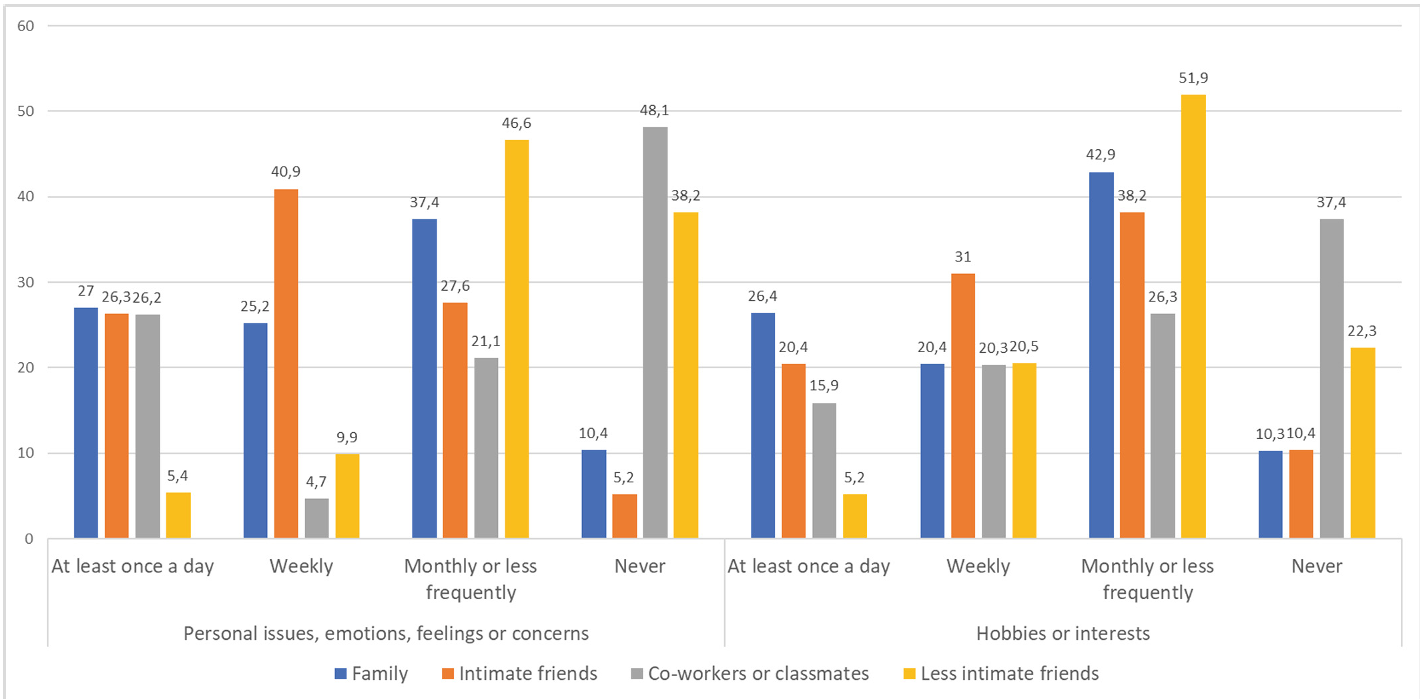 The figure above illustrates that seniors prioritize sharing personal concerns and hobbies with their closest friend networks, bridging the gap between offline and online worlds.
Key Results: Digital Totems in Action
The study highlights that while the percentage of users is low, the intensity of ritualized use is high among those who are connected:
- Strengthening Ties: 89.7% use SNS to keep in touch with distant people; 56.8% use it to strengthen existing offline ties.
- Recognition Gestures: Clicking "Like" (67.3%) acts as a "digital nod," a phatic gesture of acknowledgment that says "I am here, and I see you."
| Feature | Usage Rate (%) |
|---|---|
| Send Messages | 84.4 |
| Like Posts | 67.3 |
| Chat Services | 59.2 |
| Comment Posts | 56.0 |
| Table showing that communication-heavy features dominate over game-play or cause-support. |
Critical Insight: The Digital Sacred and Profane
For the senior user, the "profane" world is one of disconnection and obsolescence. The "sacred" space is the digital network where they can maintain their Ontological Security.
The paper suggests that Facebook and mobile phones act as Digital Totems. Just as a tribe gathers around a totem to reaffirm its existence, seniors use digital platforms to reaffirm their presence in a fast-changing world. Interestingly, the study found that seniors do not report feeling overwhelmed by updates (only 12%), suggesting a more focused, quality-driven approach to digital social capital compared to younger generations.
Conclusion: A Moral Order of Connectivity
The Durkheimian lens reveals that SNS usage among seniors is not a luxury—it is a form of Social Regulation.
- Takeaway: Digital inclusion strategies for the elderly should not just focus on "how to use a mouse," but on "how to maintain a ritual."
- Limitations: The study relies on self-reported data which can be subject to interpretation bias regarding "hours spent."
- Future Work: Exploring how the breakdown of these digital rituals (e.g., losing access to an account) affects the psychological well-being and sense of "moral order" in seniors.
Ultimately, the "Elementary Forms" of digital life turn out to be the same as they were a century ago: a desperate, human need to belong.