
SGTA & SATD: Solving Internal Dependencies in Complex Mobile Crowdsourcing
Dynamic Allocation for Complex Mobile Crowdsourcing Task with Internal Dependencies
This paper introduces SGTA and SATD, a novel framework for mobile crowdsourcing that addresses complex tasks with internal logical dependencies. By combining DFS-based topological sorting with a dynamic re-allocation strategy, the authors achieve optimized task-chains for workers while maintaining high reliability through feedback-driven adjustments.
TL;DR
Mobile crowdsourcing is evolving from simple "photo-taking" tasks to complex multi-step projects. This paper tackles the "Dependency Dilemma"—where sub-tasks must be done in a specific order—by introducing SGTA for dependency-aware allocation and SATD for dynamic re-allocation of failed tasks. Using real-world Mobike data, the researchers prove that logical task-chaining reduces latency and improves work quality.
The Problem: The "Dependency Dilemma"
Most existing crowdsourcing platforms (like Uber or Waze) treat tasks as isolated points on a map. However, a task like "Repairing a House" or "Comprehensive Environmental Inspection" consists of multiple sub-tasks ().
- Logical Dependence: cannot start until is finished.
- Logistical Waste: If and are assigned to different workers, the "handoff" causes massive delays and information loss.
- NP-Hardness: Optimizing allocation for time-sensitive, spatially-distributed, and logically-dependent tasks is computationally expensive.
Methodology: Chains and Graphs
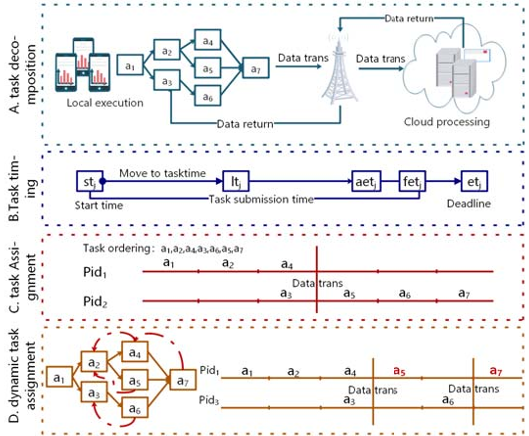
The authors propose a systematic three-phase workflow: Decomposition → Assignment → Dynamic Adjustment.
1. Task Decomposition (DAG)
The complex task is modeled as a Directed Acyclic Graph (DAG). To determine the execution order, the system uses a Depth-First Search (DFS) algorithm for topological sorting. This ensures that the logical flow of the project is preserved.
2. SGTA (Scoring Greedy Task Assignment)
Instead of assigning one task at a time, SGTA builds Task Chains. It scores participants based on:
- MTask Completion Rate: How many serial tasks a worker can finish within their time window.
- Load Balancing (): Ensuring a worker isn't overloaded beyond their individual capacity.
- Cost Minimization: Reducing the travel distance and incentive payouts.
3. SATD (Similar Task Dynamic Allocation)
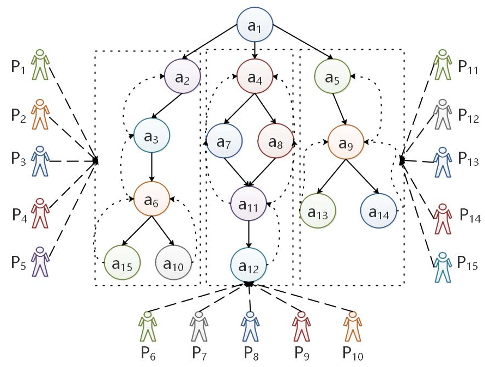
Real life is messy; workers quit or fail. SATD detects failures through feedback reports. It then uses the Tarjan Algorithm to find strongly connected components in the task graph—grouping similar unexecuted tasks and redistributing them to workers with available "load" based on an "average division" logic.
Experimental Insights
The framework was tested on 3.2 million Mobike travel records from Beijing.
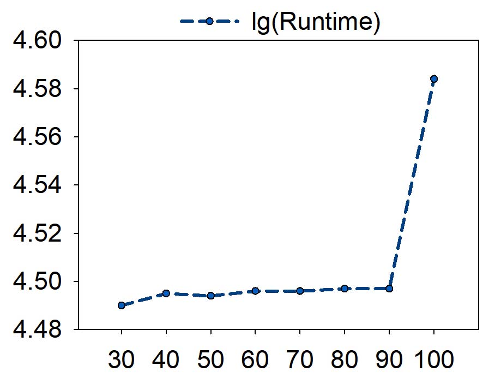
- The "Sweet Spot" for Load: The researchers found that setting a load threshold of 11 tasks per participant yielded the highest efficiency. Too few tasks lead to underutilization; too many lead to high failure rates.
- Scalability: As the number of tasks increases, the "Serial Matching Number" (the ability of the system to link tasks together) grows significantly, which validates the logic of task-chaining.
- Efficiency: Despite the complexity, the SATD dynamic redistribution keeps the workload evenly distributed across the visible crowd.
Critical Analysis & Conclusion
Takeaway: This paper successfully shifts the focus from "point-to-point" matching to "chain-to-worker" matching. By respecting the internal logic of tasks, they solve the high-latency issue inherent in complex crowdsourcing.
Limitations:
- The movement model assumes a constant speed (300m/min for bikes), which might not account for urban traffic variability.
- The skill-matching component is simplified; in higher-stakes environments (e.g., specialized engineering), the skill variance would be a much larger constraint.
Future Outlook: Integrating Reinforcement Learning to predict worker failure before it happens could make the "Dynamic Allocation" phase even more proactive rather than reactive.