
Rebuilding the Bridge: Enabling Dynamic Analysis in Anonymized Social Networks
Enabling Dynamic Analysis of Anonymized Social Network Data
The paper proposes a connection rebuilding framework for anonymized social network snapshots, enabling dynamic analysis through a two-stage matching strategy. It introduces the concept of "Social Threading" to link nodes across sequential releases, achieving high accuracy without modifying existing anonymization protocols.
TL;DR
Researchers from Tsinghua University have developed a way to perform dynamic analysis on social network data that has already been anonymized and "disconnected" across time snapshots. By using a "Seed-and-Expand" graph matching algorithm, they can rebuild node-to-node connections with over 97% precision, effectively "threading" individual nodes through sequential releases without requiring changes to existing privacy methods.
Background & Motivation: The Static Trap
Anonymization is a double-edged sword. To protect user privacy, platforms often replace real IDs with random markers and perturb the network structure before sharing data with researchers. However, most current methods treat these releases as static snapshots.
When a network evolves over time (e.g., a month of growth on a microblogging site), researchers need to track individual node behavior to understand dynamics. If snapshots are anonymized independently, the "User A" in Snapshot 1 cannot be linked to the "User A" in Snapshot 2. While some researchers suggested keeping IDs fixed, this creates a massive privacy loophole. The authors ask a critical question: Can we reconstruct these connections after the fact, using only the structural signatures of the network?
The "Social Threading" Methodology
The authors frame the problem as finding a Social Threading—a collection of disjoint "threads" where each thread contains the various anonymized IDs of the same physical entity across different snapshots.
Stage 1: Seed Threading (Mining the Hubs)
The algorithm starts by finding "Community Hubs." These are nodes with high degrees and high betweenness. Because of the "Matthew Effect" (the rich get richer), these hubs tend to remain prominent even as the network evolves, making them stable landmarks.
- Extract top hubs from each snapshot.
- Build a weighted complete graph where edges represent structural similarity.
- Use combinatorial optimization to find the best initial alignment (the Seed).

Stage 2: Threading Expansion (The Ripple Effect)
Once the seeds are planted, the algorithm grows the threading iteratively. It looks at the neighbors of established threads and uses a BestMatch function. This function calculates a matching score based on how many "already matched" neighbors a new candidate node has. To prevent false positives, they use an Eccentricity Threshold (): a match is only accepted if the top score is significantly higher than the runner-up.
Experimental Results
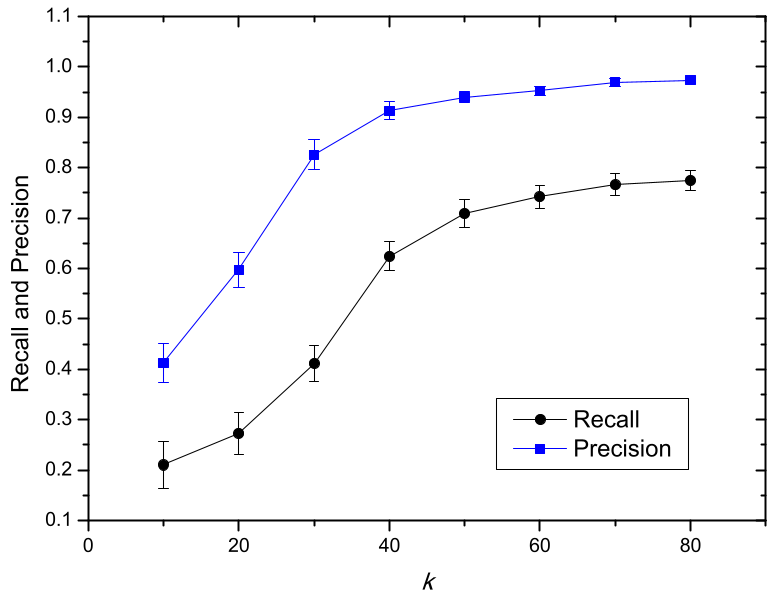
The team tested their approach on real data from the Netease Microblog, involving six snapshots ranging from 47k to 204k nodes. Even with 20% "noise" (randomly added/removed edges), the results were striking:
- High Precision: With hubs, the precision reached 97.3%.
- Scalability: The "Seed-and-Expand" approach avoids the NP-complete complexity of traditional graph matching, making it viable for large-scale social networks.
- Robustness: The stability of hubs (shown in Figure 4) proves that social structures are surprisingly resilient to local perturbations.
Critical Insight: The Irony of Attack and Utility
One of the most profound takeaways from this paper is its philosophical origin. The authors adapted techniques originally designed for de-anonymization attacks (specifically the work of Narayanan and Shmatikov) and repurposed them for data utility.
Limitations & Future Work
- Privacy Boundary: While the method restores utility, it also highlights how "structure is identity." If a researcher can rebuild these connections, so can an adversary.
- Structural Stability: The method relies on the "Matthew Effect." In networks where top positions shift rapidly (highly volatile structures), the seed construction might struggle.
Conclusion
This work demonstrates that we don't need to choose between rigorous one-time anonymization and dynamic analysis. By treating connectivity as a post-processing reconstruction task, we can unlock the temporal value of existing datasets without compromising the original privacy protocols.