
Dynamic Community Mining: Tracking the Pulse of Temporal Social Networks
Dynamic Community Mining and Tracking Based on Temporal Social Network Analysis
This paper proposes a computational framework for mining and tracking dynamic communities in temporal social networks. By integrating static user profiling with keyword-based dynamic interest weight calculation (TF-IDF variant), the authors develop the Dynamically Socialized User Networking (DSUN) model to track community evolution—including creation, merging, and splitting—across time slices detected from Twitter data streams.
TL;DR
This research presents a robust framework for discovering and tracking how communities form, merge, and dissolve in real-time. By combining static user attributes with a dynamic, keyword-frequency weighting mechanism (the DSUN model), the authors provide a way to visualize the "lifecycles" of social groups using Twitter stream data.
Positioning: This work is an evolutionary step in Temporal Social Network Analysis (SNA), moving beyond static graph clustering toward time-aware, interest-driven community tracking.
Problem & Motivation
In the era of "crowd computing," social networks are not frozen structures. A user interested in "AI" today might shift to "Sustainability" tomorrow, causing their community affiliations to fluctuate.
The authors identified that prior work often failed to:
- Capture Temporal Trends: They treated the network as a single snapshot.
- Quantify Informational Benefit: They ignored the direction of influence, treating friendships as simple bidirectional links.
The insight here is that communities are defined by shared temporal interests, and the strength of these interests can be calculated through the frequency of keywords within specific time slices.
Methodology - The Core
The architecture of the proposed system (Fig. 1) relies on a pipeline of feature extraction, trend detection, and network building.
1. The Dual-Feature Mechanism
- Static Features: Rule-based scoring for Location, Occupation, Education, etc.
- Dynamic Features: A frequency-based weight formula (similar to TF-IDF) that measures the significance of a keyword within a specific time interval : This allows the system to ignore common "noise" words and focus on keywords that define specific temporal peaks.
2. The DSUN Model
The Dynamically Socialized User Networking (DSUN) model represents the network as . Unlike traditional graphs, its edges are directed, identifying a Benefactor (source) and a Beneficiary (target), illustrating the flow of information.
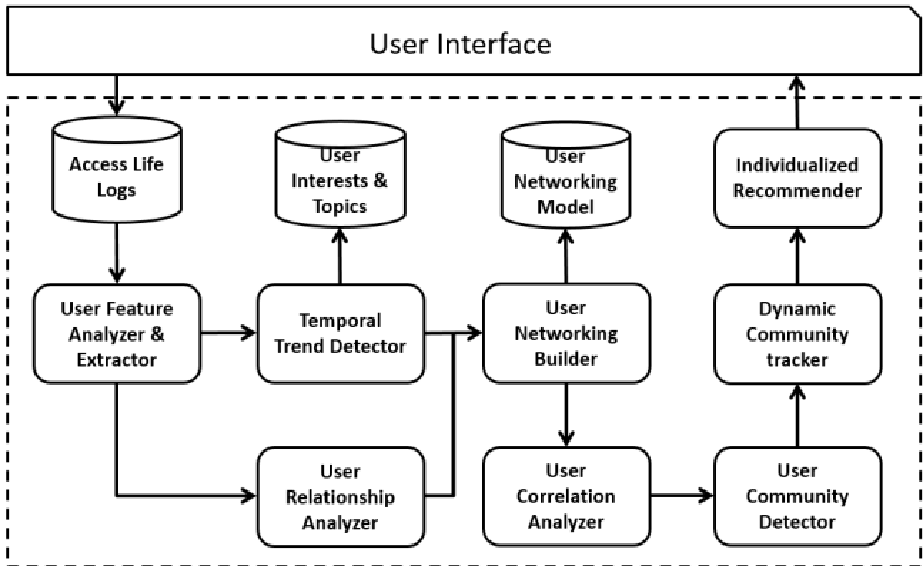 Fig 1: The generic framework for mining and tracking dynamic communities.
Experiments & Results
The authors tested their approach on Twitter data (April - June 2013). They divided the period into eight time slices based on topic shifts.
Impact of Thresholds
A critical part of the study is the Threshold Analysis. By adjusting the correlation threshold (from 0.5 to 0.95), the system demonstrates the internal resilience of communities.
- Low thresholds result in large, diverse "Regular" communities.
- High thresholds force these communities to "split" into smaller units or shed outliers into "Isolated" nodes.
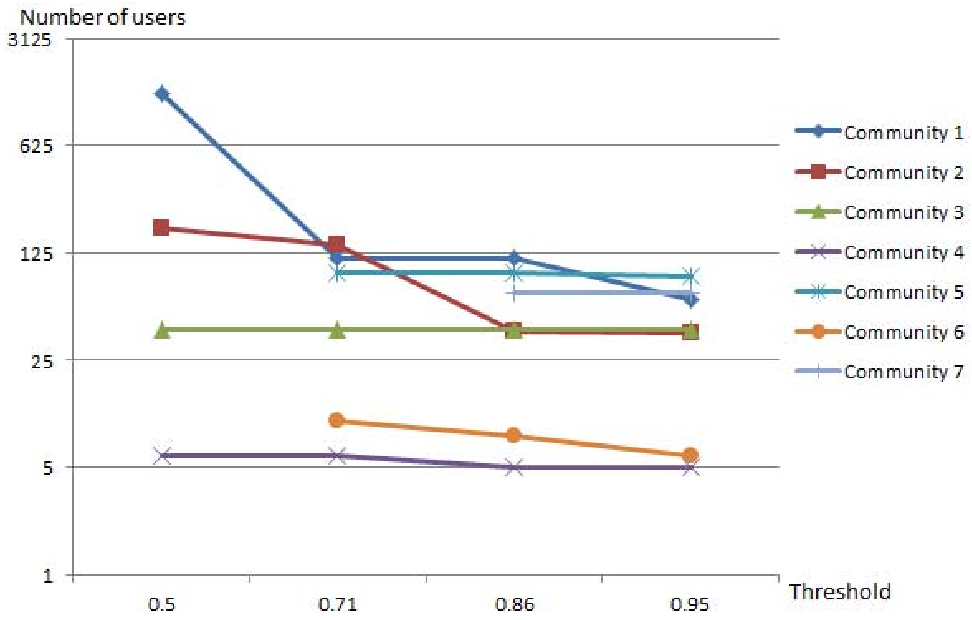 Fig 2: Tracking community size changes; note how Community 3 remains stable while others diminish as the definition of "related" tightens.
Key Quantitative Observations:
- At , increasing the threshold to 0.95 created 15 regular communities and 15 isolated users, revealing that 50% of the nodes were only weakly connected to their primary hubs.
- The number of regular communities generally peaks at higher thresholds, indicating that the algorithm effectively segments broad groups into meaningful niche sub-communities.
Critical Analysis & Conclusion
Takeaway
The value of this paper lies in its temporal agility. Instead of a "one-size-fits-all" graph, it adapts to what people are talking about now. This has high utility for Individualized Recommenders, ensuring that a user is recommended content based on their evolving interests rather than their historical profile.
Limitations
The current keyword weighting is primarily frequency-based. It lacks semantic understanding (e.g., it might treat "Apple" the fruit and "Apple" the tech company as the same feature if they appear in the same slice). Integrating NLP-based Word Embeddings (like BERT or Word2Vec) would be a logical next step to improve feature extraction accuracy.
Future Outlook
The authors plan to build a specialized recommendation system upon this framework. In the future, we can expect such models to be used for detecting real-time shifts in public opinion or identifying the first "sparks" of emerging social movements.