
Dynamic Economic Dispatch: How Private Storage Reshapes Power Market Equilibrium
16981_Dynamic Economic Dispatch Game The Value of Storage.
This paper formulates a Dynamic Economic Dispatch (DED) game where strategic generators utilize private energy storage, introducing time-coupling constraints to power market operations. The authors propose a "storage-unaware" market framework and demonstrate that efficient outcomes can be achieved through specific bidding strategies and a Marginal Contribution Pricing (MCP) mechanism.
TL;DR
As renewable energy penetration grows, industrial-scale storage is becoming a staple for power generators. This paper investigates a critical question: Can a market still be efficient if the grid operator (ISO) doesn't know about or control these storage assets? The answer is a resounding yes. By modeling the interactions as a Dynamic Economic Dispatch (DED) Game, the authors show that private storage actually suppresses strategic manipulation and stabilizes prices.
Background Positioning
While most DED research focuses on optimization algorithms for ramping constraints, this work shifts the focus to Game Theory. It occupies a unique position in the literature by proving that the "Value of Storage" isn't just in balancing load—it's in its ability to foster competition and market efficiency.
The Problem: The "Storage-Unaware" ISO
In modern electricity markets, the ISO conducts dispatch over a 24-hour horizon. If a generator has a private battery, they can choose when to produce (generation) and when to sell to the grid (supply).
The ISO faces two massive hurdles:
- Information Asymmetry: The ISO doesn't see the state of charge (SoC) of private batteries.
- Strategic Play: Does storage give generators more "market power" to withhold supply and spike prices?
Methodology: The Power of Internalized Bidding
The authors model the system as a convex optimization problem where the objective is to minimize total social cost. The genius of the methodology lies in Proposition 1, which proves that there exists a bid profile where the dual variable (LMP) of the overall system becomes the bid price for the generator.
Architecture of the DED Game
The game is structured such that:
- ISO solves the dispatch based on reported bids, blind to storage.
- Generators optimize their internal generation and storage SoC to maximize profit based on the ISO's signals.
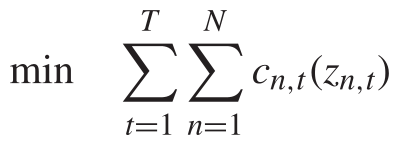 The optimization objective (1a) and coupling constraints (1b-1f) that define the dynamic system.
The Marginal Contribution Pricing (MCP) Alternative
To further solve the incentive problem, the authors propose a Marginal Contribution Pricing mechanism. Heavily inspired by the Vickrey-Clarke-Groves (VCG) mechanism, it pays generators based on the externality they provide to the grid.
Essentially, a generator's payment is:
[Total Social Cost without Generator N] - [Total Social Cost with Generator N (excluding N's own costs)]
This ensures that the generator's dominant strategy is to bid their true (efficient) cost profile.
Experimental Insights: Flattening the Curve
Using the IEEE 57-bus test case, the study demonstrates the physical and economic impact of storage.
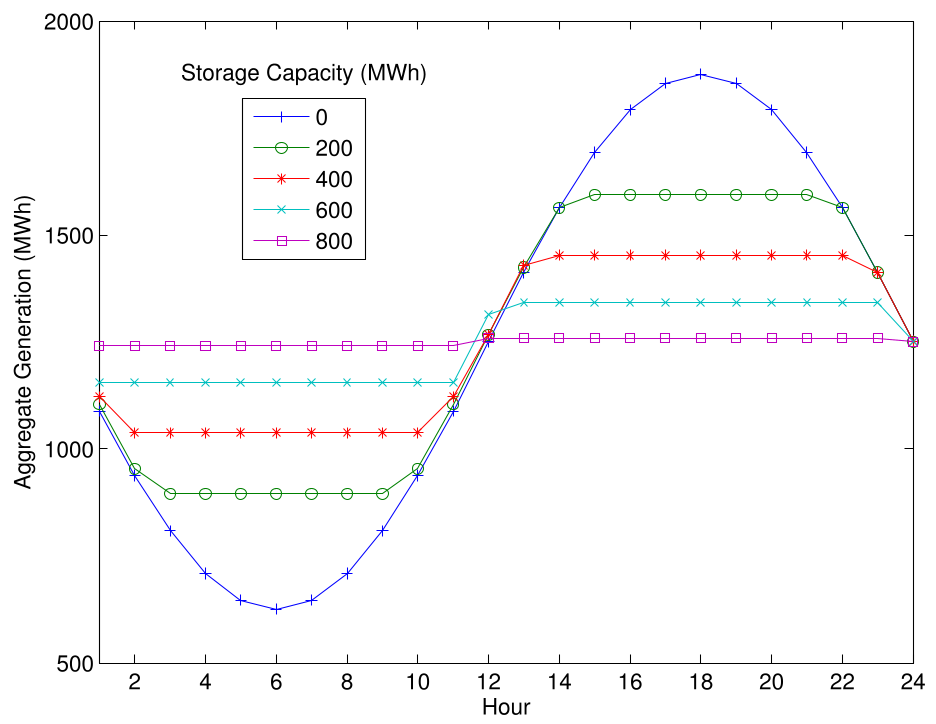 Fig 6: As storage capacity (C) increases, the aggregate generation curve flattens, decoupling from the instantaneous demand curve and reducing the need for expensive "peaker" plants.
Key Findings:
- Price Volatility: Storage capacity dramatically flattens the LMP curve.
- Social Cost Reduction: Moving from a static dispatch (SED) to the storage-aware DED approach reduces total system costs by 4% to 10% across various standard test cases.
- Strategic Play: Unlike common fears, storage reduces market power. In cases like Example 1 in the paper, storage allows a cheap generator to "bridge" a high-demand period where a more expensive generator would otherwise have a monopoly.
Critical Analysis & Future Outlook
Takeaway: This work provides a strong theoretical foundation for leaving storage control in the hands of decentralized agents (the generators) rather than centralizing it under the ISO.
Limitations:
- The model assumes a DC Power Flow, which simplifies the physics of the grid by ignoring reactive power and voltage magnitudes.
- It does not account for the degradation costs of batteries or the uncertainty of renewable generation (wind/solar), which are critical for real-world deployment.
Future Work: The logical next step is extending this game-theoretic framework to Stochastic DED, where the agents must make strategic decisions under the "fog of war" of weather-dependent energy.