
Dynamic Emotion Modeling: Detecting Anomalies through the Mirror of Emotional Tensors
Dynamic emotion modelling and anomaly detection in conversation based on emotional transition tensor
This paper introduces a dynamic emotion modeling framework for social conversations, utilizing a hybrid CNN-LSTM model for emotion recognition and an improved MCMC algorithm for emotional transition sampling. The core achievement is the development of a 3rd-order emotional transition tensor used to detect conversation anomalies with high accuracy (76.67% on test sets).
TL;DR
A standard chatbot might know you are "sad" right now, but it doesn't understand if that sadness is an abnormal departure from your typical personality. This paper presents a sophisticated hybrid system: a CNN-LSTM for high-accuracy emotion detection, combined with an improved MCMC sampling method and 3rd-order tensors to model how emotions move. It successfully identifies abnormal emotional shifts—like sudden depressive cycles in conversation—with over 76% accuracy.
Problem & Motivation: The Static Sentiment Trap
Most sentiment analysis models suffer from "static vision." They treat a sentence as an isolated data point. However, human emotion is a dynamic process. The same "angry" response might be normal for one user but a red flag for another, depending on the previous context (the stimulus) and the user's personality (historical transitions). Prior work in anomaly detection often relied on unsupervised outliers or specific "negative words," failing to capture the temporal logic of how a person's mood evolves.
Methodology: The Core Architecture
The authors break the problem into three distinct layers: recognition, sampling, and detection.
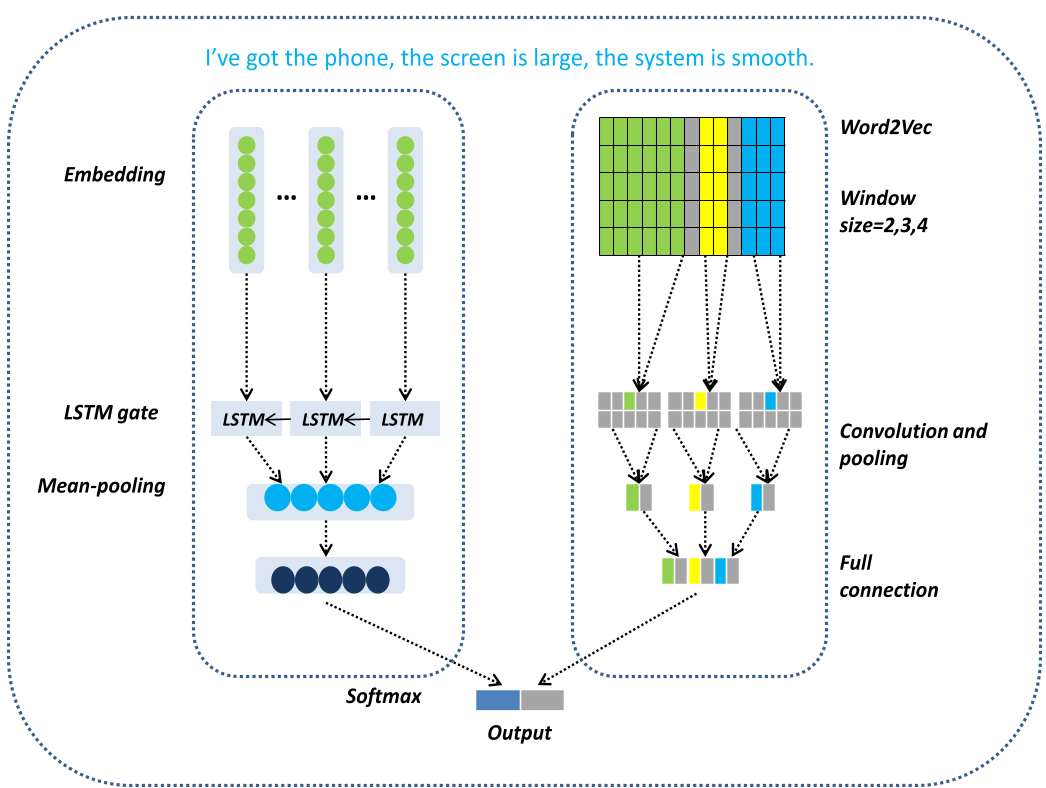
1. Hybrid Emotion Recognition (CNN-LSTM)
To ground the model, the authors built a multi-channel network. The Convolutional Channel (CC) extracts local contextual features (n-gram style), while the Long Short-Term Channel (LC) captures global dependencies and word order.
2. The Emotional Transition Tensor
This is the mathematical heart of the paper. Instead of a simple 2D transition matrix, the authors use a 3rd-order tensor representing:
- Dimension 1: Initial Emotion ()
- Dimension 2: Stimulating Emotion ()
- Dimension 3: Transitioned Emotion ()
This cube allows the model to specify the probability of a shift, given both human nature and external stimuli.
3. Sampling with Improved MCMC
To simulate a user's "normal" behavior, the authors use Markov Chain Monte Carlo (MCMC). They improved the Metropolis-Hastings (MH) algorithm by amplifying the acceptance rate . This ensures the "Markov Chain" doesn't get stuck and can efficiently traverse the emotional state space to generate sequences that reflect a user’s true characteristics.
Experiments: Proving the "Depression" Detection
The model was tested on diverse datasets: "Daily English Dialogues," "Friends" (TV show), and "Movie Transcripts."
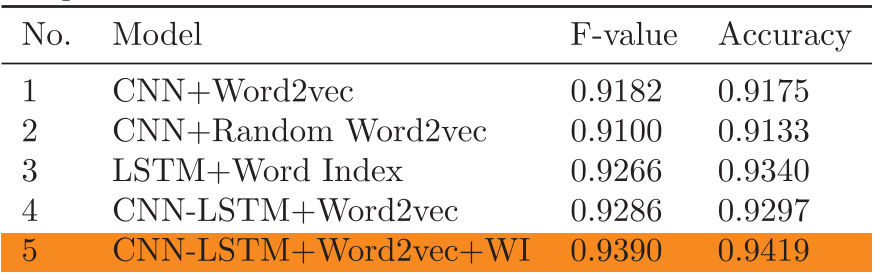
SOTA Comparison
The hybrid CNN-LSTM+Word2vec+WI achieved 94.19% accuracy, significantly higher than standalone CNN (91.75%) or LSTM (93.40%).
Visualizing Transitions
By adjusting the "convergent limit," the authors show how simulated emotional sequences stabilize. In "Movie" datasets, fluctuations are more extreme compared to "Daily Dialogues," proving the model can differentiate between dramatic writing and normal human speech.
Real-World Anomaly Detection
In a fascinating case study using the film Before Sunset, the model flagged specific segments (lines 301-400 and 601-700) as anomalies. Quantitative analysis showed a Similarity Index drop to 0.5272, whereas normal dialogue stayed around 0.80. Qualitative review confirmed these lines contained heavy themes of "death," "suicide," and "gloom," which deviated from the characters' typical playful banter.
Critical Insight & Conclusion
This work shifts the focus from What a person says to How their mood shifts. By using a tensor-based approach, it provides a mathematical vessel for "Personality."
Key Takeaways:
- Context is King: Modeling the "Stimulus" is just as important as the response.
- Tensors > Matrices: To capture the complexity of human interaction, 2D transitions are insufficient; we need higher-dimensional structures.
- Future Impact: Such systems could be integrated into "Emotional Support Robots" or "Psychological Counseling Bots" to trigger alerts when a user's emotional transition pattern looks like a downward spiral.
Limitations: Currently, the model requires a robust "history" to build a normal tensor. It also struggles when a user is intentionally masking their emotions through "neutral" words that hide deep internal shifts.