
The Physics of Social Language: How Delicious, Flickr, and YouTube Build Collective Knowledge
Dynamic Features of Social Tagging Vocabulary: Delicious, Flickr and YouTube
This paper investigates the evolution of social tagging vocabularies in Delicious, Flickr, and YouTube (2003-2008). It proposes Macro and Micro Tag Growth Algorithms (MaTGA & MiTGA) and reveals that tag growth follows a power-law distribution () across all platforms, indicating the formation of stable collective vocabularies.
TL;DR
By analyzing over 44 million tags from 2003 to 2008, this paper reveals that social tagging isn't just chaotic user input—it's a governed "social language." Whether you're bookmarking a site or uploading a video, the growth of the collective vocabulary follows a strict power-law distribution. Remarkably, these digital vocabularies are more stable than the English language itself, converging into a "core" set of tags over a 3-to-5-year period.
Problem & Motivation: The Mystery of the Evolving Folksonomy
In the era of Web 2.0, "Folksonomy" (collaborative tagging) replaced rigid hierarchies. However, researchers struggled to quantify how these vocabularies grow. Is the growth infinite? Does it stabilize?
The authors argue that we must distinguish between:
- Macro Features: The behavior of the entire ecosystem.
- Micro Features: How a single popular URL or photo accumulates tags over time.
They posited that understanding these dynamics would reveal the "cognitive processes" behind how we categorize information collectively.
Methodology: Measuring Time through Actions
Instead of using physical calendars, the researchers introduced —a variable that counts the total number of tags added to the system. This treats every tagging act as a "tick" of the evolutionary clock.
They tracked three distinct giants:
- Delicious: Free-for-all social bookmarking.
- Flickr: Permission-based photo tagging.
- YouTube: Primarily uploader-driven video tagging.
The MaTGA and MiTGA Algorithms
The authors used two primary algorithms to calculate the growth exponent ():
- Macro Tag Growth (MaTGA): Analyzes the global pool of unique tags.
- Micro Tag Growth (MiTGA): Analyzes the unique tags for specific "target resources" (e.g., a viral video).
Results: The Power of Stability
The study found that for all three systems, the growth of new tags follows the formula: .
| Social Network | Growth Exponent () | Key Observation |
|---|---|---|
| YouTube | 0.8580 | Most stable vocabulary; fewer unique taggers per resource. |
| Delicious | 0.8040 | High diversity; influenced by large-scale collaborative tagging. |
| Flickr | 0.8039 | Similar to Delicious but restricted by "self-tagging" rules. |
Visualizing Growth
The researchers demonstrated that while initial growth is noisy, it eventually follows an exponential trend in relation to physical time once a "stable vocabulary" is formed.
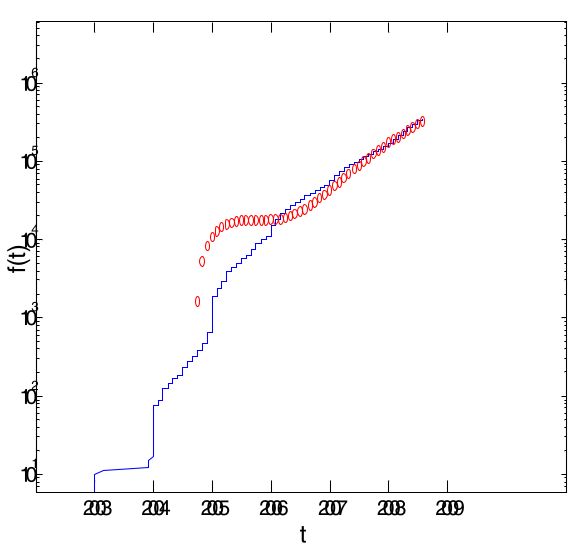 Fig 1: The exponential growth of vocabularies over physical time in Delicious, Flickr, and YouTube.
The "Stable" Ceiling
One of the most striking findings is that a resource in Delicious reaches a "stable status" when its tag growth exponent reaches exactly 0.72. At this point, new users are almost exclusively reusing existing tags rather than inventing new ones, signifying a social consensus on what that resource represents.
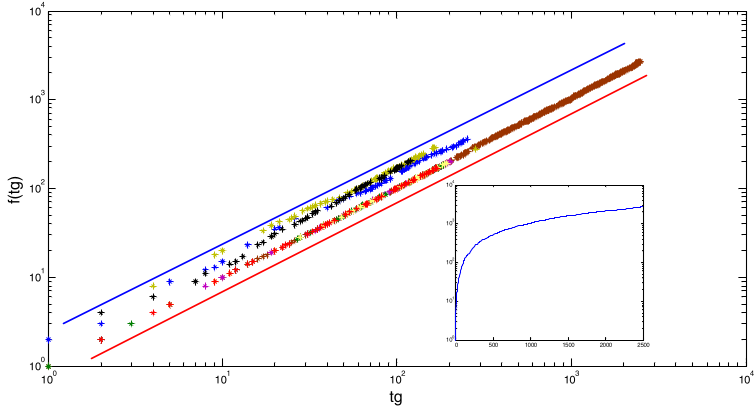 Fig 2: Tag growth for 10 popular resources in Delicious, showing sub-linear features and parallel consistency.
Critical Insights & Conclusion
Why is Social Language More Stable?
Traditional English corpora have values between 0.4 and 0.6. Social tagging systems are significantly higher (0.8-0.9). This is because:
- Lack of Grammar: Tags are mostly nouns; they don't need the complex connective tissue of standard language.
- Collective Filtering: Users naturally gravitate toward "common" tags to ensure their resources are findable by others, creating a self-reinforcing loop of semantic agreement.
Limitations & Future Work
The study notes that YouTube and Flickr are heavily influenced by "self-tagging," which limits the diversity of the vocabulary compared to Delicious. Future research could explore how AI-suggested tags (common today, but rare in 2008) interfere with these natural power-law distributions.
Takeaway: Social tagging is a remarkably efficient way to reach a conceptual consensus. It only takes a few years for a global community to "agree" on the language used to describe its digital universe.