
DHCP: Capturing the Pulse of Mobile Social Networks through Dynamic Ensemble Learning
A Dynamic Human Contacts Prediction Method in Mobile Social Networks
The paper introduces DHCP (Dynamic Human Contacts Prediction), a novel ensemble-based framework for predicting future interactions in Mobile Social Networks (MSNs). By treating contacts as dynamic graph reasoning and employing a time-weighted Naive Bayes ensemble, the method achieves significant performance gains over static baselines.
TL;DR
Human contacts in mobile social networks are anything but static. This paper presents DHCP (Dynamic Human Contacts Prediction), a method that moves beyond static graph snapshots. By extracting fine-grained temporal features and using a time-weighted ensemble of Naive Bayes classifiers, it achieves a nearly 30% improvement in AUC for predicting future human encounters compared to traditional static-aware models.
Problem & Motivation: The Static Fallacy
Most link prediction algorithms assume that the underlying social fabric stays relatively constant. However, in Mobile Social Networks (MSNs), edges (contacts) emerge and disappear with high frequency based on daily routines and mobility patterns.
The authors identify two core challenges:
- Data Scarcity: We often only have sparse sensor data from a subset of the population.
- Temporal Degradation: Using a snapshot from "last week" to predict "tomorrow" is ineffective because social structures evolve. Existing methods that treat snapshots equally fail to account for the fact that recent behavior is a better predictor of near-future contact.
Methodology: From Structural to Temporal Features
The core of the DHCP method lies in its two-pronged approach: superior feature engineering and a dynamic ensemble strategy.
1. Advanced Feature Extraction
Beyond simple "Common Neighbors," the authors introduce metrics that capture the intensity and synchronicity of relationships:
- CTRCN (Contact Time Ratio of Common Neighbors): Measures how much time a person spends with mutual friends relative to their total social time.
- TOTR (Total Overlap Time Ratio): Quantifies the "simultaneity" of contact. As shown in the figure below, it calculates the intersection of time two nodes spend with a mutual acquaintance.
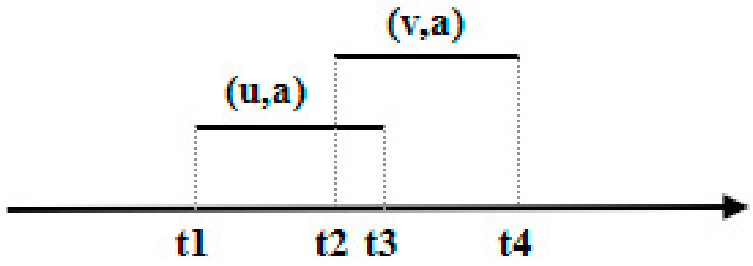 Figure 1: Illustration of overlap time OT between nodes u and v via common neighbor a.
2. The Time-Weighted Ensemble
Instead of training one model on a massive aggregate of data, DHCP trains a separate Naive Bayes classifier for each discrete time period . To predict the future, it aggregates these classifiers using a decay function: This weighting ensures that information from the recent past has a stronger "vote" in the final prediction than distant history, effectively tracking the network's evolution.
Experiments & Results
The researchers validated DHCP using real-world mobility traces from the Infocom 2005 and Infocom 2006 conferences.
SOTA Comparison
DHCP was compared against the static baseline and the Jahanbakhsh method. In the larger Infocom 2006 dataset:
- Accuracy: Reached 92.5%.
- AUC (Area Under Curve): Achieved 0.892, a massive 28.4% increase over previous benchmarks.
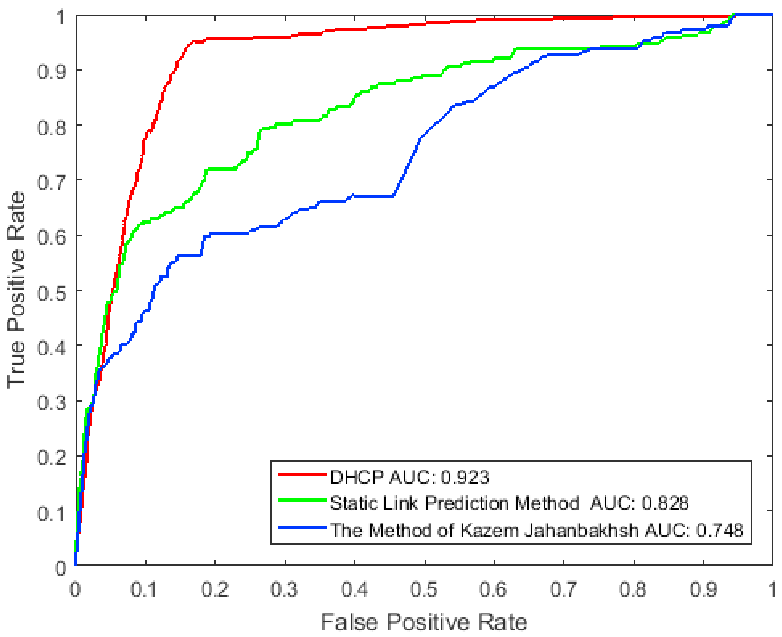 Figure 2: Superiority of DHCP over traditional methods in varying network densities.
Critical Insight & Conclusion
The success of DHCP tells us that "how long" and "when" humans interact is just as important as "who" they interact with. By shifting the perspective from static topology to a dynamic ensemble, the authors proved that even simple classifiers like Naive Bayes can outperform complex static models if the temporal context is properly weighted.
Takeaway: Future MSN applications (like proximity-based marketing or contact tracing) must prioritize temporal decay and synchronized interaction features to maintain high predictive accuracy in shifting environments.
Limitations: The model relies on discrete time bins (). If the bin is too large, temporal resolution is lost; if too small, data becomes too sparse for the Naive Bayes classifiers to converge. Optimal binning remains a heuristic challenge.