
Deciphering the Architects of Influence: Inferring Social Roles from Topology
Dynamic inference of social roles in information cascades
This paper introduces an unsupervised framework for mining social roles in information cascades by leveraging purely topological features. The authors propose the Evolutionary Role Mining (ERM) methodology, which utilizes dynamic ensemble clustering to categorize users into roles like "Influencers" or "Blockers" based on their structural fingerprints and temporal connectivity history.
Can you identify the leaders and the barriers in a digital crowd without ever hearing what they are saying? According to the authors of "Dynamic inference of social roles in information cascades," the answer lies not in the content of the transmission, but in the geometry of the connections.
TL;DR
This research moves away from traditional activity-based modeling (who reposted what) to a topology-first approach. By analyzing the evolution of structural metrics in social networks like Digg and Flickr, the authors developed an unsupervised method to categorize users into distinctive social roles—such as high-impact seeds or cascade blockers—based solely on their position in the network over time.
The Structural Intuition: Why Focus on "Where" instead of "What"?
In any information cascade, users naturally fall into functional categories: some are seeds, others are amplifiers, and many act as blockers. Most prior work analyzes the "flow" to identify these players. However, this paper posits that the structural patterns in a node's neighborhood contain enough latent information to infer these roles independently of the flow itself.
The motivation is clear: Topological data (friendship links) is often more persistent and easier to collect than volatile activity logs. If we can understand the "topological fingerprint" of an influencer, we can predict their impact before a cascade even begins.
Methodology: The Evolutionary Role Mining (ERM) Framework
The core of the paper is the Evolutionary Role Mining (ERM) methodology. It operates on a simple but powerful premise: a node's role is a product of its current position and its historical trajectory.
1. Structural Metric Selection
The authors identified specific metrics that act as proxies for social behavior:
- Reachability: Measured via Eigenvector Centrality and Degree.
- Commitment: Measured by the Locality Index (ratio of internal vs. external neighborhood connections) and Common Neighbors.
- Cohesion: Neighborhood degree standard deviation, which signals how uniform a user's local "social circle" is.
2. Dynamic Ensemble Clustering
Instead of a single snapshot, the ERM method uses a weighted ensemble.
 Algorithm 1 (detailed above) uses a Data Distribution Weighting (DDW) function. Unlike simple time-decay (where old data just fades), DDW compares the similarity between past and present clustering. This allows the model to handle Concept Drift—situations where the network structure shifts abruptly, ensuring the "roles" evolve logically.
Experimental Insights: Influencers vs. Blockers
The authors tested their method on vast datasets from Digg and Flickr.
The "Influencer" Profile
Influential users aren't just those with many followers. The study found that User Commitment (high density of shared neighbors) significantly boosts influence scores. Structurally, these users sit at the heart of dense, well-connected clusters, allowing their message to reverberate efficiently.
The "Blocker" Profile
What stops a social epidemic? The researchers discovered that Neighborhood Cohesion (the standard deviation of degrees among neighbors) and Triadic Closure (clustering coefficient) are critical. Contrary to the "small world" theory—which suggests information spreads faster in dense networks—the study shows that high local clustering can actually create "echo chambers" or structural redundancies that impede viral growth.
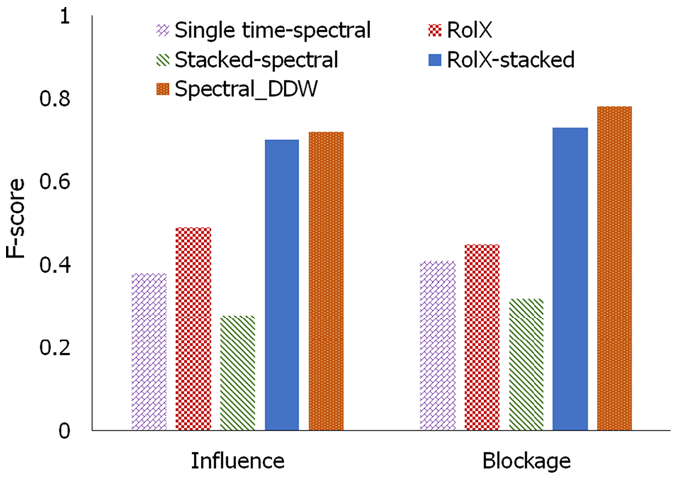 As shown in the F-score comparisons, the Spectral-DDW method significantly outperforms Single-time and Stacked baselines, highlighting the importance of temporal integration.
Conclusion and Takeaways
The paper successfully demonstrates that topology is destiny in social dynamics. By using an unsupervised ensemble approach, the authors proved that:
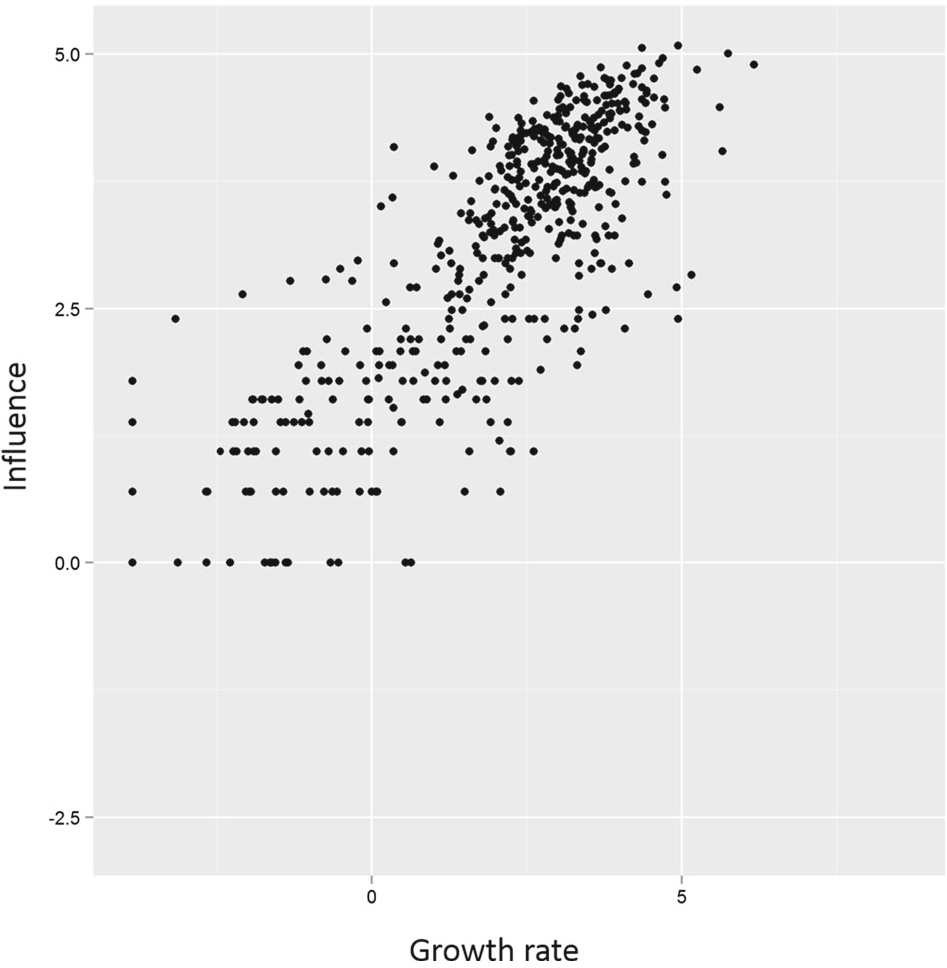
- Temporal History Matters: Static analysis misses the growth rate, which is a key indicator of influence.
- Structural Fingerprints are Robust: The role of a user (Influencer, Blocker, etc.) is highly correlated with local connectivity patterns.
Future Outlook: For practitioners in viral marketing or misinformation mitigation, this framework offers a way to identify strategic nodes in a network without needing to monitor private interactions—a win for both efficiency and privacy-preserving analysis.