
Markets to Promote Wind Capacity: Decoding the Dynamics of Green Investment
4487_Dynamic Interactions of TGC and Electricity Markets to Promote Wind Capacity Investment.
This paper presents a System Dynamics (SD) model to simulate the long-term interaction between Electricity Markets and Tradable Green Certificate (TGC) markets, specifically focused on promoting wind power investment. The model incorporates feedback loops, time delays, and stochastic wind speed dynamics to provide a comprehensive framework for regulators to evaluate renewable energy policies.
TL;DR
Achieving a high share of renewable energy isn't just a matter of setting targets; it's about understanding the chaotic feedback between electricity prices and subsidy markets. This paper introduces a System Dynamics model that simulates how wind power investors react to Tradable Green Certificates (TGCs). By accounting for construction delays and stochastic wind speeds, the authors reveal how different regulatory policies—like "banking" certificates—can either stabilize or disrupt the transition to green energy.
Context & Motivation: Why Static Models Fail
The deregulation of power industries has created a volatile environment for capital-intensive technologies like wind power. Traditional models often treat market equilibrium as a static destination. However, the real world is plagued by:
- Time Delays: Reaching a decision to invest and actually finishing a wind farm takes years.
- Interlinked Markets: The price of electricity affects the demand for green certificates, and vice versa.
- Uncertainty: Wind doesn't blow on command.
The authors argue that to truly understand if a policy works, we must model the causal loops that drive investor behavior.
Methodology: The "Living" Market Model
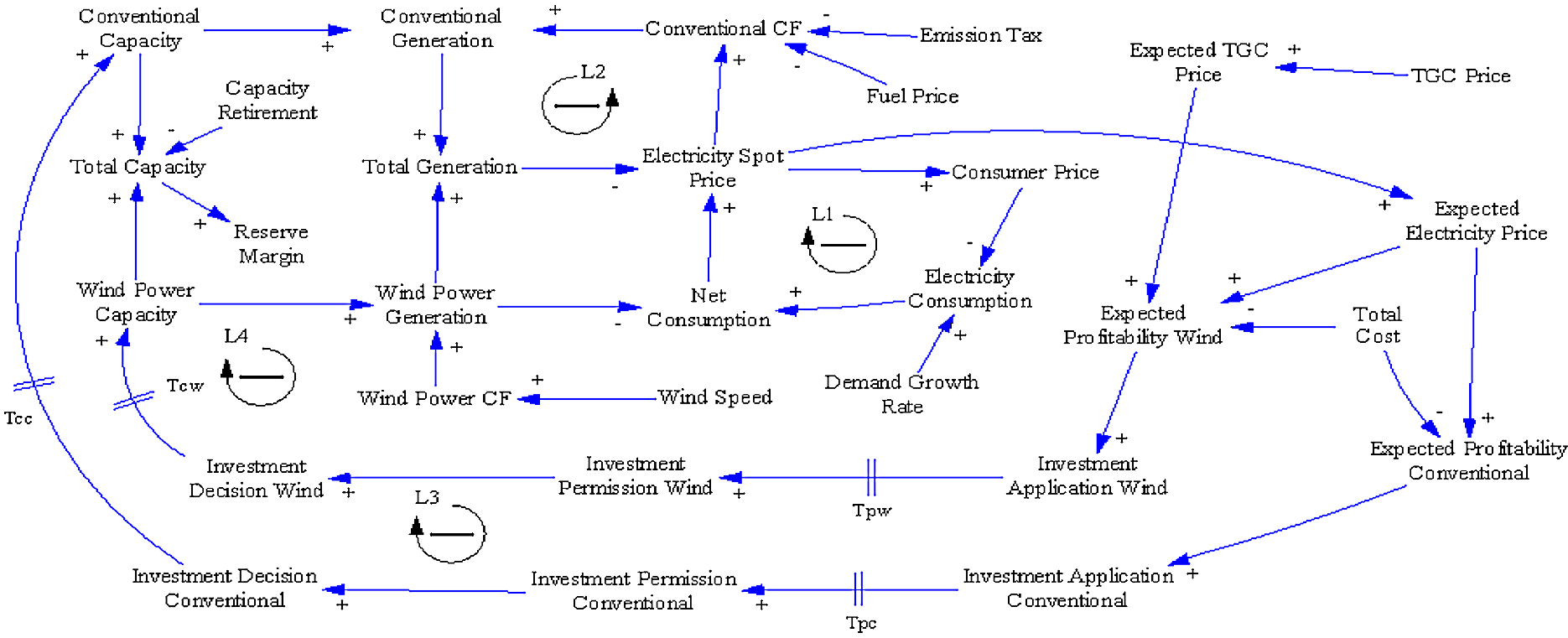
The core of this research is a coupled feedback system between the Electricity Market and the TGC Market.
1. Causal Loop Architecture
The model identifies several critical loops. For instance, Loop L1 (Investment Loop) shows that as wind profitability increases (due to higher electricity or TGC prices), more capacity is commissioned. However, after a construction delay, this new capacity increases supply, which eventually pushes prices back down (a balancing effect).
2. Stochastic Wind Modeling
Unlike previous models that assumed a fixed "Capacity Factor" for wind, this paper uses an ARMA (Auto-Regressive Moving Average) model based on Weibull distributions. This captures the realistic "jitter" in wind generation, which directly impacts the number of certificates issued and the resulting market price.
3. Strategic Trading (Banking & Borrowing)
The model simulates two key strategies:
- Banking: GenCos hold onto certificates when prices are low, hoping for a spike.
- Borrowing: DisCos (Distribution Companies) defer their green obligations if certificates are too expensive.
Key Results: What Drives the Wind?
The simulation covers a 20-year horizon with a target of increasing wind penetration from 5% to 25%.
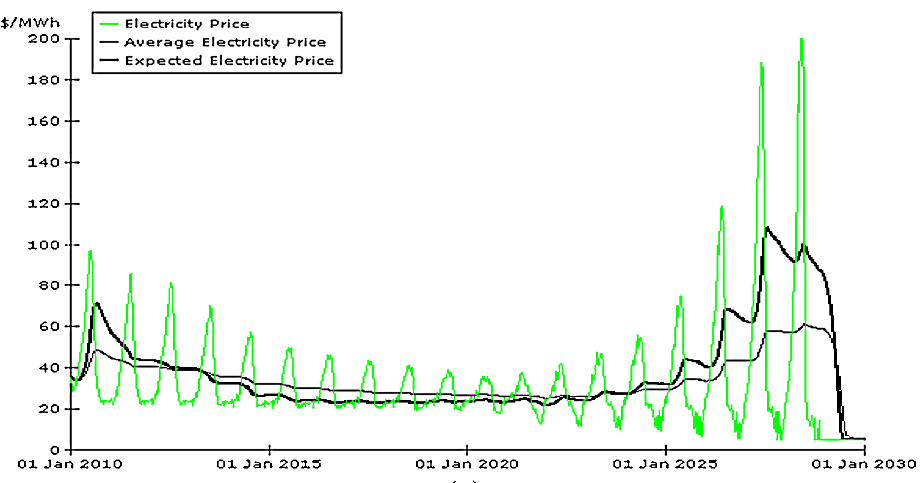
- The TGC Price Cap: In the early years, wind capacity is scarce, causing TGC prices to hit the "penalty price" (the regulatory cap). As capacity builds up, the price eventually crashes once the target is met or exceeded.
- The Fuel Price Paradox: Interestingly, as fossil fuel prices rise, the electricity price increases. This makes wind more inherently profitable in the energy market, reducing the "subsidy" needed from the TGC market.
Sensitivity Analysis Highlights:
| Parameter | Impact on Wind Investment | Why? |
|---|---|---|
| High Fossil Fuel Price | Increase | Higher energy revenue makes up for lower TGC revenue. |
| High Emission Tax | Decrease (Unexpectedly) | While it penalizes coal, it can lead to reduced overall demand or earlier shifts to gas, which may saturate the "need" for wind in certain growth scenarios. |
| Extensive Banking | Increase | Allows GenCos to hedge against low-price periods, sustaining investment signals. |
Critical Insight: The Regulator's Challenge
The study proves that the TGC validation lifetime (how long a certificate is "alive") is a powerful lever. If certificates expire too quickly, GenCos are forced to sell in a glut, crashing the price and killing future investment. If they last forever (Extensive Banking), it protects investors but can lead to long periods where consumers pay the maximum penalty fee.
Conclusion
This paper shifts the perspective of renewable energy planning from "policy targets" to "systemic dynamics." It highlights that the success of wind power depends not just on the wind itself, but on the delicate timing of investment decisions and the rules governing certificate trading. For future products in grid management or energy trading, these loops provide a roadmap for predicting market volatility in an increasingly green grid.