
Dynamic Item Recommendation: Capturing the Pulse of Evolving Social Interests
Dynamic Item Recommendation by Topic Modeling for Social Networks
This paper introduces a dynamic item recommendation technique for social networks by integrating Latent Dirichlet Allocation (LDA) with temporal dynamics. The method, based on a modified LDA model, represents users, tags, and items as topic distributions and incorporates a time-based similarity weight to capture shifting user preferences, achieving significant improvements in precision over static baselines.
TL;DR
In the fast-moving world of social networks, a user interested in "Football" in autumn might shift to "Basketball" by spring. This paper addresses this drift by proposing a Dynamic Topic Modeling approach. By extending Latent Dirichlet Allocation (LDA) to include temporal weights, the authors show that we can significantly boost recommendation precision by simply understanding when a tag was used.
Problem & Motivation: The Static Fallacy
Most recommender systems suffer from "temporal blindness." They treat a tag applied three years ago with the same weight as one applied yesterday. In social media (like Flickr or Instagram), users describe resources using a personal "vocabulary" of tags. These tags are:
- Succinct: They provide a distilled summary of the item.
- Implicit: They reveal hidden preferences without requiring a 1-5 star rating.
- Dynamic: The vocabulary evolves as the user's life and interests change.
The authors argue that static systems fail because they don't account for this "interest drift." If the system doesn't know your current context, it risks recommending "yesterday's news."
Methodology: Fusing LDA with Temporal Logic
The core innovation lies in a modified generative process that doesn't just look at Who (User) and What (Tag), but also When (Time).
1. The Extended LDA Architecture
The model combines two variations of LDA: Topics Over Time (TOT) and LDA for Collaborative Filtering.
- Latent Topics: Items are treated as a mixture of topics.
- Beta Distribution for Time: Unlike discrete time slices, the model uses a Beta distribution () to represent the time-based distribution of each topic.
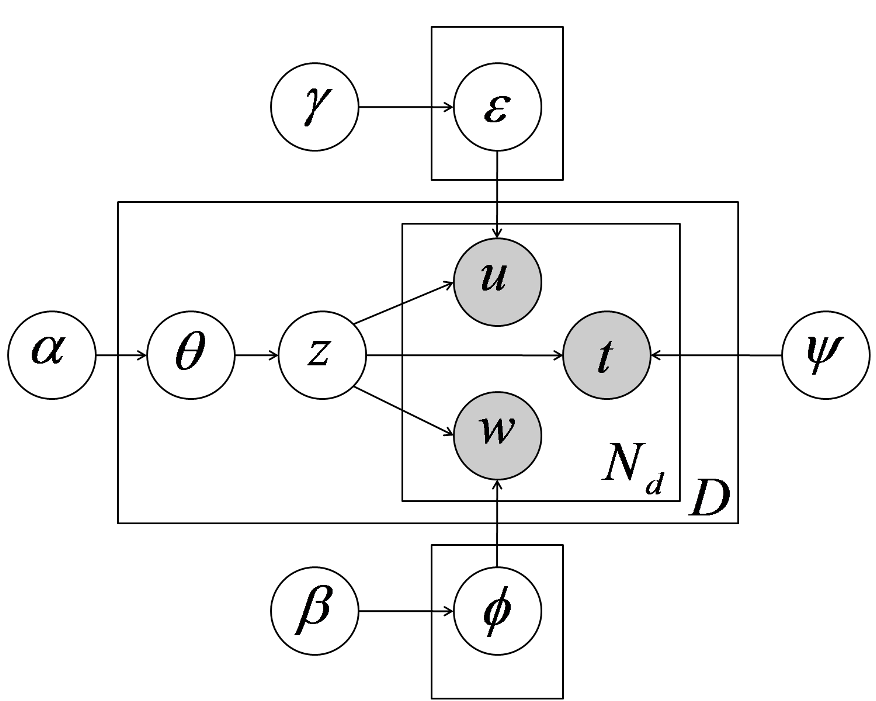 Fig 1: The graphical model showing the interplay between users (u), tags (w), and timestamps (t) through latent topics (z).
2. Time-based Similarity Weights
Instead of calculating a simple cosine similarity between a new item and a user's history, the authors introduce a Group Similarity Weight: This weight essentially "amplifies" items that belong to the topic groups currently trending for that specific user's cluster.
Experiments & Results: Real-World Evidence
The system was tested on a massive Flickr dataset. By tracking "Favorite" actions as signals of preference, the researchers compared their dynamic model against a standard static topic model.
Precision Gains
The results were conclusive. As the threshold for recommendation became stricter, the dynamic model's lead widened.
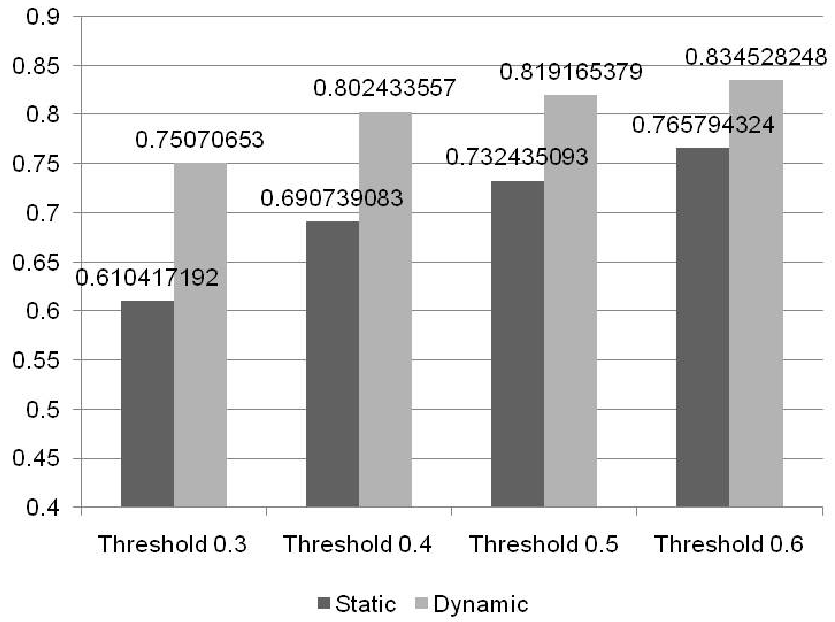 Fig 2: Comparison of Static vs. Dynamic Precision. The Dynamic approach (right columns) consistently outperforms the Static approach (left columns).
Key Findings:
- Precision +8% to +14%: Depending on the similarity threshold, the dynamic model provided much more accurate "hits."
- Top-K Efficiency: For users who only want to see a few items (Top-1 to Top-10), the dynamic model was significantly more effective at ranking relevant items at the very top.
Critical Analysis & Conclusion
Takeaway
This work proves that temporal context is not just an "add-on" but a fundamental dimension of user intent. By clustering users into groups and tracking how those groups' vocabularies shift over months, the system gains a "predictive" quality regarding seasonal interests.
Limitations & Future Work
While effective, the model uses a monthly granularity for time. In modern social media, trends can rise and fall in days or even hours (e.g., viral memes). The authors acknowledge the need to move toward daily trends and perhaps integrate more complex temporal patterns like seasonality (cyclic trends) rather than just linear drifts.
In conclusion, the shift from what a user likes to when they like it marks a vital step forward for personalized Discovery Engines in social tagging environments.